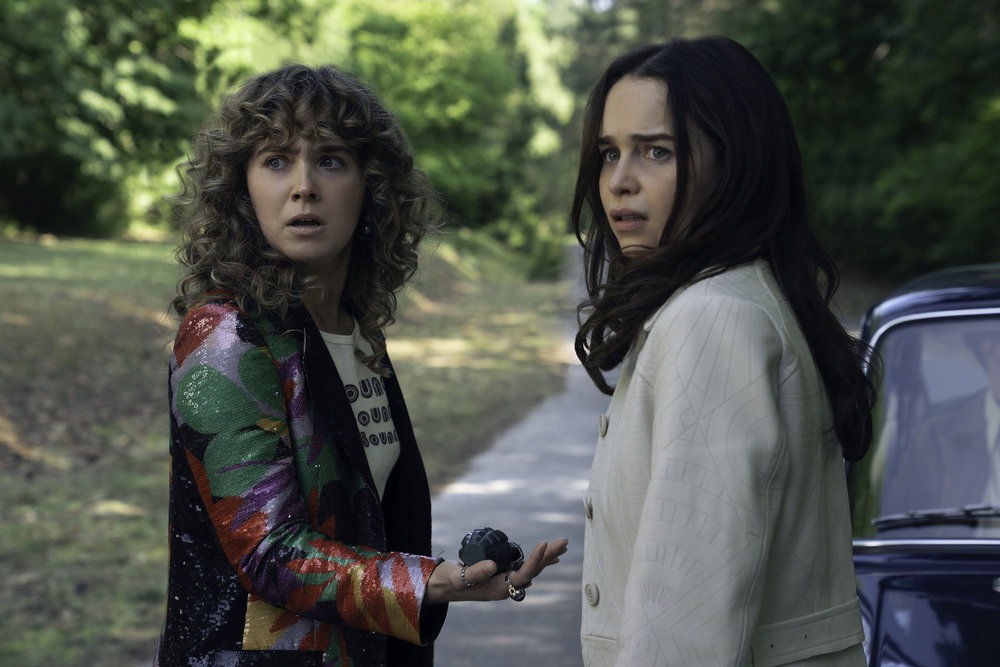
Peacock‘s Ponies, starring Game of Thrones‘ Emilia Clarke and The White Lotus‘ Haley Lu Richardson, uses Cold War Moscow as backdrop for a comedic buddy spy thriller. While weaving real people and events, including George Bush as CIA director and Elton John touring the Soviet Union, the series is fictional (though a lot of elements, from the Zhiguli and Volga cars and the Soviet songs of the era to the lines in front of stores and the old grocery scales hit too close to home for those of us who grew up behind the Iron Curtain during that period).
Created by Susanna Fogel and David Iserson (The Spy Who Dumped Me), Ponies (Persons of No Interest), which dropped all eight episodes on Jan. 15, is set primarily in 1977. (It starts on Christmas 1976). The series follows two secretaries, Bea (Clarke) and Twila (Richardson) at the American embassy in Moscow. When their husbands Chris and Tom, who worked for the CIA while posing as American diplomats, die under mysterious circumstances, the women stay in the Soviet Union and become CIA operatives in order to find the truth about what happened.
Their assignments, handed by local CIA chief Dale and his deputy Ray, include Bea, who speaks Russian, posing as a Russian schoolteacher, Nadiya, and getting entangled with a senior KGB officer, Andrei Vasiliev, while also working a local asset, Sasha, who is passing on intel about Soviet technology.
Bea and Twila are tasked by Dale with finding the kompromat facility their husbands had died trying to locate where the KGB stores tapes of Americans and other foreigners lured into having sex for the purpose of blackmail. The spy novices eventually find it with the help of Sasha, who becomes romantically involved with Bea, and Bea’s Belarusian-born grandmother Manya (Harriet Walter), posing as Soviet fixer Vera whom Twila accidentally kills.
But Bea’s cover is blown, Sasha is gravely wounded, with his fate unknown, and the U.S. Embassy is invaded by KGB agents posing as firefighters after a senior embassy secretary, Ray’s wife Cheryl, is revealed as a Soviet mole and smuggles a tracker/explosive devise inside before killing her nanny Eevi whom she had framed. Gone in the fire are the boxes of shampoo bottles containing the sex tapes Bea and Twila had retrieved (though the one bottle in Twila’s apartment survived.)
Bea and Twila, who had just learned from interrogating Vasiliev that Bea’s husband Chris had been a KGB informant, are suddenly held at gunpoint. And in yet another finale cliffhanger, Bea’s dead husband shows up very much alive in Manya’s home village where she had returned to visit a childhood friend. Manya was followed there by Dale who are both shocked when Chris greets them.
Ponies is not a documentary, and there is some suspension of disbelief. Clarke, as hard as she tries, would never pass off as a Russian with her accent, though Walter’s Russian pronunciation, by the final episode, is very good.

PONIES: (l-r) Harriet Walter, Pál Mácsai, Adrian Lester, Nicholas Podany
Katalin Vermes/Peacock
In an interview with Deadline, Fogel and Iserson discuss the efforts for authenticity on the show, which filmed in former Eastern block country Hungary, and that “Christmas in December” line by Bea that has forums buzzing. They also address the big cliffhangers and the burning questions left by the finale, the prospects for a second season and what we might expect from it as well as the song choices in the series.
DEADLINE: You worked together on The Spy Who Dumped Me. How did that lead to PONIES and what other inspirations did you draw upon? The final frame with Bea and Twila holding hands as guns are pointed at them is very Thelma & Louse-esque.
FOGEL & ISERSON: Right after Spy Who Dumped Me came out, we had various meetings with studios and networks who wanted us to develop what was essentially a television version of that – but while there were themes in that movie we were interested in exploring further (the power of female friendship, for instance, a theme that shows up in most of Susanna’s work), we didn’t want to be trapped in an overly comedic box season after season. There will always be some humor in the way our characters see the world, because that’s how we move through life, but we wanted to ground the world itself.
We (especially David) had been avidly reading Cold War history books and memoirs and we got excited about exploring female characters and a friendship through the prism of that time and place. We were familiar with classic paranoid thrillers of the 70s — Three Days of the Condor, Parallax View, Day of the Jackal — but were also inspired by chatty 70s dramas and dramedies that had nothing to do with spies –like Annie Hall and Altman. More than anything, we wanted these characters and their friendship to feel real and lived-in, if unlikely, and to end the season with an image that would show how far these women have come, not just individually but together.
DEADLINE: You ended the season on multiple big cliffhangers. Did you get Peacock’s blessing to do that? Did you have a safer version of the finale where you tie all lose ends for fans?
FOGEL & ISERSON: We did get their blessing. Obviously there are never guarantees for more seasons but it would feel like a violation of the show we were making — where we ended every episode with a cliffhanger — to not do the same with the finale. We are betting on this show and our ability to keep telling this story. This was the only version we shot.
L-R: Emilia Clarke and Haley Lu Richardson in ‘Ponies’
Peacock
DEADLINE: Speaking of the finale, who exactly is holding Bea and Twila at gunpoint? KGB? They are technically on American soil, are they in danger? What happens next?
FOGEL & ISERSON: KGB dressed as firefighters are holding them at gunpoint as they steal files. Yes, this is American soil, but the fire in the embassy and the KGB firefighters trying to steal files was a real historical thing that happened.
DEADLINE: If Season 1 was about Bea and Twila learning the spy craft and learning to trust each other, what would be the focus in their story in a potential second season? Will they stay in the U.S.S.R. or go to another country?
FOGEL & ISERSON: Bea and Twila have come so far and learned so much from each other by the end of season one, season two will be about them having to put those skills to use when the stakes are so much higher. The political crisis created by the events of the finale has thrown everything into chaos. They’ve learned to trust each other and built up that skill, but there are now a host of other figures that are of questionable trustworthiness — from Chris to Cheryl–and they (and the audience) need to figure out who to believe and who has what agenda.
There are also new power dynamics in play — Andrei has escaped and the KGB has wrought havoc on the CIA, but Twila has one shampoo bottle that could implicate Andrei to his own people. Both sides have a card to play, and Bea and Twila will have to be strategic about when and how to play theirs. Bea will also find herself having to make emotional, personal choices if/when she’s confronted with the reality of Chris being alive, and if/when she will see Sasha again. This, combined with Andrei knowing their secrets now, will present a myriad of challenges they’ll have to face separately and together.
DEADLINE: What are the prospects of a second season? How do you feel about it?
FOGEL & ISERSON: We’re thrilled at how the show has been received. Every project is a labor of love, but it’s not always the case that that love and care is recognized by an audience, or critics. We’re ready to dive into season two as soon as the starting gun goes off and we hope someone fires it soon!
DEADLINE: How is Chris still alive when Vera saw him and Tom getting gunned down, why did he surface in Manya’s Belarusian village of all places and what does he want from her and Dane?
FOGEL & ISERSON: We saw someone get shot out the window of the plane from Vera’s POV. We don’t know if that was really Chris or a setup for Vera to see (or if the man she saw die really died). Chris has heard of this village that Manya had such fond memories of from Bea (in the flashback in episode 106) and when he was looking for an out of the way place to hide out, that city stood out in his memory.
DEADLINE: Could Tom be alive too?
FOGEL & ISERSON: We suppose he could be. But he isn’t.
PONIES: (l-r) Artjon Gilz, Petro Ninovskyi, Emilia Clarke
Katalin Vermes/Peacock
DEADALINE: Sasha. If you were going to kill him off, you would’ve given him a heroic death in the finale. Can we assume that he is alive? And how will Bea juggle him, Chris (and potentially Andrei) in Season 2?
FOGEL & ISERSON: You asked if we had a “safer” version of the finale, which we did not. We did however have a version where Sasha died. We can assume he is alive, but we don’t know where the Marines are taking him and whether they trust him to the degree Bea does. They almost certainly don’t. We hope they don’t take him back to his apartment where he is a sitting duck. But we only know what Bea knows, which is that he will probably make it.
DEADLINE: When did you settle on Cheryl as the mole and what clues did you plant along the way pointing to her that we may have missed?
FOGEL & ISERSON: We always planned on her being the mole. She is someone Bea and Twila underestimate, while they are also being underestimated. The clues are that the mole is close to Ray and Dane and we watch as Cheryl is undervalued, under-appreciated, and feels insecure by Eevi. These are all things that make her very recruit-able by a foreign power. We will explore how she was turned much more in Season 2.
DEADLINE: Why did she kill Eevi? Who did the nanny work for?
FOGEL & ISERSON: She killed Eevi so Eevi would take the fall as the mole and give Cheryl cover to hide the decoy tracker in the CIA evidence locker. Clare Hughes always played Eevi so that she could be an innocent who is excited by Ray’s mysterious life OR she is a plant that Cheryl would not know about. Both scenarios lead her to the same unfortunate fate.
DEADLINE: Why did you decide to set the series in Moscow and why did you pick that specific period, 1977, under Brezhnev and Carter (with cameo of George Bush as the outgoing CIA director)?
FOGEL & ISERSON: We love this time period–the look, the feel, the music. The 50s and 60s have been so well covered in Cold War cinema and the 80s was a Soviet Union closer to collapse. The 1970s were a time when the Americans and British were having a hard time running spy operations in the USSR and all our research told us they were willing to try unconventional approaches. A change in administration felt like the right cover to slip something like this through. Plus it’s fun to start a show on Christmas. And it was slyly funny to us that George Bush had that actual job.
DEADLINE: How did you pair Emilia and Haley? Did you test other actresses with Emilia?
FOGEL & ISERSON: We didn’t test actors with Emilia, but after meeting Haley, we introduced her to Emilia over zoom, just to see if they’d get along. Instantly, they did, and formed a big-sister-little-sister dynamic that carried them through the whole season and is a nice element of their onscreen dynamic. Casting a friendship onscreen is a little like matchmaking in general. You meet two people individually, then take a guess about whether their respective vibes would complement one another. Emilia and Haley are both such great actors, we have no doubt they could have sold a friendship even if they didn’t get along, but seven months in Budapest wouldn’t have been nearly as much fun as it was.
PONIES: Emilia Clarke
Katalin Vermes/Peacock
DEADLINE: Ponies is done with a great attention to detail, from the cars to the clothes to the Russian dialogue. But there were a couple of questionable moments, like Bea (as Nadiya) telling Andrei that she celebrated Christmas in December, which should have raised a red flag since the Russian Christmas is in January. Bea also gave Sasha instructions in inches, which would be impossible for him to follow since the Soviet Union used the metric system and there were no rulers in inches at that time. Did you have Russian writers or Soviet cultural consultants on the show?
FOGEL & ISERSON: In the script stage, we had a Russian cultural consultant and historian to talk to and vet the scripts. We also conducted interviews with women who lived in Moscow in the 70s. Then, once we were in preproduction and production in Eastern Europe, we had several Soviet/Russian expats on set to help us make sure we were culturally accurate, or enough so within the context of a fictional show. For instance, our cinematographer, Anna Patarakina. It was also helpful shooting in Hungary given Hungary’s own relationship to communism — most people from our local crew have relatives who remember that time like it was yesterday, and there was a lot to mine just from personal anecdotes. We also had translators and language experts as we worked on the Russian dialogue.
As for the two examples you’ve cited, the scene with Andrei used to be longer where it really feels like she blew it by getting Christmas wrong. The Sasha inches thing came out of a real anecdote we found. The CIA would likely tell her in inches, and that’s why she gives him the string.
DEADLINE: Music plays a major part on the series, with vinyl’s playing during every conversation in the American embassy to outsmart listening devices. How did you pick the songs from that period (including a few Soviet ones), and why did you name each episode after a song?
FOGEL & ISERSON: From the very beginning of this project, we were building a large playlist of songs from the period to help pull the audience into the era. We had a link to that playlist on the first page of the script when we were selling the show. So it was always going to be part of the language of PONIES. We tried to make sense of the taste of the characters (we assumed Bea wasn’t listening to underground punk, but believably listened to Todd Rundgren.) We were lucky that we were able to secure many of the songs we wished for at the very beginning including the first song in the first episode (Fleetwood Mac’s “Second Hand News”). Elton John was always going to play into the plot of the show so it was fortunate we were able to license three Elton songs. In the end, it came down to taste, and we got to use songs from some of our favorite musicians: Blondie, Electric Light Orchestra, David Bowie, The Cars, Billy Joel, Love, Elvis Costello. Plus some slightly less-known gems like “Couldn’t Get it Right” by the Climax Blues Band and “Crying in the Night” by Buckingham Nicks. Naming the episodes after songs was a way of telling the audience what kind of show this would be, that the mixtape/nostalgia aspect is part of the journey.
DEADLINE: There is brief mention of gay relationships on the show with Dane (What was his electroshock therapy for? It is for depression.) and Twila and Ivanna. Will that be explored further in a second season? Homosexualism is a criminal offense in the Soviet Union at that time.
FOGEL & ISERSON: Yes, it was a crime then and a crime now in that country. Twila exploring who she is will remain a part of her arc and our story.