Experts share 10 simple ways to maximise the health benefits of going for a stroll
Free, simple and almost too good to be true – walking is widely regarded by experts as one of the greatest health hacks for your body and mind. Unlike most exercises, it doesn’t even require a huge effort – just 4,000 steps a day can reduce the risk of early death and heart disease, making it a no-brainer for everyone who is able to.
Having said that, not all walks are equal, and there are ways to supercharge yours from casual stroll to unbeatable health-builder.
“A few simple tweaks can completely change how effective your walk is for the body, mind and brain, and importantly how enjoyable your walking feels,” says Joanna Hall, a sports scientist and founder of the WalkActive method.
New FeatureIn ShortQuick Stories. Same trusted journalism.
Here, we look at the best ways to maximise your walk, and the common mistakes to avoid.
10 ways to improve your walk
Get a bit breathless
“My biggest message is that it’s not just about more steps, it’s about better steps,” says Hall. And better steps often start with a faster pace.
While all walking paces have been linked with a lower risk of cancer and cardiovascular disease, there are additional gains to be made by those who walk at a moderate-to-vigorous intensity when it comes to reducing cancer risk. This is also linked with improved cardiometabolic health, including glucose control and blood pressure.
Brisk walking is defined as around three miles per hour (around 20 minutes per mile, or 12 minutes per kilometre), but is best thought of as a pace where you can talk, but not sing along to a song.
You can also try the Active 10 app, which tells you when you’re walking fast enough and suggests ways to fit in some more brisk walking.
Walk uphill
Most people could probably guess that walking uphill is more demanding on our bodies, thanks to how puffed it can leave even the fittest among us.
In a study comparing people walking on treadmills at a 0 per cent, 10 per cent and 16 per cent incline, the metabolic demand on participants’ hearts, lungs and muscles of the steepest walk was 44 per cent higher than the flat surface.
Also more demanding than a flat surface is walking downhill – research shows it leads to great muscle damage, due to how the muscles are loaded while in a stretched position, ultimately leading to stronger muscles.
Whether walking in a park, on the roadside or on a treadmill, try to find varying inclines to increase energy and muscle burn.
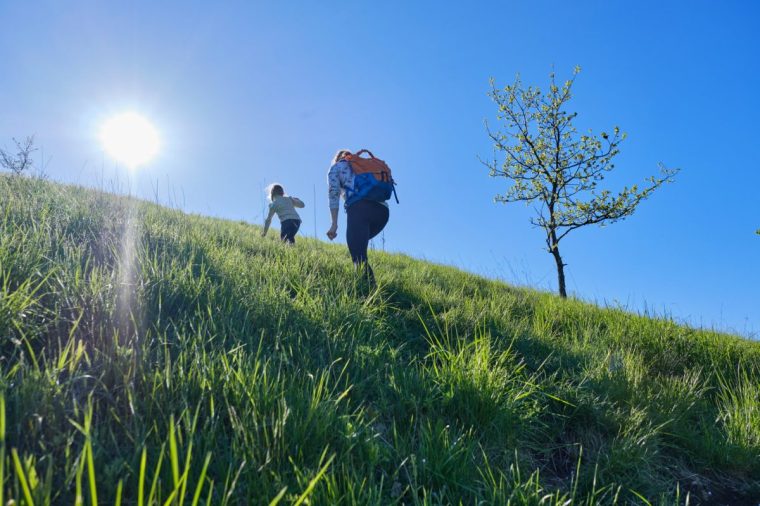 Adding a gradient to your walk is a good way to increase metabolic demand (Photo: Jan Nevidal/Getty/E+)
Add weight
“If you’re looking to retain and build muscle mass while walking, wearable weights can be a good idea,” says personal trainer and founder of Ladies Who Crunch, Nancy Best. “Whether you use a weighted vest or rucksack will change the load to either the front or back of the body, challenging different muscle groups.”
The extra resistance also challenges your heart to work harder, increasing cardiovascular fitness for those who can’t do or don’t enjoy more intense cardio workouts.
Hall advises getting comfortable with walking well under your own body weight before adding resistance in the form of a vest or bag.
“And, in the same way that you wouldn’t start a strength-training programme with a heavy barbell, begin with a couple of kilograms of resistance and slowly increase the weight once the resistance feels comfortable,” adds Best.
The best bit? If you already lug a rucksack with a laptop, lunch box and water bottle to work every day, it counts. Ensure the straps are properly secured to prevent hunching, and add some extra steps to your commute to reap the benefits.
Find uneven ground
Even smaller changes in terrain can make a huge difference to the effectiveness of your walk. “Mountainous and uneven terrain work your stabilising muscles harder, increasing the difficulty and output from your walk,” says Best.
It also leads to more load on the hip and knee joints, as well as extra muscle stimulation in seven muscles in the legs. All of which, in turn, prompts higher energy burn and greater strength.
If you don’t have a local mountain range handy, don’t worry: uneven terrain can be found on gravel paths, sand and off-track grounds – but if you struggle with weaknesses in the knees and hips, build this up slowly.
Go Nordic
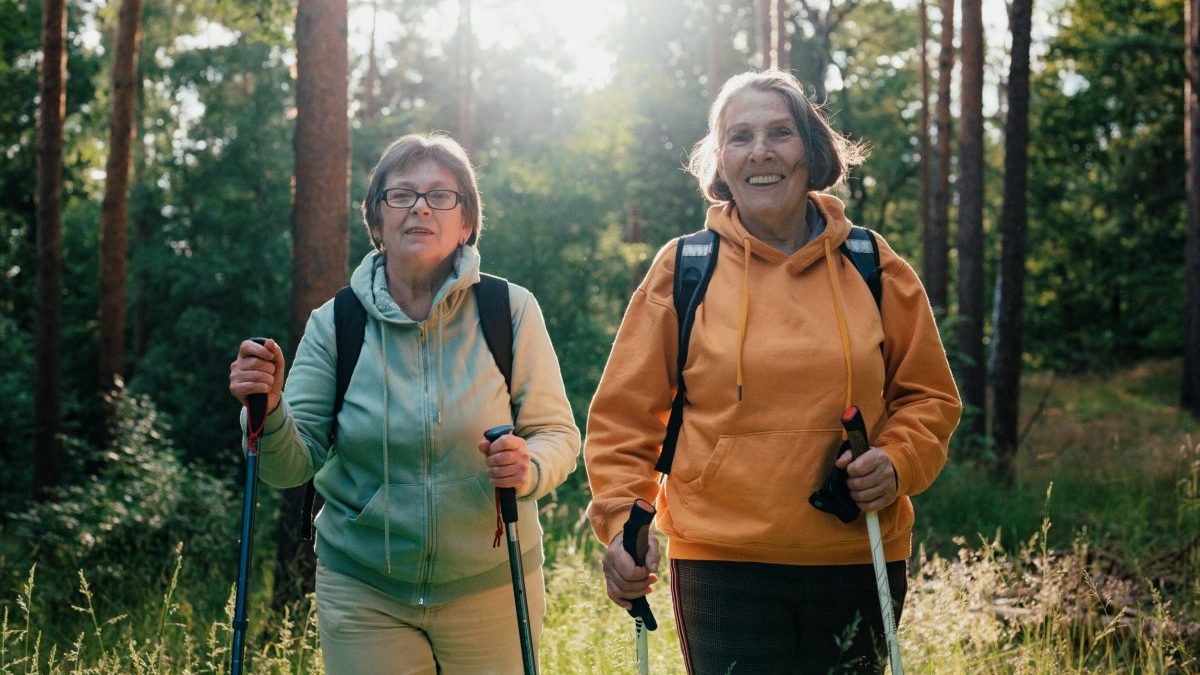
Another way to build resistance is by using poles. Known as Nordic walking, the technique engages the arms as well as the legs and core, turning walking into a full-body workout that burns around 20 per cent more energy and improves upper-body strength compared with regular walking.
The poles are also useful for people with mobility or stability struggles, including older adults, making this a great way to build fitness for all ages.
Nordic walking technique – involving keeping the poles behind the body, specific arm movements, and a grip-release pattern to hold them – isn’t very intuitive, but has been found to lead to the most beneficial workout. It could be of use to get a coach: look at British Nordic Walking or Nordic Walking UK for accredited trainers. Poles can cost between £12-£40 from sports retailers or Amazon.
 Walking can do more for you than many think (Photo: Maskot/Getty)
Make it 15 minutes
What is better: a long walk or lots of shorter bursts of stepping across the day? A paper published last year reported that people who got their steps in during longer bouts of walking had a longer life and better cardiovascular health compared with people who did shorter walks of the same cumulative distance. But longer walks weren’t hour-long hikes – they were defined in the study as anything over 15 minutes. That isn’t an impossible chunk of movement to add into your day. “Getting off the bus one stop early to walk to your destination adds up,” says Best.
The study didn’t look at the intensity of the walk, but for those who really have only seconds to spare, other research has found that very short bursts of walking can be just as beneficial if they’re intense. This is often referred to as “exercise snacking” – small chunks of exercise done throughout the day – which improves fitness despite the brevity.
“Ultimately, research shows that people with a high step count have better health markers than those who don’t – but for some people, little and often is more realistic than carving out an hour a day.”
Walk after eating
A walk is beneficial at any time of day, but after eating could be best. Research has found that 10- to 30-minute walks taken 10 to 30 minutes after a meal can reduce the peak blood-sugar measurements reached, and that blood sugar rises more slowly, rather than spiking and crashing.
Slower and lower blood sugar throughout the day reduces the risk of type 2 diabetes and cardiovascular disease in the long term, as well as supporting better energy levels throughout your day.
So, walk your commute after breakfast, lap your office after lunch and take your dog walk after dinner to support your health.
Improve your posture
There is a form to walking just as there is for any exercise, and using the right muscles can make it feel more comfortable and effective.
“Your walking technique is something you use every single day – it’s absolutely worth improving,” says Hall. “Imagine you’re ‘framing your body’ as you walk – staying tall through the spine, gently opening your chest and keeping your eyes forward.
“I also talk about ‘walking out of your backspace’ – filling the space behind you as well as in front of you.
“This stimulates the posterior chain of your body, which not only instantly improves posture, but stimulates better alignment to reduce joint strain on your knees and hips, boosts your walking pace by stimulating your glutes to work more and helps you to feel more confident and energised.”
Go green (or blue)
Walking in nature has more psychological benefits than walking on concrete. Forests, parks and seaside (known as green and blue spaces) are shown to significantly reduce anxiety, depression and heart rate compared with walking through a city environment.
If you are not lucky enough to have a forest near home or a house in the countryside to escape to, finding pockets of greenery in your concrete jungle can still improve benefits: a meta-analysis reported that people who walked in urban green spaces had significantly reduced stress (in the form of heart-rate variability, an indicator of nervous system activation) and reported better moods and energy.
Even tree-lined streets are better than plant-free environments.
 Head to green or blue spaces (Photo: Goodboy Picture Company/Getty/E+)
Meet outside
You don’t need to struggle to fit in your walk alongside your other commitments when you can simply do both. “Interrogate whether your meetings need to be sedentary. Could a call be audio-only so you can get some fresh air, rather than sit on a video call?” asks Best. “Or could you arrange a walking meeting rather than a coffee?”
Walking side by side is also a good time to have serious conversations, whether with your boss about a pay rise or a friend about something that is troubling you.
Experts think this is because people feel more comfortable shoulder-to-shoulder rather than looking into each other’s eyes, while the mental relaxation of walking keeps people calm.
Five mistakes to avoid
Focusing too much on step count
There is no magic step count to improve health benefits, but we know for sure that the 10,000 step goal – while a great, whole number to aim for – was devised by a pedometer marketing company.
Most research says that benefits plateau at 7,000 steps a day, and that the biggest gains aren’t made from consistent 20,000 step days but when people who do very little start doing more. “Steps are helpful, but they’re only part of the picture,” says Hall. “I’d much rather see someone take fewer, better-quality steps.”
Using ankle or wrist weights
“I personally never advise people to walk with hand or ankle weights, because they tend to pull the body out of its best alignment,” says Hall. “Ankle weights can tug at the hip flexors and knees; wrist weights can encourage people to ‘throw’ their arms from the hands instead of moving from the shoulder. If you’re using walking as your main health tool, that’s not ideal and can aggravate existing joint issues.”
Doing one-and-done
A three-hour hike on a Saturday is a lovely way to spend a day – but if the only steps you take from Monday to Friday are from your bedroom to your home office, you’re missing out on benefits. “Be consistent rather than heroic. Two or three 20- to 30-minute walks across the week, plus shorter ‘movement snacks’, will do far more for your health than the odd punishing power walk that leaves you exhausted or sore.”
Thinking it’s not a workout
Intense exercise, such as running and HIIT, comes with a host of benefits – but don’t think that walking can’t compete. It packs in similar cardio and brain-boosting side effects as higher intensity training without the same recovery time thanks to less strain on the joints and the nervous system.
“People often think walking doesn’t really count unless it’s a long, sweaty hike,” says Hall. “In reality, walking is incredibly powerful.”
Your next read