
Long-delayed flood defences for Clontarf in north Dublin that were due to be in place next year will now not be completed until 2033 “if all goes well”, Dublin City Council has confirmed.
Following an “extreme tidal event” in February 2002, which devastated many homes and businesses in Clontarf, the council began planning for the construction of major flood defences along the coastline.
The coastal suburb has since been identified as one of the areas most at risk of flooding in the State. However, according to the council’s engineers, construction is not now expected to start before 2031, with completion in 2033, more than 30 years since the project was initiated.
The 2002 flood was the first significant tidal inundation experienced in the city since 1922. However, it was followed by another severe, though less extreme, tidal flood in 2004, with flooding along the Dublin Bay coastline increasing in frequency since.
The council secured planning permission from An Bord Pleanála in 2008 to build flood defences up to 2.75m (9ft) tall involving earthen embankments and walls at a cost of €4 million.
Following objections from residents, the council offered to reduce the height to 2.17m (7ft), the lowest height permitted by the planning body. Agreement was not reached on the lower height and large yellow sandbags have been left in place along the promenade since.
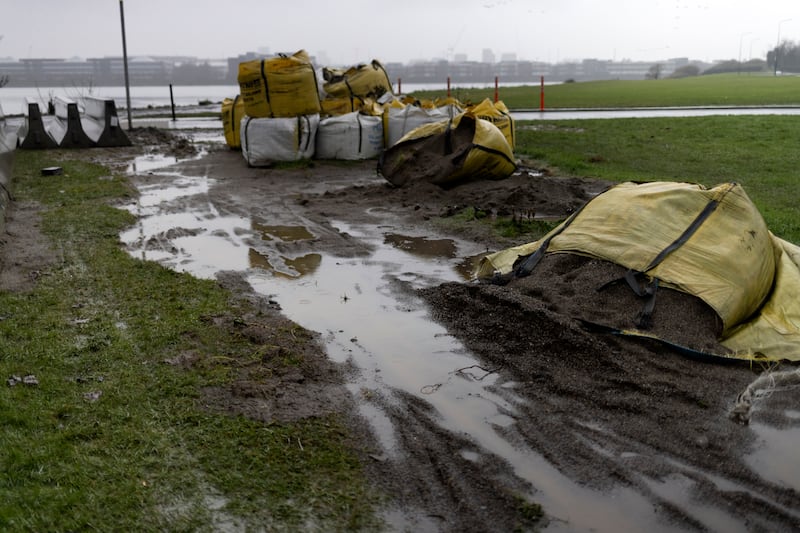 Clontarf has been identified as one of the areas most at risk of flooding in the State. Photograph: Chris Maddaloni
In late 2018, the council proposed new €10 million defence barriers up to 1.6m tall involving a dual-wall solution, with the main barrier at the sea and a secondary defence wall located along the footpath at Clontarf Road, However, concerns remained in relation to the heights.
Two years later, the council produced another dual-wall solution, which would be partially demountable. The demountable sections would be erected at times when the area is at risk of flooding.
In late 2021, the council said it hoped to lodge an application for the scheme with An Bord Pleanála by the middle of 2023. If the board granted permission at the start of 2024, the defences could be completed by 2027, it said.
However, the council this week said the “dual wall system was rejected by a number of local residents for different reasons” and “this put Dublin City Council back to the start”.
It now intends to appoint a consultant to design the project by the end of this year. It would then take a “minimum of three years” for the consultant to prepare an application for submission to An Comisiún Pleanála, which has replaced An Bord Pleanála.
If the commission granted permission within one year, and there was no legal challenge to that permission, work was “likely to commence around Q2 2031 after the Brent Geese have left for the summer. Construction would probably be over three summers, April to August, due to environmental constraints, [from] 2031-2033 if all goes well.”
The council said the “length of time taken to reach the point of appointing a consultant reflects the complexity of delivering a flood defence scheme in a highly sensitive and well-used coastal area, and the need to ensure that any proposal is both technically robust and publicly acceptable”.
It had “spent a prolonged period engaging with residents, businesses and local stakeholders to better understand the concerns that had been raised and to explore whether alternative approaches could be identified that might command broader public support”.
Local Green Party Cllr Donna Cooney said the serious risk of flooding was “not being addressed with the urgency required” by the council.
“I am absolutely shocked we are being left with sandbags, concrete blocks that have to be moved in and out by workers, and a muddy mess until at least 2033. The residents aren’t to blame for that.”