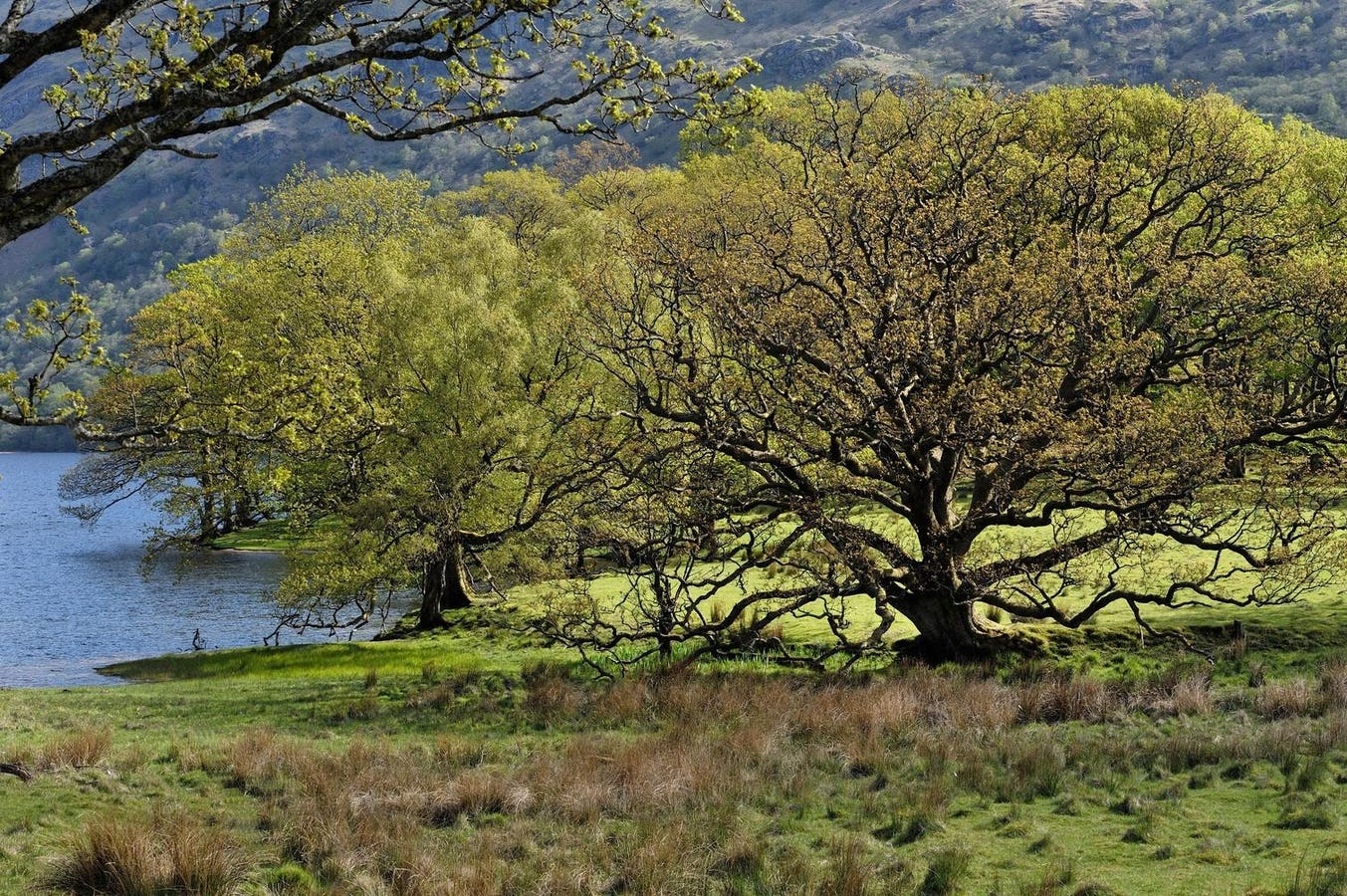
Native trees, especially oaks and birch, are important to the reproductive success of insectivorous birds and other wildlife.
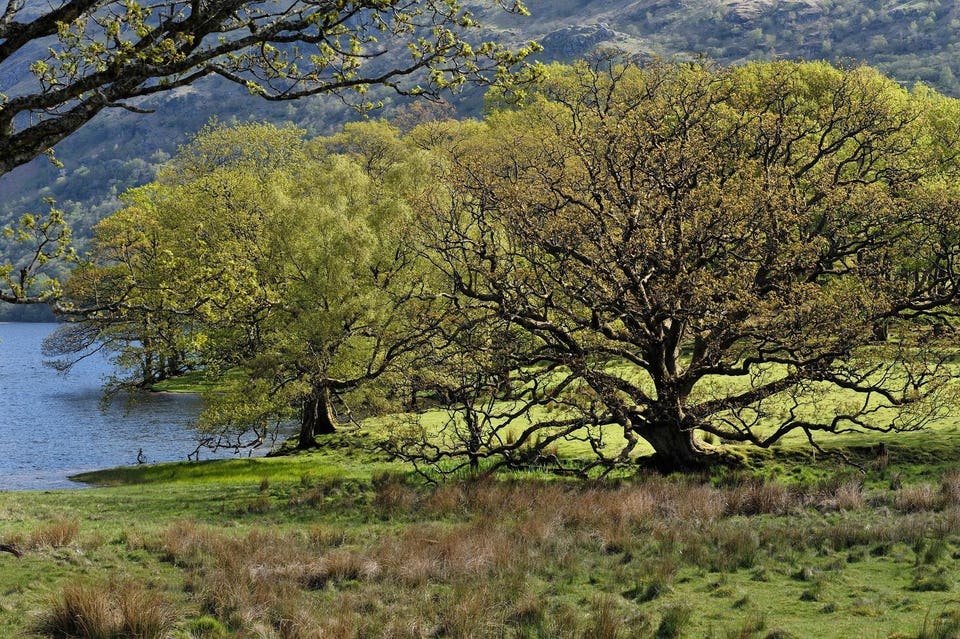
Oak trees in spring on the banks of Loch Lomond in Scotland. (Credit: Andia / Universal Images Group via Getty Images)
Universal Images Group via Getty Images
“One tree is like another tree, but not too much. One tulip is like the next tulip, but not altogether. More or less like people — a general outline, then the stunning individual strokes.”
― Mary Oliver (1935–2019), Upstream: Selected Essays
One tree is just like another, some people claim. But are they? A new study reports that native trees — especially native oak and birch trees — are important to wild songbirds and their offspring, and are closely tied to their overall reproductive success.
The study bird, a Eurasian blue tit (Cyanistes caeruleus), with a caterpillar in its beak. (Credit: Alexis Lours / CC BY 4.0)
Alexis Lours via a Creative Commons license
“My research is centred around understanding how species are responding to environmental change,” the study’s lead author, urban ecologist Claire Branston, told me in email. Dr Branston is a research associate at the University of Glasgow and a University Tutor at Edinburgh Napier University.
“Recently I’ve been focussing on understanding how animals are responding to urbanisation, as this is a rapidly expanding and unrelenting aspect of environmental change,” Dr Branston elaborated in email. “Many bird species now live alongside us in cities, but not all are thriving there. From our previous work, and that of others, we know that species, such as blue tits, raise fewer chicks in urban areas. However, we didn’t fully understand what may be driving these differences. The aim of this study was to identify aspects of the urban environment that might be contributing to blue tits having reduced reproductive success in cities compared to rural areas.”
A city park in the Glasgow city center was situated at the urban end of the study gradient. (Credit: Claire Branston)
Claire Branston, with kind permission
The Eurasian blue tit, Cyanistes caeruleus, is a small blue and yellow songbird known for their acrobatic abilities as they search for insect prey. They are usually resident throughout much of Europe and Asia, where they are live in deciduous or mixed woodlands that typically support a high number of native oak trees. The blue tit is insectivorous during the breeding season, although they do eat seeds when they are not breeding.
To understand why blue tits have higher reproductive success in rural woodland environments, Dr Branston and collaborators compared blue tits residing in urban and rural environments. They monitored an urban–non-urban gradient that was approximately 40 kilometers (24.8 miles) long, with the extremes of the gradient located in the Glasgow city center at one end and in Loch Lomond National Park at the other end.
A path in the Loch Lomond and The Trossachs National Park at the end of May. (Credit: Alexey Komarov / CC BY-SA 4.0)
Alexey Komarov via a Creative Commons license
This gradient has been monitored annually between 2014 and 2022 and consisted of between 5 and 20 sites, depending on the year. Dr Branston and collaborators examined a number of details, including the amount of tree foliage, tree species, the density of people present and the local temperatures (Figure 2). Using statistical analyses, Dr Branston and collaborators investigated the individual impacts of these different factors on how well the birds were doing.
F I G U R E 2 : Environmental variation along an urban–non-urban gradient in Scotland. In all plots, black circles represent the mean value of each environmental variables at each site, and the lines the SD. (doi:10.1002/ecy.70294)
doi:10.1002/ecy.70294
The study’s key finding was that the abundance of native trees, especially oak and birch trees (Figure 2c, d, e), is vitally important to the overall well-being of insectivorous birds and their ability to reproduce and to successfully raise chicks. In areas where more native trees were present, blue tits laid more eggs, laid them earlier in the year and successfully raised more chicks to fledging. In contrast, greater non-native foliage density was associated with later and smaller clutch sizes and a reduced number of fledglings.
F I G U R E 1 : The foliage availability (per square meter) for each tree genus/species category at each site along a 40-km urban-forest gradient in Scotland, UK. (doi:10.1002/ecy.70294)
doi:10.1002/ecy.70294
Why are native trees so important to these birds?
“Blue tits feed their chicks a range of invertebrates, with different groups being important at different stages of development,” Dr Branston replied.
The invertebrate species that were present were also important.
“From previous work at the extremes of our urban gradient we know that rural birds feed their chicks a diet that has a higher proportion of caterpillars (Lepidoptera) in it. Whereas urban birds rely more on flies (Diptera), beetles (Coleoptera), and aphids (Hemiptera) than their rural counterparts,” Dr Branston elaborated in email. “However, the chicks do best, and are more likely to leave the nest successfully, when their diet contains more caterpillars.”
The parents typically feed their chicks on moth caterpillars that are from taxonomic families such as Geometridae, Noctuidae and Tortricidae. This confirms findings from a previous study that found that blue tit numbers are closely tied to the numbers of caterpillars in their local environment (more here).
Perhaps not so surprising was that Dr Branston and collaborators’ discovered that a larger human population density reduced fledging success, and that higher ambient temperatures were negatively related to first egg laying date, clutch size and the number of fledglings produced.
Further, the numbers of caterpillars collected by Dr Branston and collaborators over the blue tits’ breeding season were positively related to the density of native oak foliage, even when this foliage was found in an urban setting. Dr Branston and collaborators think this observation is because native trees support more native insect life — more caterpillars of moths and butterflies in the case of oak trees. Further, the team confirmed this by counting caterpillar numbers during the birds’ breeding season.
These findings highlight the importance of carefully considering which tree species we should be planting, particularly in urban areas where there are fewer trees of any sort.
“Our research shows that the presence of native oak trees increases the number of chicks that breeding blue tits can successfully rear, as these trees mean they have more of the food they need,” Dr Branston told me in email.
This study indicates that the presence of oak trees can help support entire food chains in urban environments, and this is something that urban planners and property holders should be considering when designing urban green spaces.
“We want to highlight that native deciduous trees support more caterpillars, which are an important food resource for many birds during reproduction. Therefore, urban areas that have more native trees will ensure that there is ample food for insectivorous birds during reproduction, helping to address the reduced reproductive success we often observe in these birds in cities,” Dr Branston concluded. “By prioritising native trees that support caterpillars in the design of urban green spaces, we can improve conditions for wildlife, build resilience to future environmental change and create an environment that benefits humans too.”
Source:
Claire J. Branston, Pablo Capilla-Lasheras, Conor Haugh, Paul J. Baker, Rachel Reid, Kate Griffiths, Stewart White, and Davide M. Dominoni (2026). Native trees are related to advanced bird breeding phenology and increased reproductive success along an urban gradient, Ecology 107(1): e70294 | doi:10.1002/ecy.70294
© Copyright by GrrlScientist | hosted by Forbes | LinkTr.ee
Socials: Bluesky | CounterSocial | LinkedIn | Mastodon Science | Spoutible | SubStack | Twitter