
Deal or no deal? That was the question waiting for Danish prime minister Mette Frederiksen on Friday in Greenland.
On a snap visit to show “strong Danish support” for the island, an autonomous territory of the kingdom of Denmark for three centuries, Frederiksen had barely landed when a journalist wanted to know “if the crisis is over?”
Frederiksen had no answer. Instead she walked away from the cameras with Greenland’s prime minister Jens-Frederik Nielsen.
It was a telling, wordless moment in what Frederiksen, with a dash of understatement, called a “serious situation”.
“Everyone can see that,” she replied to an earlier question. “Now there is a diplomatic, political track that we are going to pursue, and that is what we need.”
That she cancelled a planned meeting of fellow Nordic leaders to fly to Nuuk, the Greenlandic capital, was signal enough that, for Denmark and Greenland, the stand-off with Washington continues. Regardless of any “all-access deal” announced by US president Donald Trump in Davos.
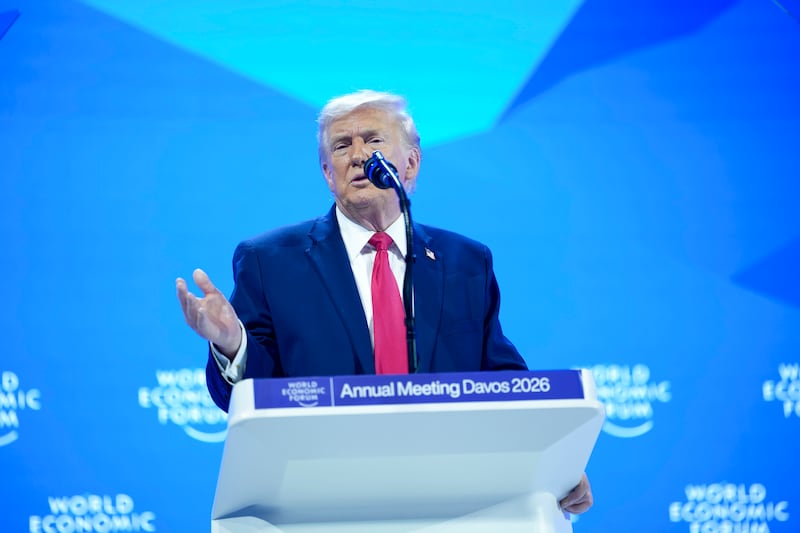 US president Donald Trump addresses the World Economic Forum in Davos, Switzerland, on Wednesday. Photograph: Doug Mills/The New York Times
Hours after the Trump announcement, Danish foreign minister Lars Løkke Rasmussen was back in Washington for talks, saying only afterwards: “We want to take the drama out of this.”
That Denmark is still planning for drama on the island is clear, however, from a short, blunt military order issued last week.
If Greenland is attacked, according to the order seen by public broadcaster DR, Danish troops are to respond – including with live ammunition.
Among those likely to respond: newly-arrived black beret members of the armed Jutland Dragoon Regiment.
[ ‘Time to step up’: von der Leyen pushes Arctic defence at EU summitOpens in new window ]
They would lead an armed, multi-phased Danish response to any takeover attempt and, according to the order, “demonstrate the will and ability to defend the sovereignty and territorial integrity” of the kingdom of Denmark.
What made the order noteworthy was less its content – building on a standing 1952 Royal Order that remains active – than its timing.
Days earlier US president Donald Trump’s vowed to take Greenland “the easy or the hard way”.
To the New York Times, Trump said US ownership of Greenland was “what I feel is psychologically needed for success”.
After the Davos deal, US journalists asked if his self-professed deal met his own conditions for success. Trump’s answer was evasive: “It’s a long-term deal … that’s forever”. Pressed on the detail, Trump demurred: “Much different, much more detail.”
[ Trust is broken. Europe-US relations have never been lowerOpens in new window ]
Ask Danish analysts about any deal and the smart money is on an overhaul of an existing bilateral deal, signed in 1951, granting US wide-ranging rights on the island to establish and operate military facilities.
That meant 17 bases at the height of the Cold War, though just one is operational now in Greenland’s northwest.
In addition the document allows the US government “the right to exercise exclusive jurisdiction over those defence areas in Greenland for which it is responsible”.
Crucially, however, the 1951 agreement exists “without prejudice to the sovereignty of the Kingdom of Denmark over such [a] defence area”.
Any new arrangement may allow for a greater Nato “Arctic Sentry” presence and, reflecting US security concerns, could contain new provisions to block China and Russia from the island and its mineral deposits.
In addition, US officials are reportedly pushing for “sovereign base areas”, similar to RAF bases in Cyprus that are considered British territory.
Denmark insists it will not compromise on its sole sovereign claim on the island and, in unison, politicians in Copenhagen or Nuuk insist this will not change – even after a key meeting in Davos between Trump and Nato secretary general Mark Rutte.
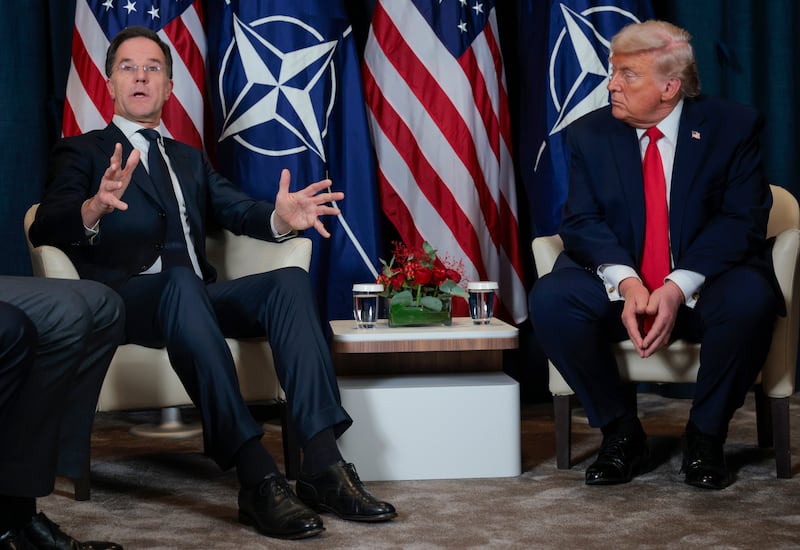 Trump listens as Nato secretary general Mark Rutte speaks during a bilateral meeting on the sidelines of the World Economic Forum on Wednesday. Photograph: Chip Somodevilla/Getty
Danish defence minister Troels Lund Poulsen, also in Davos, described his own meeting with the Nato head in diplomatic terms as “very useful for Rutte … about the red lines of the kingdom”.
More outspoken was Greenland MP Aaja Chemnitz, who sits for the island in Denmark’s parliament: “In no way has Nato its own mandate to negotiate anything about us from outside. Nothing about us, without us.”
Strong cross-party support in Denmark exists for this stance, and for the fresh military order. It builds on a pre-existing 1952 royal decree that, put simply, any attack on Danish territory is to be considered a mobilisation order to respond.
Denmark knows it has no chance against the full force of the US military, but is determined to put up a fight if necessary. And while Trump derided Greenland’s defences as “two dog sleds”, the Danish military begs to differ. It has been investing in maritime patrol aircraft capacity, additional icebreaker ships and even radar with additional drone capacity.
On the water it has Thetis-class frigates; in the air, Seahawk helicopters. And, yes, there is the “Sirius Dog-Sled Patrol” – though with an additional €37 million funding to ensure “greater flexibility and speed” of deployment.
And Denmark insists it is continuing with its Arctic Endurance exercise throughout 2026 “on land, at sea and in the air”.
As the standoff with Washington drags into another week, initial anxiety in Denmark is shifting to irritation. The Berlinske daily attacked Trump’s Davos claims as an “accumulating doom loop of bad decisions”.
“Trump surrounds himself with flattery instead of truth,” it added, “and Greenland is the price of sycophancy.”