
A shy, ferret-sized predator called the coastal marten has been quietly hanging on in the forests of southern Oregon and northern California.
Researchers have now pinpointed where these animals appear, how many individuals a single landscape can support, and which forest features matter most for their survival.

The study focuses on the coastal marten, also called the Humboldt marten, and offers a more detailed snapshot of a species nearly erased in the last century.
Coastal martens almost disappeared
Coastal martens once ranged widely along the Pacific coast, from northern Oregon into northern California.
That changed fast in the 1900s. Trappers heavily targeted martens for their fur, while widespread logging reshaped the older, complex forests the species depends on.
The species’ range and numbers collapsed so dramatically that researchers at one point considered it extinct, until scientists found a small surviving population in northern California in 1996.
Today, the remaining pockets of martens are still vulnerable. The species faces mounting risks, including rodenticides, vehicles, disease, and ongoing habitat loss, and conservation agencies list it as threatened.
On top of that, climate change is altering forest conditions in ways that can hit martens hard, especially through larger and more frequent wildfires.
To get a clearer read on the species, researchers from Oregon State University (OSU) ran a three-month survey in 2022 across roughly 150 square miles east of Klamath, California.
Instead of trapping animals, the team used non-invasive tools: hair snares and remote cameras.
Hair snares are exactly what they sound like – devices designed to snag a few hairs as an animal investigates. Researchers then analyze the hairs genetically, allowing them to identify individual animals without ever handling them.
Cameras fill in the behavioral and location side of the story, helping confirm where martens show up and how often.
The team placed 285 hair snares – made from PVC pipe – and set up 135 cameras across the study area.
What the DNA revealed
The genetic work identified 46 individual martens. Of these, 28 were males and 18 were females.
These results matter because they move beyond simple presence checks. The data allow counts of distinct animals and reveal population size and trends over time.
Just as importantly, martens ranged across the study area rather than clustering in one small corner of the map.
Their presence across the landscape suggests it still contains a patchwork of habitats the species can use – at least for now.
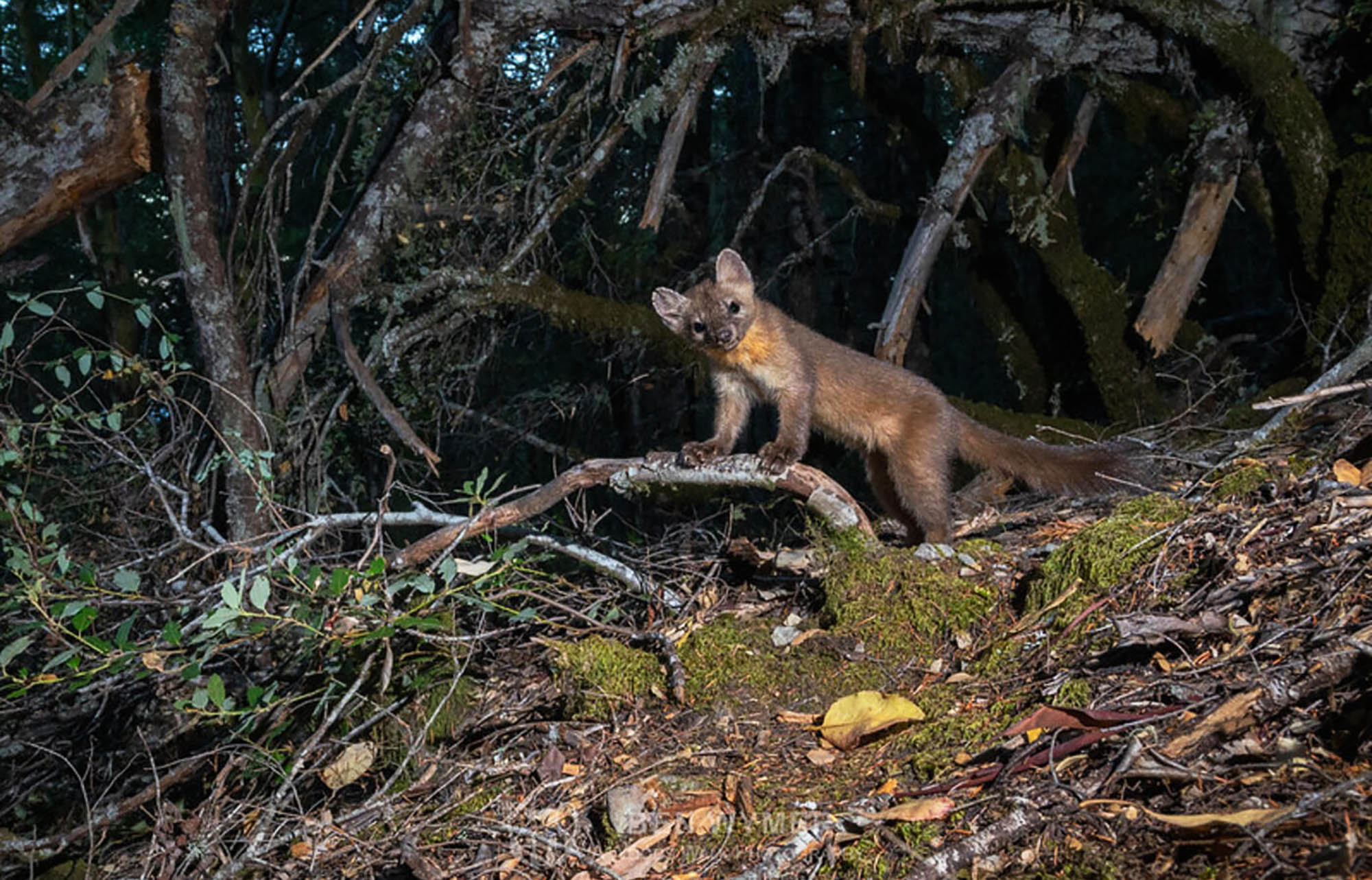 Average adult coastal humboldt martens range from 20-24 inches long, including their tails, which are often about ⅓ of their body length, and weigh only 1.5-3 lbs. Photo by Ben Wymer, A Woods Walk Photography. Click image to enlarge.Two habitats, one species
One of the most useful outcomes from studies like this is learning where animals concentrate. Here, martens showed up most strongly in two kinds of places.
At higher elevations, they were most numerous along forested ridgetops that hold consistent winter snowpack.
At lower elevations, the pattern shifted: martens were often found in ravines, riparian zones, and coastal forest areas that likely offer cover, moisture, and structural diversity.
That split matters for conservation because it shows the species does not rely on a single “marten habitat recipe.”
Instead, it may rely on a range of forest settings, depending on elevation, microclimate, and the structure of vegetation on the ground.
Forest traits of coastal martens
The study also reinforces a broader idea that keeps coming up in marten conservation: these animals do best in forests with older-growth traits and messy, layered structure.
“Coastal martens like forests with old-growth characteristics and those types of forests are being threatened by the effects of climate change, including more frequent and severe wildfire, and certain forest management practices,” said Sean Matthews, a wildlife ecologist at Oregon State University.
“Beyond that, there’s a lot we don’t know about this species, including information as basic as what forests do coastal martens still occupy, how many martens are there, and are these populations increasing.”
Structural complexity in forests
The habitat details match what field results show.
“Martens tend to select forest stands with greater than 50% canopy cover and lots of large-diameter trees, snags, and hollow logs,” said Erika Anderson, a faculty research assistant at Oregon State University.
“Structural complexity with coarse woody debris helps them hunt and also provides cover from predators and competitors,” Anderson explained.
“But despite continued conservation concern over the last 30 years, we have a lot to learn about marten distribution and demography and how forest conditions influence their distribution and density.”
In plain terms, martens appear to like forests that provide both hunting opportunities and protection.
Their preferred forests have overhead cover, hiding spots, and downed wood that supports prey and breaks up open ground where predators might have an advantage.
Landscapes with overlapping goals
Researchers conducted this work across multiple, non-uniform landscapes rather than in a single park.
The study area included parcels managed by multiple entities. The land spans elevations from about 100 feet (30 meters) to 4,600 feet (1,400 meters) and sits on ancestral lands of the Yurok and Karuk Tribes.
That mix is important because it reflects reality. Martens are surviving in landscapes shaped by overlapping goals, such as habitat restoration, cultural resource protection, recreation, timber harvest, grazing, and more.
 Between 1989-2012, there were only 26 confirmed sightings of Coastal martens. They were considered functionally extinct, until a small population was rediscovered in 1997. Credit: Oregon State University. Click image to enlarge.Land management choices
One-third of the study area is owned by the Yurok Tribe, including land acquired in 2019 that had previously been managed for commercial timber production.
The Tribe now manages it for multiple uses, including restoration and conservation, alongside some timber harvesting.
Green Diamond Resource Company still manages about one-fifth of the study area, while the Forest Service manages its portion for a range of objectives.
For a threatened species living in a working landscape, those management choices can influence whether forests become more supportive over time – or less.
Lessons from coastal martens
This project doesn’t solve everything about coastal martens, but it does tighten the picture in a helpful way.
The research confirms a solid number of individuals detected in one key region, shows martens using both snowy ridgelines and lower riparian terrain, and strengthens the case that complex, high-canopy forests remain central to their survival.
The work also points to an obvious next step. Repeating this kind of work across other suspected marten habitats and over multiple years would show whether populations are holding steady, growing, or shrinking.
The study is published in the journal Global Ecology and Conservation.
—–
Like what you read? Subscribe to our newsletter for engaging articles, exclusive content, and the latest updates.
Check us out on EarthSnap, a free app brought to you by Eric Ralls and Earth.com.