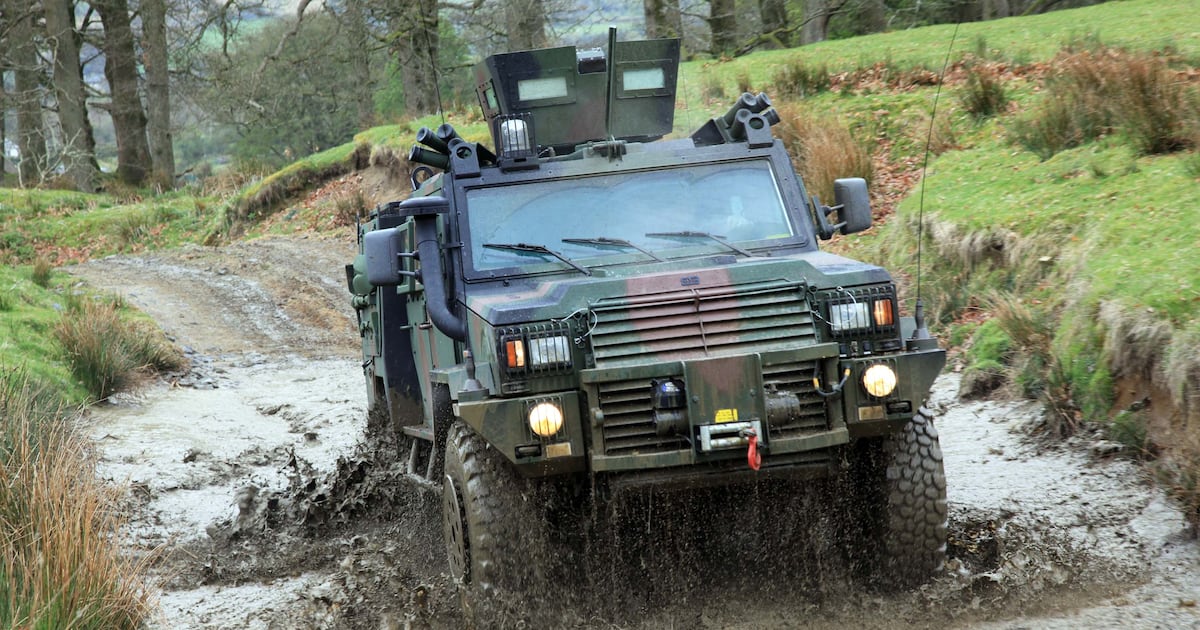
The Defence Forces quietly retired its fleet of 27 light armoured vehicles after they proved to be “disastrous” in the field.
The South African-made light tactical armoured vehicles (LTAVs) saw infrequent operational use after being acquired in 2010, due in part to many technical issues.
This is despite being deployed on missions in the Middle East and Africa, and being used as part of Ireland’s previous contribution to the EU Battlegroup
Mileage figures provided under Freedom of Information legislation show the vehicles recorded low mileage during their 15-year lifetime. One vehicle drove an annual average of 540km, the rough equivalent of one full fuel tank a year.
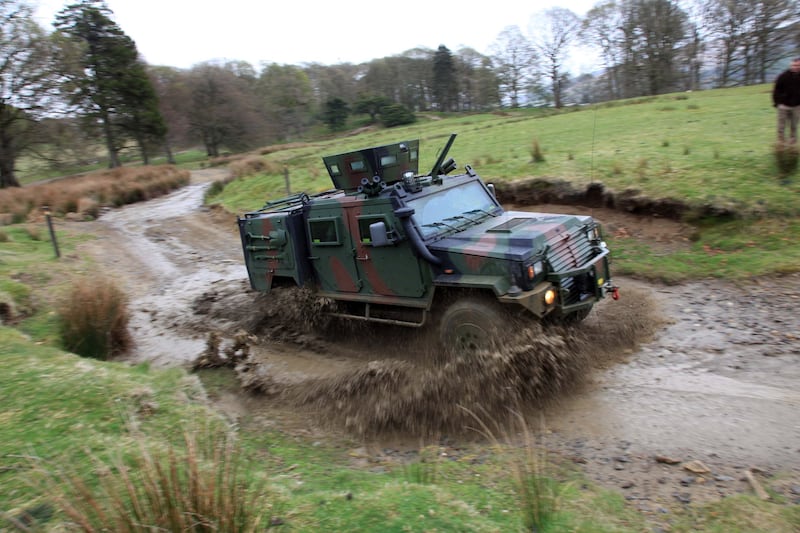 RG-32M light tactical vehicle in use in the Glen of Imaal. Photo: Óglaigh na hÉireann/Defence Forces
Military experts say there are important lessons to be learned from what one called the LTAV “debacle” as the Government dramatically steps up military spending.
One of the biggest planned purchases, which could amount to €500 million, is a fleet of new vehicles to replace the LTAVs and complement the Defence Forces’s 80-strong fleet of Mowag armoured personnel carriers.
As Ireland strengthens its military, one country and company gain the most
Read the full article here
A group set up by the Department of Defence and Defence Forces is understood to be expected to recommend a French-made family of three armoured vehicles called the Jaguar, Serval and Griffon.
Requirements for the new vehicles include “level four” armour that can stop high-calibre rounds and the ability to be fitted with mortar systems.
The LTAVs, known as RG32M Outriders, were purchased in 2009 from the now defunct BAE Systems Land Systems South Africa for just under €20 million or €726,000 each. They out-performed similar vehicles from Switzerland and Italy in Irish field tests.
They were designed to serve as an intermediary option for situations judged too dangerous for soft-skinned vehicles but not necessitating an armoured personnel carrier (APC).
The Irish Defence Forces was among the first militaries to purchase the vehicles. Irish officials had them heavily customised and ordered them in several variants, including reconnaissance versions and versions equipped with remote control grenade launchers.
Ten were to be kept on the island for training and 17 were to be deployed overseas to peacekeeping missions.
Problems with the vehicles were evident from the start. Users reported severe reliability and maintenance issues including electrical connections not matching up and driveshafts shearing off.
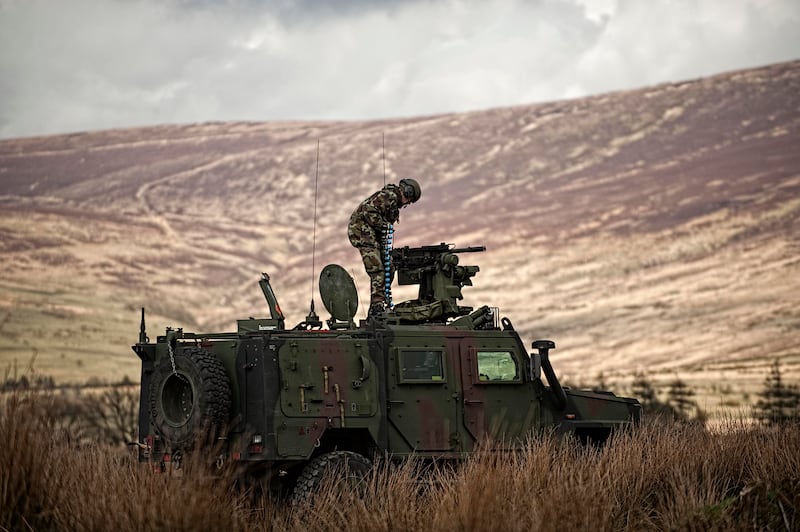 RG-32M light tactical vehicle in use in the Glen of Imaal. Photo: Óglaigh na hÉireann/Defence Forces
Reliability issues meant officers frequently refused to deploy them on patrols in Lebanon and other potentially dangerous areas. One military source said a LTAV deployed to Unifil in Lebanon remained consigned to base for an uninterrupted 18-month period.
The acquisition in 2017 of 24 armoured utility vehicles (AUVs) further reduced the need for the LTAVs. The AUVs, which are essentially armoured versions of civilian Toyota Land Cruisers, proved much more reliable and popular in the field.
The LTAVs have yet to be officially withdrawn from service but all have now been consigned to storage in Ireland. By contrast, the Defence Forces Mowag APCs, which were first acquired in 1999, are expected to remain in service past 2030, having recently undergone a mid-life refit.
Some of the Irish vehicles recorded lifetime mileages generally expected of a military vehicle. For example, the most heavily used LTAV travelled 32,535km over 14 years or just over 2,000km a year.
However, nine LTAVs travelled less than 1,250km a year, with one travelling just 540km a year.
“They were a bit of a running joke,” said one military source.
“The problem was they bought an immature platform which had not been vetted in the field by bigger militaries. Then they started adding loads on to them, which made them more complicated and less reliable.”
Former TD and Army Ranger wing commandant Cathal Berry said the LTAVs were “a disaster” and their purchase offered valuable lessons as Ireland looks at spending hundreds of millions on military equipment in the coming years.
“In terms of lessons learned, we’re looking for reliability, sustainability and operational capability. As well as speed mobility and firepower,” he said.
“Cost is a factor but not the dominant factor. The dominant factor is the effectiveness of the vehicle.”
French companies make sense due to their reputation and proximity to Ireland, said Mr Berry.
“And there is obviously a major concern about buying anything American at the moment for fear the contracts could be torn up.”
A Defence Forces spokesman defended the LTAV’s track record.
“They have been deployed on multiple UN and EU peace support missions, where their combination of mobility, protection and adaptability has proven particularly valuable in complex and austere environments,” he said.
“The LTAV fleet enhanced the Defence Forces’s ability to operate safely and effectively in contemporary operational theatres, reinforcing Ireland’s contribution to international peacekeeping while also strengthening national operational readiness.”
Bae Systems, the former owner of the company, and Denel, which subsequently purchased it, did not respond to a request for comment.