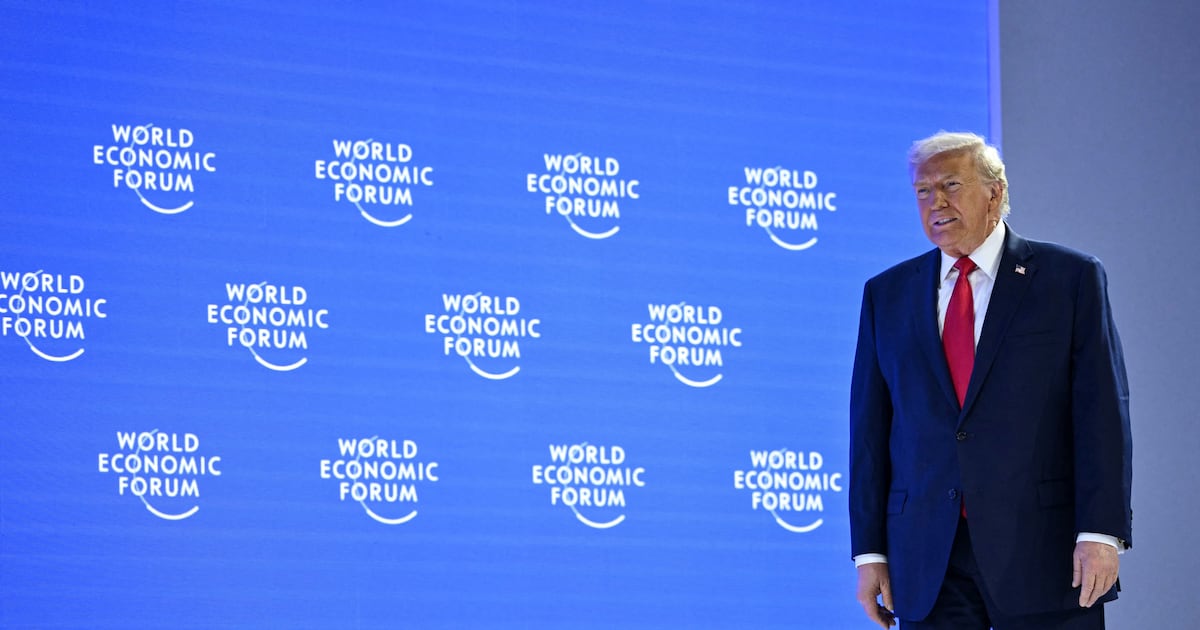
The truism that the future is uncertain is made more concrete when the principal guest at a conference on a Swiss mountain had previously declared a trade war for territory against his country’s closest allies, many of whose leaders were also guests. This is surreal, at the least. But what does it mean for the world’s future, not least its economic future, to be vulnerable to the unpredictable whims of the president of the world’s leading power?
Before returning to that question, let us look at where the economy has been and might go in the near future. The World Bank’s new Global Economic Prospects provides a clarifying view of the recent past.
In particular, it notes: “The global economy has shown notable resilience to heightened trade tensions and policy uncertainty. Last year’s faster-than-expected pace of growth capped a recovery from the 2020 recession unmatched in six decades, even if vulnerable emerging market and developing economies are lagging behind.”
The fact that the recovery from the economic impact of the pandemic has been so strong is cheering. It is due, not least, to the effectiveness of vaccines, for whose development Donald Trump, with his Operation Warp Speed, bore much responsibility. The contrast with the attitude to vaccines of his second administration is stupefying.
The two deepest global recessions since 1960 occurred in 2009 and 2020. The recovery from the latter has been the strongest of all: within five years, global GDP per head is 10 per cent above its 2019 level. The recovery in high-income economies has been faster than after the previous recessions. While the recovery of emerging market and developing economies (EMDEs) has been faster than in high-income countries, it has been far slower than in 2010-14.
More worryingly, a large number of individual developing countries have performed very poorly in the more recent period: by 2025, GDP per head in nearly 90 per cent of high-income economies had surpassed its 2019 level; in contrast, it remained lower than in 2019 in more than one-quarter of EMDEs and in 40 per cent of low-income countries. Worse still, the decline in the proportion of the population in extreme poverty in the poorest countries has halted over the past decade. This really ought to matter to policymakers worldwide. The massive decline in the proportion of the world’s people in extreme poverty was a huge gain.
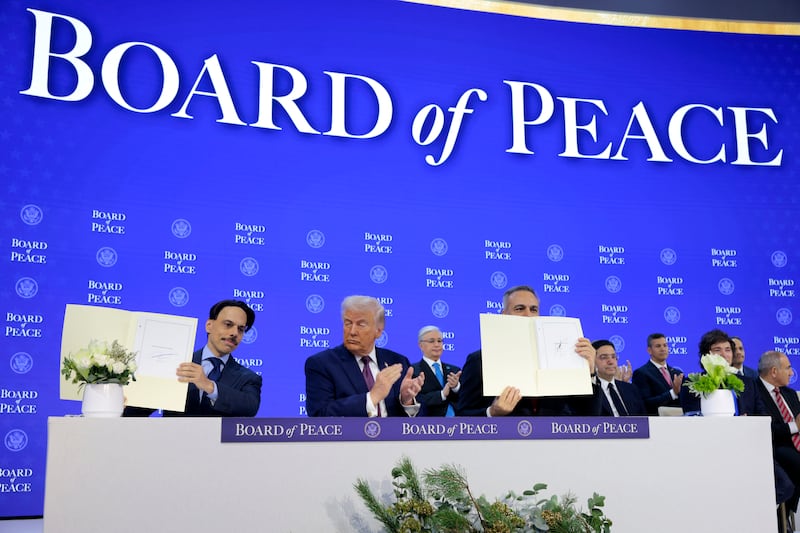 Saudi Arabia’s Foreign Minister Faisal bin Farhan (L) and Turkey’s Foreign Minister Hakan Fidan join US president Donald Trump at the World Economic Forum on January 22, 2026 in Davos, Switzerland. Photograph: Chip Somodevilla/Getty Images
Yet who cares in today’s more openly predatory world? Probably not many of those in Davos. So, let us turn to what does matter to them: global economic prospects in a world subject to the whims of Trump.
The IMF’s recent World Economic Outlook is comforting. It says that “global growth is projected to remain resilient at 3.3 per cent in 2026 and at 3.2 per cent in 2027: rates similar to the estimated 3.3 per cent out-turn in 2025”. This forecast marks a small upward revision for 2026 and no change for 2027 compared with October 2025. On balance, accommodative monetary and fiscal policies, buoyant stock markets and AI euphoria have offset both Trump-induced uncertainty and the negative impact of tariffs, themselves substantially less aggressive than indicated on “liberation day” last April.
So, is the Trump era, albeit all the noise, “a tale told by an idiot, full of sound and fury, signifying nothing”, at least where the economy is concerned? He has learnt that he cannot bully China. He believes he can bully everybody else and nothing, so far, suggests he is wrong. The cost of his expeditions to Venezuela and other such ventures seems modest. In all, the upside may be small, but the downside may be small, too: his bark is worse than the bite.
Yet my guess is that this complacency is mistaken. What we are seeing is a slow-motion erasure of the operating systems of the global economic and political orders.
Thus, with the US neither predictable nor bound by any fundamental principles of action, apart from some short-term gains, its credibility as a reliable partner and ally is being destroyed, perhaps permanently. Domestically, the rule of law, fiscal stability, the independence of the Federal Reserve (and so monetary and financial stability) and the commitment to science are all in question. Internationally, the US is mounting a war on almost all significant institutions, notably the EU. The World Trade Organization has been made irrelevant. Co-operation on climate and health is ruined. In all, the administration has announced its decision to pull out of a total of 66 international organisations, including 31 UN entities.
It is possible that even such an unco-operative and unstable environment will not impair the willingness of business and policymakers to take big bets on the future. Look at the AI boom. But this must be doubted. The costs may not come swiftly or even visibly. Yet we know that populist policies erode domestic economic performance. The same is sure to be true when the regime in question is a global superpower. But, in this case the damage will be to the world economy, too, as we lose a host of global public goods. Casualties might well include the global roles of the dollar and the US financial system.
At the same time, as the recovery from the pandemic tells us, the world economy has great momentum: it has, after all, grown substantially in every year since 1950. Important innovations come apace, not just in the US, but also elsewhere. Adam Smith famously said that “there is a great deal of ruin in a nation”. He was right. But it would be grotesque to test this optimistic view to the point of US and global destruction. – Copyright The Financial Times Limited 2026
[ The worse Trump behaves, the more room there is for optimismOpens in new window ]