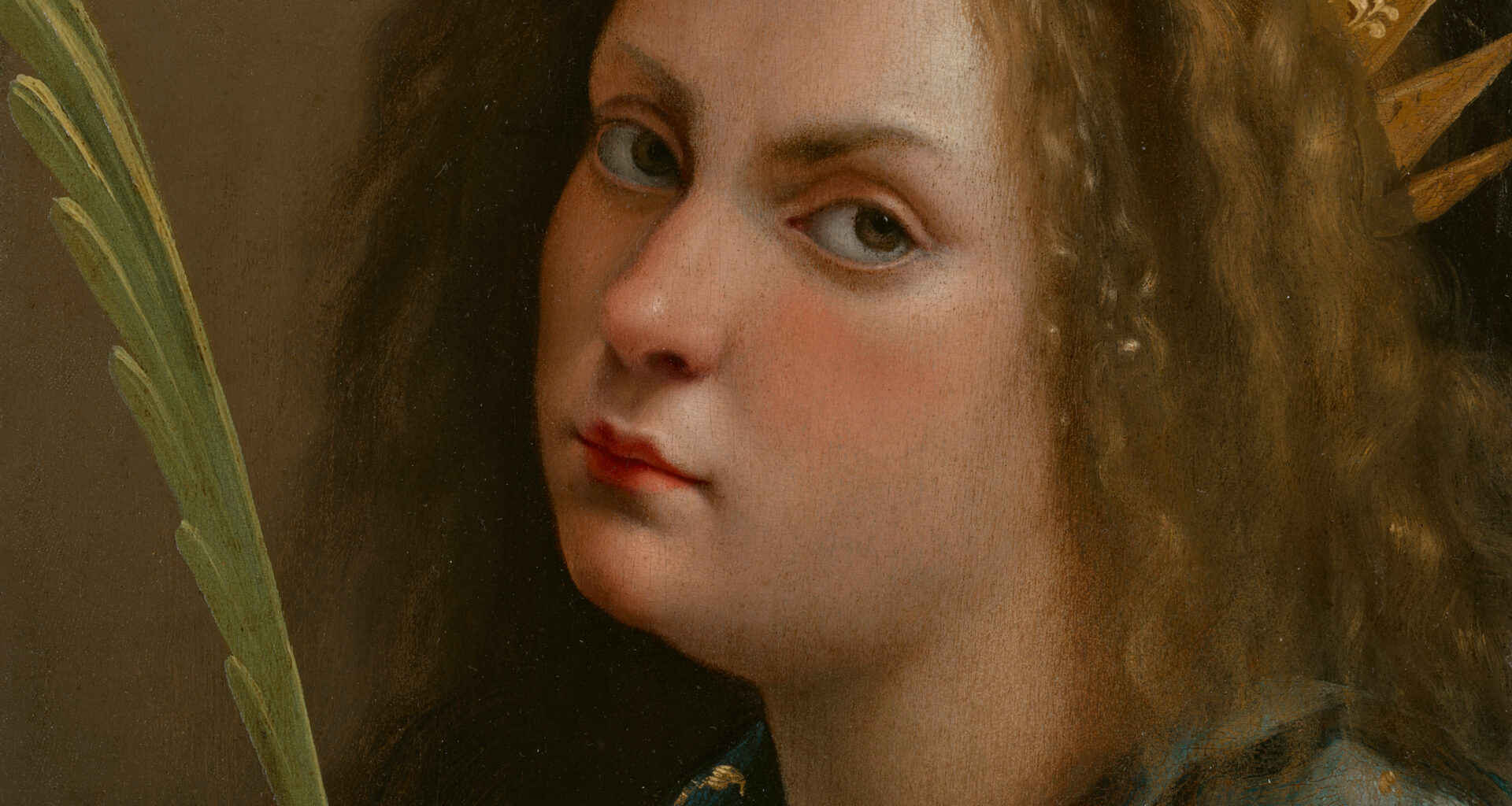
In both depictions, Artemisia holds a palm frond — symbol of martyrdom — and wears a crown, pointing to Catherine’s royal birth. The story of this early Christian martyr, as recounted in The Golden Legend, tells of her intellectual triumph over fifty eminent philosophers summoned by the Roman emperor Maxentius to dispute with her, but a young Catherine successfully defended her faith and converted them all. She was sentenced to death and bound to revolving wheels studded with iron spikes, from which she was freed by divine intervention. The instrument of her torture was Catherine’s attribute in art and can be seen here lower left.
By endowing the saint with her own features, she also creates an intimate union between artist and subject, inviting the viewer to read the image as both devotional and self-reflective. ‘Many of Artemisia’s paintings feature women from the Bible and ancient history as their main protagonists. Such subjects were by no means unusual at the time, but Artemisia brought a particular realism and psychological depth to her heroines’ strength, passion and vulnerability,’ explains Treves. And while the subject matter in this work might have been determined by a patron, she adds, ‘…what they wanted from her was something no male artist could provide – a female perspective and sensibility.’
Owning the conversation
Interest in Artemisia has accelerated significantly since her rediscovery in the 1970s, spurred by feminist art history. She was featured in the landmark 1976 exhibition Women Artists, 1550–1950, curated by Linda Nochlin and Ann Sutherland Harris, and by artist Judy Chicago’s monumental installation The Dinner Party (1974–79) – permanently on show at the Brooklyn Museum – which symbolically restored Artemisia to the table of art history. Like Artemisia, Chicago forged a path through determination and insistence on the value of women’s creative labour, both historically and in the present – a struggle that continues to this day.
London’s 2020 National Gallery landmark show, following the purchase of Self-Portrait as Saint Catherine of Alexandria two years earlier, catapulted the artist into public awareness. That same year Artemisia Gentileschi became the second most Googled female artist (after Frida Kahlo) and the fourth most Googled artist overall, surpassing Picasso, Banksy and Velázquez in rankings.