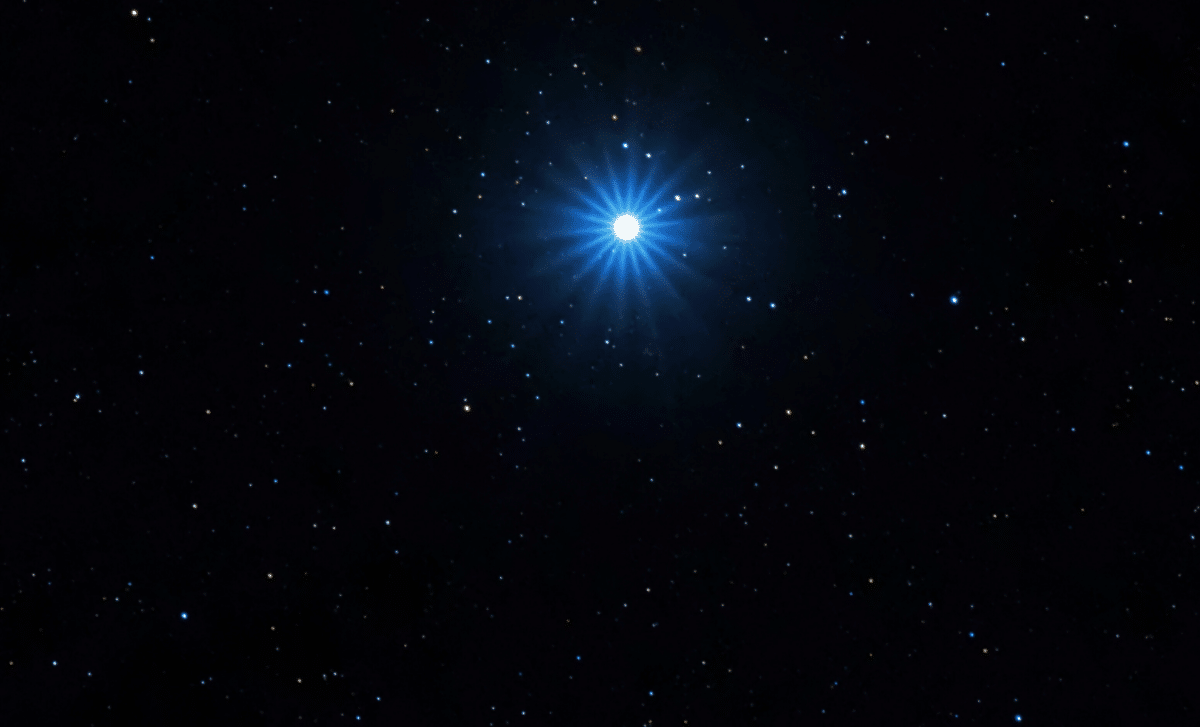
As the weekend of January 23 to 25, 2025 approaches, stargazers across the Northern Hemisphere are in for a celestial treat. The evening skies will offer spectacular views of Saturn, the waxing moon, and Sirius, the brightest star in the night sky. With a combination of planetary conjunctions and brilliant winter constellations, the weekend presents a perfect opportunity to reconnect with the stars.
Friday, January 23: A Farewell Dance Between The Crescent Moon And Saturn
The first evening of the weekend, Friday, January 23, features the last act of a captivating three-night celestial pairing: the waxing crescent moon and the ringed planet Saturn. As darkness falls, observers should direct their gaze toward the west-southwest, where a 26%-illuminated moon will appear just above Saturn’s golden glow. This moment marks not only a stunning visual pairing but also an astronomical shift, as Saturn continues its gradual descent toward the sun’s glare, slipping lower in the evening sky each night.
The close proximity of the two celestial bodies creates a helpful reference point for tracking Saturn’s movement in the coming weeks. While the moon will move on in its orbit, Saturn will fade from the night sky entirely by early March. For now, this final alignment offers one last chance to view the planet with ease. The visual contrast between Saturn’s steady amber light and the silver crescent moon is subtle yet striking, especially when viewed through binoculars or a telescope.
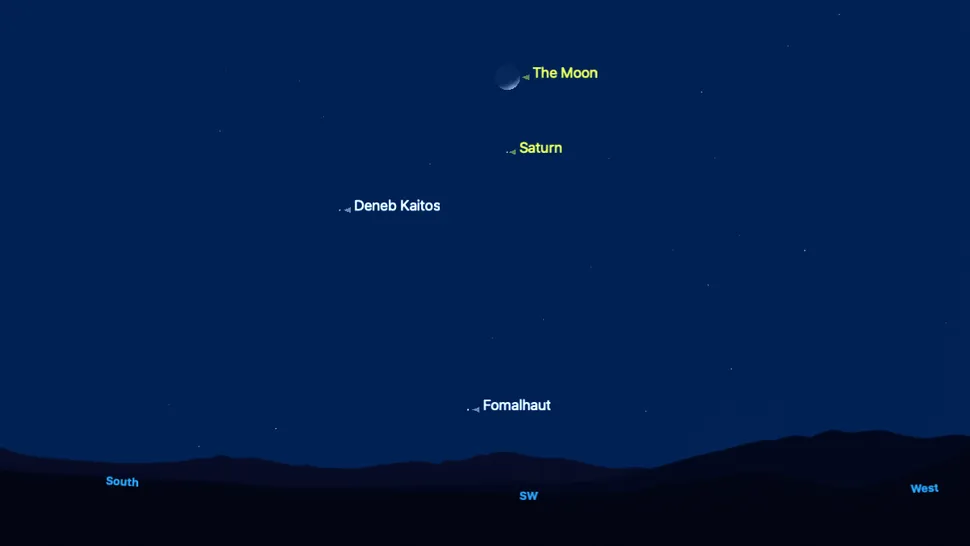 See a waxing crescent moon and Saturn on Jan. 23. (Image credit: Starry Night)
Saturday, January 24: Sirius, The Brightest Star, Takes Center Stage
Saturday night shifts focus from planetary wonders to stellar brilliance, as Sirius, the brightest star in Earth’s night sky, rises high in the southeastern sky after sunset. Located in the constellation Canis Major, Sirius shines just below Orion, making it easy to locate by following Orion’s Belt downward to the horizon. This proximity to one of the most recognizable constellations makes Sirius a popular target for casual and seasoned stargazers alike.
According to Space.com, Sirius owes its brilliance to both proximity and power. Only 8.6 light-years away, it’s one of the nearest stellar systems to Earth. But what many observers don’t realize is that Sirius is actually a binary star system, consisting of Sirius A, a massive blue-white star, and Sirius B, a faint white dwarf companion. Due to atmospheric turbulence, Sirius often appears to twinkle in red, blue, and white hues, adding to its mythical and captivating presence.
The star’s visibility near the horizon gives it an especially dynamic appearance, as its light filters through more of Earth’s atmosphere. This phenomenon produces a prismatic effect, often leading people to mistake it for a flashing aircraft or even a UFO. With clear skies, Saturday night provides an ideal window to observe this celestial beacon at its brightest.
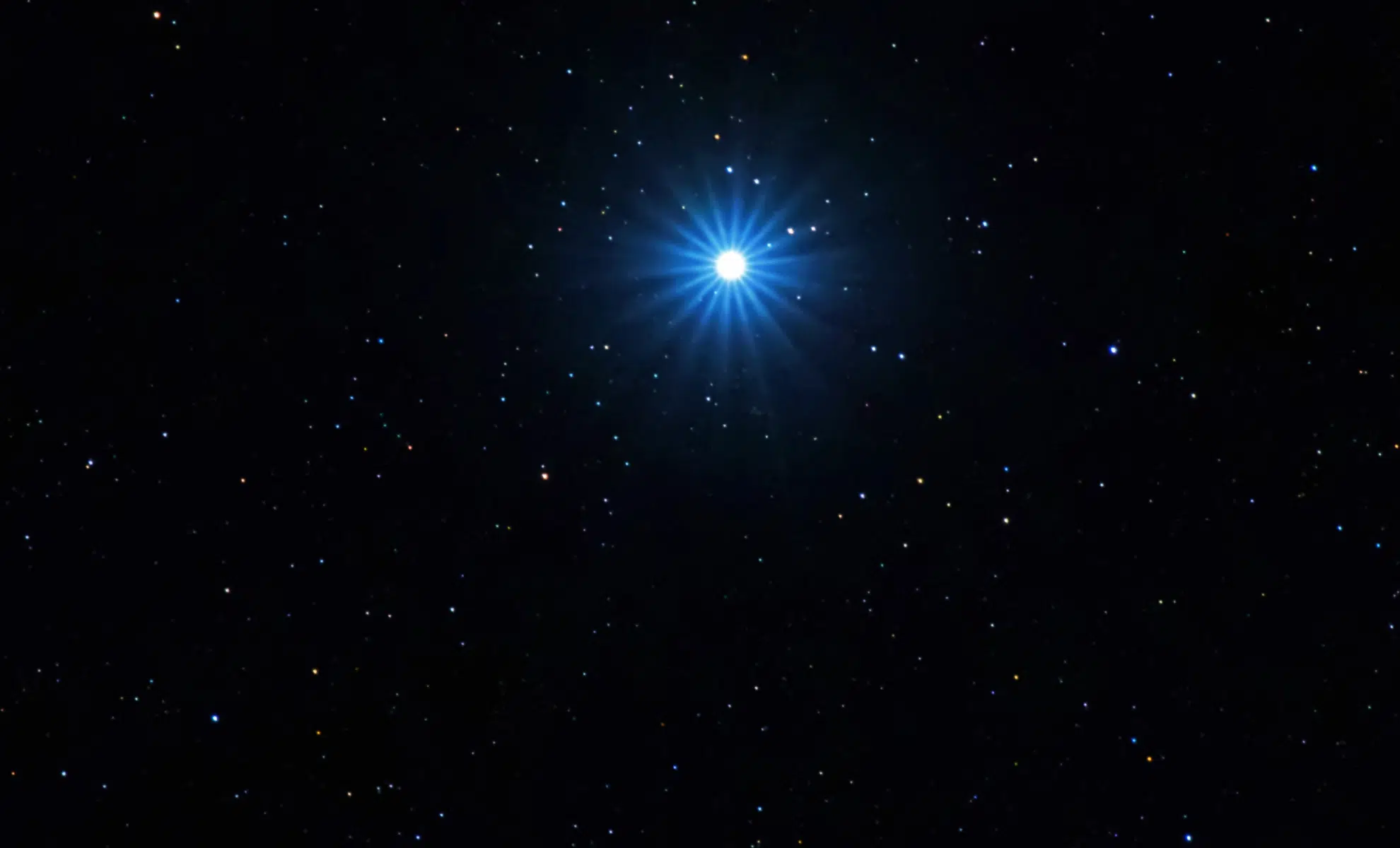 Sirius, the brightest star in Earth’s night sky. Credit: Canva
Sunday, January 25: The First Quarter Moon Highlights Lunar Geography
On Sunday, the moon takes center stage once more, reaching its first quarter phase and standing high in the southern sky after nightfall. Unlike the sharp crescent seen earlier in the week, the first quarter moon presents a perfect half-lit disk, which is ideal for observing lunar surface features. Along the boundary known as the terminator—the line dividing night and day on the moon, shadows cast by mountains and craters become most pronounced.
This lighting angle reveals crisp contrasts in the lunar terrain, making surface features like crater rims, ridges, and lunar highlands more visible than during any other moon phase. Using even a modest telescope or binoculars, viewers can trace the rugged surface and get a real sense of the moon’s complex geography. Space.com highlights this opportunity as one of the best times in the lunar cycle to appreciate the texture and structure of our closest celestial neighbor.
The elevated position of the moon in the sky during the evening hours also improves viewing conditions, as its light won’t be obscured by atmospheric haze. This combination of favorable lighting and optimal altitude makes Sunday an ideal night for lunar photography or simply an extended gaze into the moon’s battered surface.