Three is the magic number – or is it? For the Coronation Street actress Helen Flanagan, it was a one-way ticket to heartbreak.
As she details in extracts from her autobiography, Head & Heart, serialised by the Daily Mail and The Mail on Sunday this weekend, dating boxer David Haye while he was in an open relationship with his partner Sian Osborne almost destroyed her sanity.
She describes being in the grip of heightened paranoia, convinced that her house was being watched and that one of her neighbours was trying to kill her. ‘I’m as certain as I can be,’ she writes, ‘that my relationship with the world champion boxer David Haye, which had ended just weeks before, was a contributory factor to my breakdown.’
She goes on to describe how, having first met Haye in 2012 on I’m A Celebrity… Get Me Out Of Here!, she ran into him again ten years later at an awards ceremony. There was a connection, but nothing happened. Not long after, she read that he and Osborne were in an open relationship and looking to engage in a ‘throuple’.
Later, he got back in touch and there followed what sounds like a very traumatic relationship, which pushed her to the brink and ended acrimoniously.
And Haye had been here before, after The Saturdays singer Una Healy complained she had been ‘hoodwinked’ after dating him while he was with Osborne.
I must confess that, until relatively recently, I had never heard of the term ‘throuple’. It is not yet included in the Oxford English Dictionary (although surely it is only a matter of time), but essentially it means a polyamorous relationship where three people are romantically and/or sexually involved with each other.
It’s been described by its proponents as a form of ethical non-monogamy. Personally, I can’t imagine anything worse: I can’t even cope with one partner, let alone two.

David Haye with Una Healy (left) and Sian Osborne. Haye and Osborne were in an open relationship when Healy dated him

Helen Flanagan with her ex-partner Scott Sinclair. Helen has said her time with Haye was just about sex
It’s not the same as an old-fashioned love triangle, which tends to have an element of romantic tragedy about it. Think of Arthur, Guinevere and Sir Lancelot; of Henry VIII, Catherine of Aragon and Anne Boleyn; and, of course, Princess Diana and the current King and Queen.
There’s not much that’s romantic about a throuple. It’s more of a sex thing; indeed, in Haye’s case, almost exclusively a sex thing, by the sounds of it. When Flanagan bought him a Cartier bracelet for his birthday, he rang her and said he couldn’t accept it. ‘All I want from you is your body,’ he told her.
She writes: ‘This was the man who had rung me nearly every day for seven months and who claimed to want a baby with me. Now he was telling me I was only good for one thing. Did I mean anything to him?’
The answer, of course, is no. Men don’t always find meaning in sexual encounters. They are told they should, and society trains them to make all the right noises, but the emotion is often performative.
Which is presumably why throuples are on the rise. They enable men to indulge their sexual urges while exonerating them from disapproval through the notion that the other parties agree. Not so much ethical non-monogamy as ethical infidelity.
But what about the women? Are they truly comfortable with these sorts of arrangements, or are they just going along with them to keep their men happy? Judging by Flanagan’s experience, I have a feeling it’s the latter.
A similar thing happened to the singer Lily Allen with her erstwhile husband, Stranger Things actor David Harbour. The story goes that they were in an open marriage, but it seems that Allen didn’t quite grasp the extent of his appetite for other women.
On her break-up album, West End Girl, she details her shock, anger and heartache on the track Madeline. ‘We had an arrangement, be discreet and don’t be blatant/There had to be payment, it had to be with strangers,’ she sings, before adding: ‘But you’re not a stranger, Madeline.’
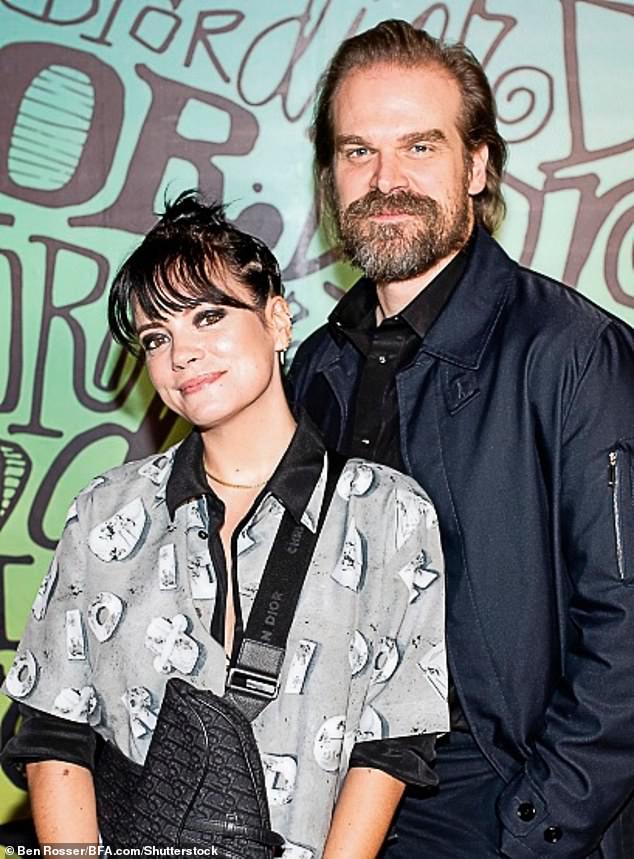
Lily Allen and David Harbour separated after they opened up their marriage, but David pushed the boundaries
Later, she sings about visiting an apartment where she thought her husband was practising karate, only to find a room strewn with sex toys and ‘a shoebox full of handwritten letters from broken-hearted women’.
Who would have thought someone like Harbour would have so much in common with someone like Haye? But their behaviour is essentially the same: an inability to contain or curtail their sexual urges and an assumption that they are entitled to have those needs met, regardless of the consequences for others.
Truth is, men and women think differently about sex. There are always exceptions, of course, but broadly speaking men are biologically programmed to have as much sex with as many partners as possible, and women are programmed to lock in one partner who can then be protector and provider for their children.
What the notion of a throuple does is dress that selfish desire in the cloak of progressive modernity. It turns promiscuity into some sort of societal choice, makes it sound all modern and fun and liberal. But if it walks like a cheating, gaslighting piece of trash and quacks like a cheating, gaslighting piece of trash, chances are it probably is one.
At the end of the day, a throuple is just an excuse for men to act like weapons-grade scumbags – and get away with it. The ‘consensual’ element is the key. If it’s all by ‘arrangement’, as it is in a throuple, then no one can really complain. You knew what you were getting yourself into, the gaslighting goes, so you can’t really get upset about it.
That is how the male brain (or perhaps I should say the organ that so often stands in for the male brain) works. But that’s not how human emotions work, and it’s especially not how women’s emotions work.
With women, the ‘consensual’ element in these situations is often more of a case of coercion. Contrary to what your average porn script would have you believe, most women are not gagging to have a threesome with another woman. That’s just another male fantasy that has found its way into mainstream culture thanks to the pornification of society.
But women are programmed to please, and so they go along with things. They hope – as maybe both Flanagan and Allen did – that the person will change their ways out of love and respect for them. They think that if they acquiesce, if they turn a blind eye, this will somehow buy them that love and respect. Truth is, it never does.
That’s what happened with both Haye and Harbour: they appear to have abused the arrangements they had, interpreting their partners’ acquiescence as carte blanche to do whatever they wanted. And while they were happily having their cake and eating it, the women concerned were slowly losing their minds.
If a man wants an open relationship, that is not a sign of modernity or progressiveness. It is the exact opposite; a red flag that immediately signals a palaeolithic mindset, which no amount of money or fame can conceal – or, for that matter, make up for.