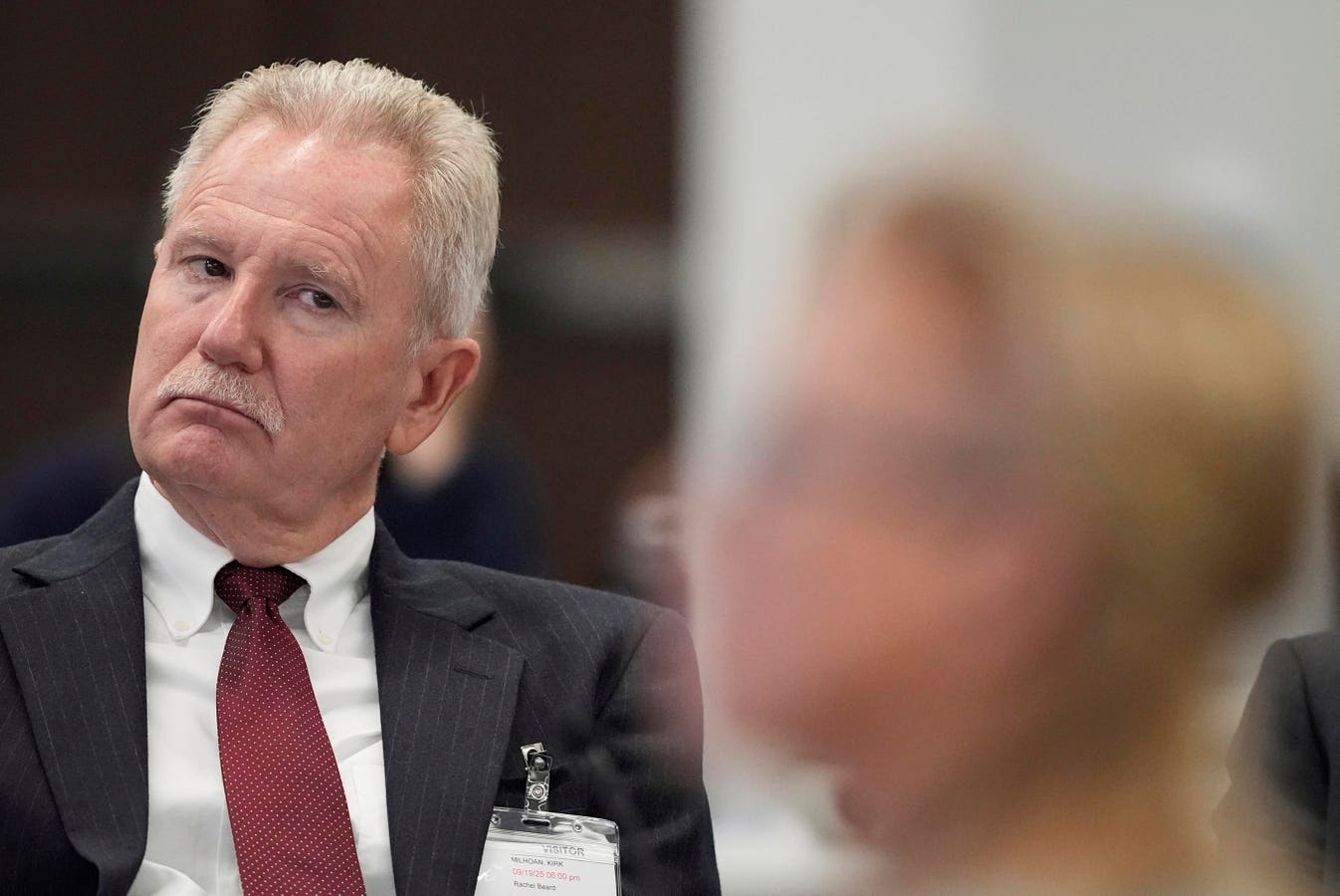
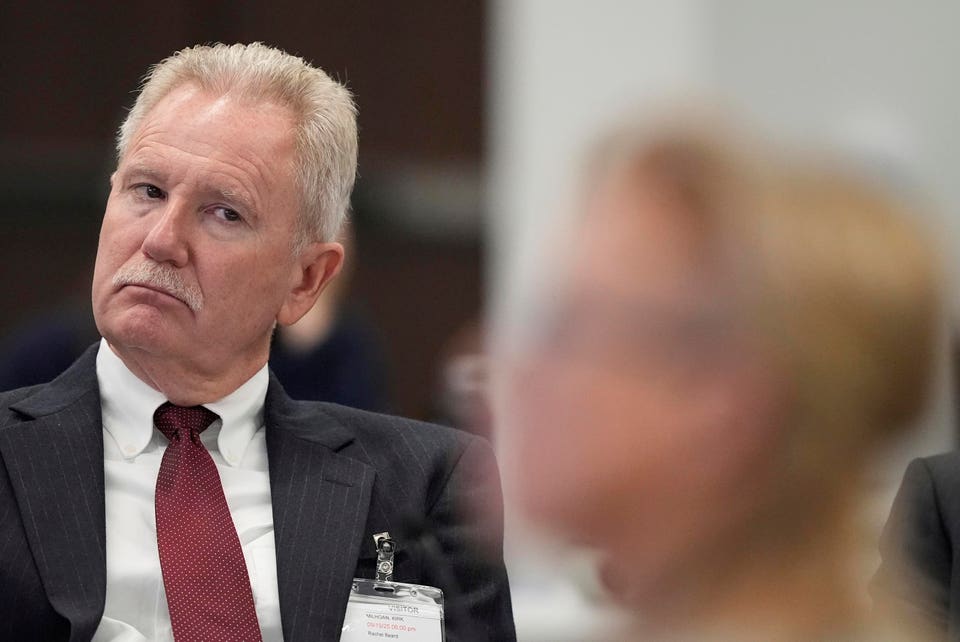
Committee member, Dr. Kirk Milhoan, speaks during a meeting of the Advisory Committee on Immunization Practices at the CDC on Thursday, Sept. 18, 2025, in Chamblee, Ga. (AP Photo/Brynn Anderson)
Copyright 2025 The Associated Press. All rights reserved.
The new chair of the federal vaccine advisory committee made some unexpected and controversial comments during an interview on the podcast “Why Should I Trust You?”
Dr. Kirk Milhoan’s said that personal freedom should be the “north star” for the Advisory Committee on Immunization Practices panel he now leads and should take precedence over other societal considerations. This is a striking shift and reversal of the prior focus from this Centers for Disease Control committee, which focused on public health.
Last year, after Robert F. Kennedy Jr. was appointed secretary of Health and Human Services, he fired the previous ACIP committee and hand-picked new members, many of whom have expressed skepticism about vaccines, including Milhoan. He has not responded to my attempts to contact him.
Who Is Kirk Milhoan?
Milhoan, a pediatric cardiologist who also serves as the senior pastor of Calvary Chapel South Maui, has said he believes that “We endeavor to show a Christ-like love to all men.” He garnered some controversy early in the COVID-19 pandemic for not requiring masks or social distancing at the church. He is also a senior fellow at the Independent Medical Alliance, a group that recommends (now debunked) ivermectin as prophylaxis and treatment for COVID-19, along with hydroxychloroquine and a variety of nutraceuticals.
Milhoan’s appointment has prompted questions about the relevance of his clinical specialty in cardiology to the committee’s traditional public health role. He believes that vaccines cause cardiovascular disease, which fits with Kennedy’s criticism of many vaccines.
In the podcast, Milhoan emphasized, “What we are doing is returning individual autonomy to the first order, not public health, but individual autonomy to the first order.” He made several controversial statements, receiving quick pushback online.
While emphasizing freedom and autonomy in decision-making, Milhoan said, “I also am saddened when people die of alcoholic diseases.” But here he is missing that opting out of vaccines puts others around them in danger — more akin to drunk driving than an individual dying of alcoholism.
The ACIP has drastically cut recommended vaccines, eliminating routine COVID-19 and flu shots, among others. Many states are choosing not to follow these recent recommendations. Through 2026, insurers are following the vaccination schedule recommended by the American Academy of Pediatrics.
Personal Freedom VS. Public Health: Science
Milhoan rejected decades of established epidemiological research. “I don’t like established science,” he said. “Science is what I observe.”
He therefore suggests making all vaccines optional, including polio and measles vaccines, which have historically been associated with significant reductions in disease incidence. Polio and measles immunizations are mandatory for school enrollment. Milhoan suggests that “trust” in public health would be restored if the immunizations were voluntary.
Milhoan further suggests a detailed informed consent from parents, although consent is already obtained by practitioners. He wants parents to assess the risks specifically for their families — although 21% of adults in the U.S. were illiterate in 2024 and 54% had literacy below a sixth-grade level. Many parents might be unable to independently read medical literature and evidence to evaluate risks and benefits for their children. This is why we rely on experts and consensus statements from knowledgeable people in a specific field.
Polio
One of Milhoan’s arguments against polio vaccination is that “we are in a different time now than we were then. Our sanitation is different, our risk of disease is different, and so those all play into the evaluation of whether this is worthwhile of taking a risk for a vaccine or not.”
But Milhoan hasn’t been able to observe polio outbreaks precisely because vaccination has been so successful globally and has eliminated them (except in Pakistan and Afghanistan). Improved sanitation was a sort of double-edged sword. Young children frequently got very mild polio from fecally contaminated water. As the water was cleaned, kids who hadn’t yet developed immunity became more severely ill when challenged by the virus later and became paralyzed.
Public health experts warn that a decline in polio vaccination will likely lead to the re-emergence of paralytic disease.
Measles
Similarly, Milhoan argues that because “we take care of children much differently now,” the risks of measles might have lessened.
We have the highest rate of measles now than in more than 25 years. Last year, three unvaccinated children died. Measles is not benign. About 1 in 5 need to be hospitalized. There are serious complications of pneumonia (1 in 20), encephalitis (brain swelling) in 1/1,000, deafness in many and deaths in 1-3/1,000. Subacute sclerosing panencephalitis (brain inflammation), a late complication, occurs in 1 in 600, and is fatal. Measles also causes immune amnesia, wiping out immune memory and leading to immunosuppression that may last up to three years.
Milhoan suggests eliminating polio and measles vaccines as an opportunity for observation. “What we’re going to have is a real-world experience of when unvaccinated people get measles,” he said, asking, “What is the new incidence of hospitalization? What’s the incidence of death?”
Elizabeth Jacobs, Ph.D., a retired epidemiologist at the University of Arizona and co-founder of Defend Public Health, commented on BlueSky, “This interview with Kirk Milhoan is one of the most disturbing things I’ve seen in my entire career.” In an email interview, she added, “Instead of viewing the declining vaccination rate as a tragedy in the making, Milhoan seems to view it as an opportunity to study the effects of measles infections in children. But we already know what will happen from extensive data. Kids will get sick, be hospitalized, and die — all from a disease which could be prevented with a vaccine.”
Public Health Or Autonomy?
Traditionally, the CDC’s ACIP has been charged with improving public health.
Jim Alwine, an immunobiologist currently working at University of Arizona, concluded, “If one believes in Christian teachings and mercy for the weakest and the poor, you could never consider an unethical experiment limiting vaccines to see how pathogens will do when the playing field is leveled. History tells us the answer: the pathogens win. But Kennedy and his followers are doing this experiment, limiting vaccines and promoting doubt about them. They call it a freedom of choice about using vaccines, but this freedom has a terrible cost, the death of children. But they want us to accept that cost; they call it the cost of doing business. That’s simply diabolical.”