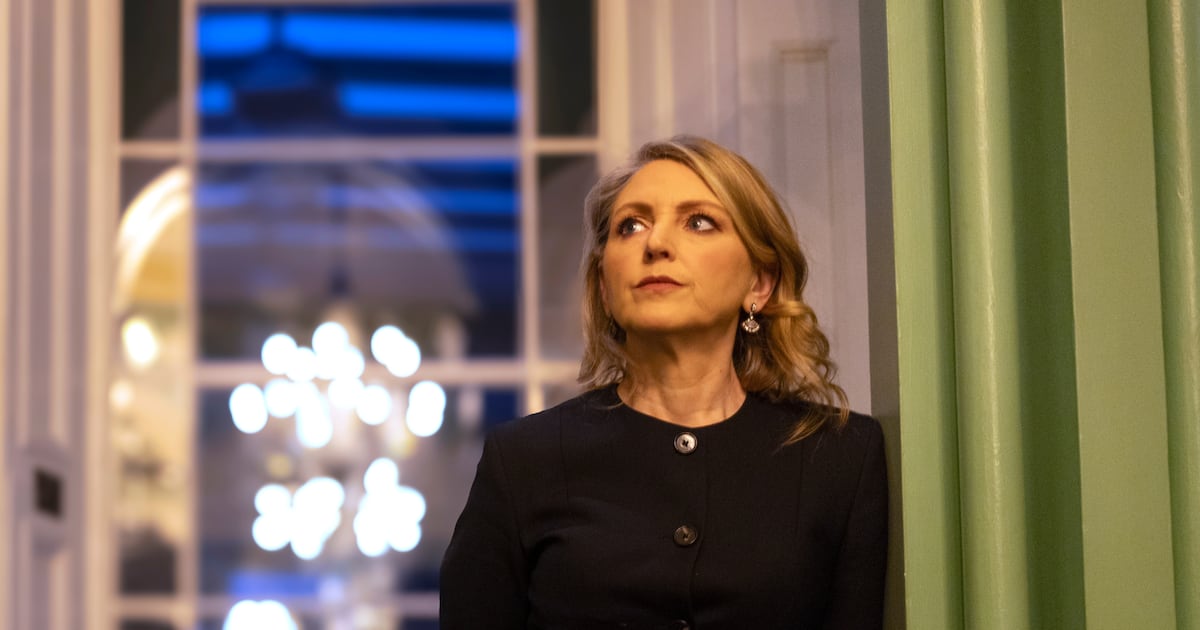
A couple of years ago, international human rights lawyer Caoilfhionn Gallagher decided to undertake a life and career audit. “It was a bit of a midlife crisis in some ways,” she smiles, over a Saturday morning breakfast of pancakes and tea in Dublin’s Shelbourne Hotel. “I decided to Marie Kondo my life”.
Emulating Japanese organisation guru Kondo saw Gallagher do a stock take of her career. She realised she was stretched too thin, that there were other barristers who could take over her cases. Kondo famously advocates getting rid of anything that doesn’t “spark joy”. “I’d been practising at the bar in England and Wales for a really long time and I loved my work but life is short, and there were other areas where I needed to focus”.
A Dubliner based in London for the past two decades, Gallagher’s Marie Kondo mission also inspired a decision to devote more time to her work “in and about Ireland.” This was her motivation for taking up the role of Special Rapporteur for Child Protection to the Irish Government using her extensive international experience with young people to improve lives in her home country. She spoke recently in that role about nudification apps including Grok, making the important point that 99 per cent of the sexually explicit deepfakes accessible online are of women and girls. “This is a gender-based violence issue,” she told RTÉ’s Morning Ireland. Regarding the child protection role she says “it sounds cheesy, but I wanted to give back”.
By any objective standards, Gallagher was already giving a lot. Her daughter, one of her three teenagers, once described what her mother does as “sad law”. Gallagher represents journalists who are targeted or wrongfully detained by oppressive regimes. She works on historic injustices through inquests and tribunals, fighting legal battles for survivors of mother-and-baby homes and families of victims of mass-tragedies such as Hillsborough or the London bombings. She supports the Irish in Britain and women’s rights campaigners in countries such as Afghanistan and Iran. She campaigns on child marriage and abortion rights. “Sad law,” no doubt, but for Gallagher it is also deeply satisfying law and work that she describes as “an honour, a privilege”.
A good deal of it involves representing the bereaved families of murdered journalists. As she talks about them, she rummages through her phone for photos of the people she has become close to over the years. “I do a lot of work with these families, it’s a specialist area I wish did not exist, trying to seek accountability and justice for them. Every bereaved family wants something slightly different … but most of them want answers and accountability. They are driven by the need for change to ensure no other family goes through what they are going through.”
She is currently writing a book on the subject, but again in an attempt to refocus her work, she wants to concentrate on much-needed systemic changes.
“These individual cases are important but there is a much bigger systemic problem. We don’t have good international systems for dealing with the deaths of journalists. The way international law works is that it’s all focused on the individual country. And of course if you’re a journalist killed in South Sudan, as one of my clients was, or another client who was killed in Libya, those countries are not going to take action or hold authorities to account for what happened. Saudi Arabia is not stepping up to account for what happened to Jamal Khashoggi. So we have a real accountability gap there,” she says. She argues that the world systematically fails to support journalists before they are killed and that they are failed again in death.
She talks about one of her clients, Filipino journalist Maria Ressa, who won the Nobel Peace prize for exposing political corruption on her website Rappler, which authorities tried to shut down. Ressa had been targeted by the regime of former Philippines president Rodrigo Duterte, Gallagher says, with spurious charges amounting to “conspiracy to commit journalism”. She represents Ressa with co-counsel Amal Clooney. (She won’t be drawn on that colleague or Clooney’s famous husband George, except to say “she is my dear friend”.) Another client, José Rubén Zamora, in Guatemala, has been in prison for more than three years on money-laundering charges viewed as a retaliation for anti-corruption coverage in his newspapers.
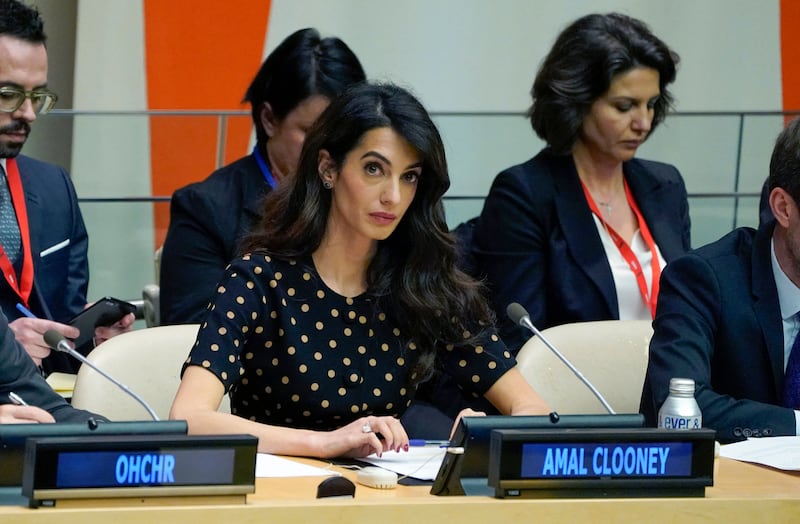 British-Lebanese barrister Amal Clooney. Photograph: Timothy A Clary/AFP/Getty
One of Gallagher’s most high profile clients is Hong-Kong based Jimmy Lai, founder of pro-democracy newspaper Apple Daily who was imprisoned accused of fraud. Her work with Lai led to her being declared an “enemy of the state” by the Chinese.
While she still retains a connection to prestigious Doughty Street Chambers in London, where colleagues include Baroness Helena Kennedy and Clooney she has, Gwyneth Paltrow style, “consciously uncoupled” from her work there in order to focus more on the systemic changes she wants to help make internationally.
In addition to her barrister practice Gallagher is a member of the Irish Human Rights and Equality Commission, a board member of the Committee to Protect Journalists, a fellow of the Royal Society of Arts and an adjunct professor at her alma mater, UCD. The day before we meet, she had given a keynote speech to the Law Society’s Voluntary Assistance Scheme, a pro-bono programme connecting charities and civil society groups with volunteer barristers. A keen writer and reader, she’s also just been appointed to the board of the Women’s Prize for Fiction. I can’t help wondering, how much sleep does she get? She laughs, saying she was an insomniac for a lot of her youth and even now only gets around four or five hours a night, “probably the only thing I have in common with Margaret Thatcher”.
Gallagher has said that anybody who knew her at school in Portmarnock Community College, where she was a keen debater, would not be surprised to learn she argues for a living. She grew up in a house “full of books and big ideas” with a mother and father who had a dim view of the influence of television on young minds. She and her one sibling didn’t have a TV until their late teens. Her mother Eithne, a midwife and later a teacher in Darndale, remains a big influence. She told her children they could do anything but that whatever they did they should “be kind”. Her father is in a care home; she visits him regularly. Another formative influence, he was a civil servant and a numismatist, a collector of specialist coins.
After completing her law degree in UCD, Gallagher went on to King’s Inns and became “a baby academic”, teaching at Trinity and UCD for two years. She went to Cambridge in 2001 to do a master’s in human rights. “It ended up being a life-changing year because suddenly I was in the UK being taught by some really amazing international and human rights lawyers at a time when we were seeing how the US and the UK in particular were responding to 9/11. There was a real crackdown on civil liberties in the name of national security.”
This led to her decision to work more in that area. She began working with Liberty, the National Council for Civil Liberties. Her career in human-rights law thrived, she took silk in 2017, and that one-year stint away from home turned into more than two decades.
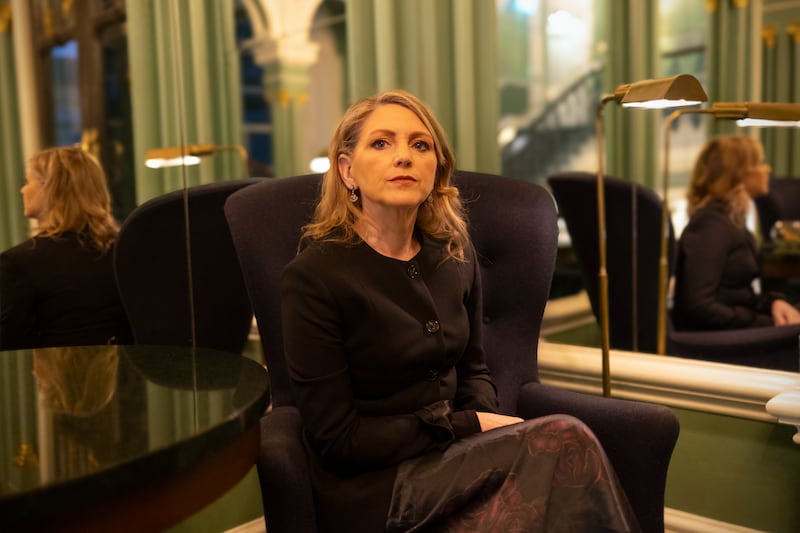 Caoilfhionn Gallagher at the Shelbourne Hotel in Dublin. Photograph: Chris Maddaloni
This will be a milestone year for Caoilfhionn Gallagher KC. She will turn 50 in November but even more significant, she says, is the fact that it marks 30 years since she was almost killed in a car accident while crossing the road near UCD. Her legs were broken and she thought she might be paralysed. There were multiple injuries to her body and face and she has a memory of coming round from the accident as medics were “stitching the top of my head”. She spent a year in a wheelchair, which led to her campaigning for disability access on campus, work that fuelled her already well-honed sense of justice. She’s now planning her 50th birthday celebrations. “I think I might have a survival party, it being 30 years since the accident. I was lucky to survive,” she says.
There was a huge audience reaction to Gallagher’s appearance on a recent Tommy Tiernan show where she spoke about threats against herself and her family. She was physically assaulted once at her workplace and these threats have also included attempts to hack her bank accounts, and abusive messages threatening violence and rape.
“Even when you know they are being sent by someone quite far away and they’re unlikely to carry it out, the reality is if you wake up, particularly in a hotel room on your own, and it’s five in the morning and you’ve been sent this graphic material where they know where you are and they know your kids’ names, it’s frightening.” She paraphrases Sinéad O’Connor, saying “even when you are being brave it doesn’t mean you are not terrified”. She became emotional talking to Tiernan about this.
“I’m quite used to having a professional veneer and not talking about it too much, but I ended up saying a bit more than I intended to,” she says, praising the presenter’s “disarming” interviewing technique.
These threats, she says, often take the form of misogynistic, grotesque memes. She mentions assassinated Maltese journalist Daphne Caruana Galizia. “Before she was killed a lot of the abusive material sent to her was about her appearance.” Gallagher now works with Galicia’s sons, journalists and activists, who are fighting for justice for their mother.
Like many people, I’ve had recurrent miscarriages, fertility issues, a young family and a busy job that has taken me all over the world
— Caoilfhionn Gallagher
Often, many of the threats against Gallagher have disparaged the size of her body – she was a larger woman until relatively recently. As part of her recent life reset she went on a health kick, responding to medical advice. “My father had a pretty catastrophic stroke in his 50s and I was reaching that age,” she says. While she has no judgment about people who use drugs for weight loss, she employed more old-fashioned methods herself, buying a Peloton for exercise and overhauling her diet.
“I’m an all or nothing person, so I went all in,” she explains in terms of her disciplined approach. She lost more than six stone and while happy about the health benefits, she says she has complicated feelings about the compliments she receives for being in a smaller body.
“When people praise how you look now, it’s kind of an insult to what you looked like before,” she explains. “I am very careful to say that I am proud of what I looked like in the past. I was a plus-sized person for a long time and I am not embarrassed by that. Like many people, I’ve had recurrent miscarriages, fertility issues, a young family and a busy job that has taken me all over the world. I am proud of the plus-sized body that carried me through all of that.”
[ Malta’s government bears responsibility for journalist’s murder, inquiry findsOpens in new window ]
She has had eight miscarriages in all. “That started 20 years ago. People didn’t talk about pregnancy loss then; we talk about it much more now, which is good because it’s a very lonely experience,” she says.
She says a move back to Dublin is on the cards sooner rather than later even if it’s logistically challenging with three teenage children and a husband – she met the former academic turned civil servant while studying at Cambridge.
Being based in Ireland will help with one of her more ambitious plans. For years, she’s been getting letters and emails from Irish law students keen to get involved in human rights who believe they have to move to London or elsewhere in order to pursue that line of work. She feels strongly that the “talented, very brilliant” young Irish lawyers with an interest in human rights should not have to travel abroad. She wants to establish a human rights centre of excellence in Ireland. “I’d like to be building teams and working with people here, in social justice and human rights work. We have a wealth of expertise, brilliant academics, brilliant diplomats … I think we can and should be doing a lot of this work in Ireland.”
Not surprisingly, given the nature of her work, Gallagher is conscious of the need for self-care, something the legal profession has been more attuned to in recent years. “I am often working with people on the worst day of their lives, with victims of child sexual abuse or trafficking, survivors of gender based abuse or bereaved families. You’ve got to do the best possible job for them and you can’t do that while you are struggling yourself.”
She has attended therapy sessions and switches off by watching the kind of “chewing gum for the brain” TV that would horrify her father. Traitors is one current distraction. She’s also been enjoying a relatively new passtime, flying, which she does mainly from the small London airport Biggin Hill.
A woman of warmth, generosity and intellectual rigour, Gallagher is also an optimist, a quality that is essential, she believes when grappling with human rights. One of her favourite quotes comes from activist Margaret Mead: “Never doubt that a small group of thoughtful, committed citizens can change the world.”
“You can achieve great things with determination, drive, focus and vision. I see it all the time. I see clients who have walked through fire and come out the other side determined to change the world for the better,” she says. She mentions her friend the Washington Post journalist Jason Rezaian who was wrongfully imprisoned in Iran for nearly two years. “He managed to get out and now spends a huge amount of time supporting other people who have been wrongfully detained and trying to improve systems for people, to make the world a better place. And I feel strongly that if someone like Jason can do it, we all should.”