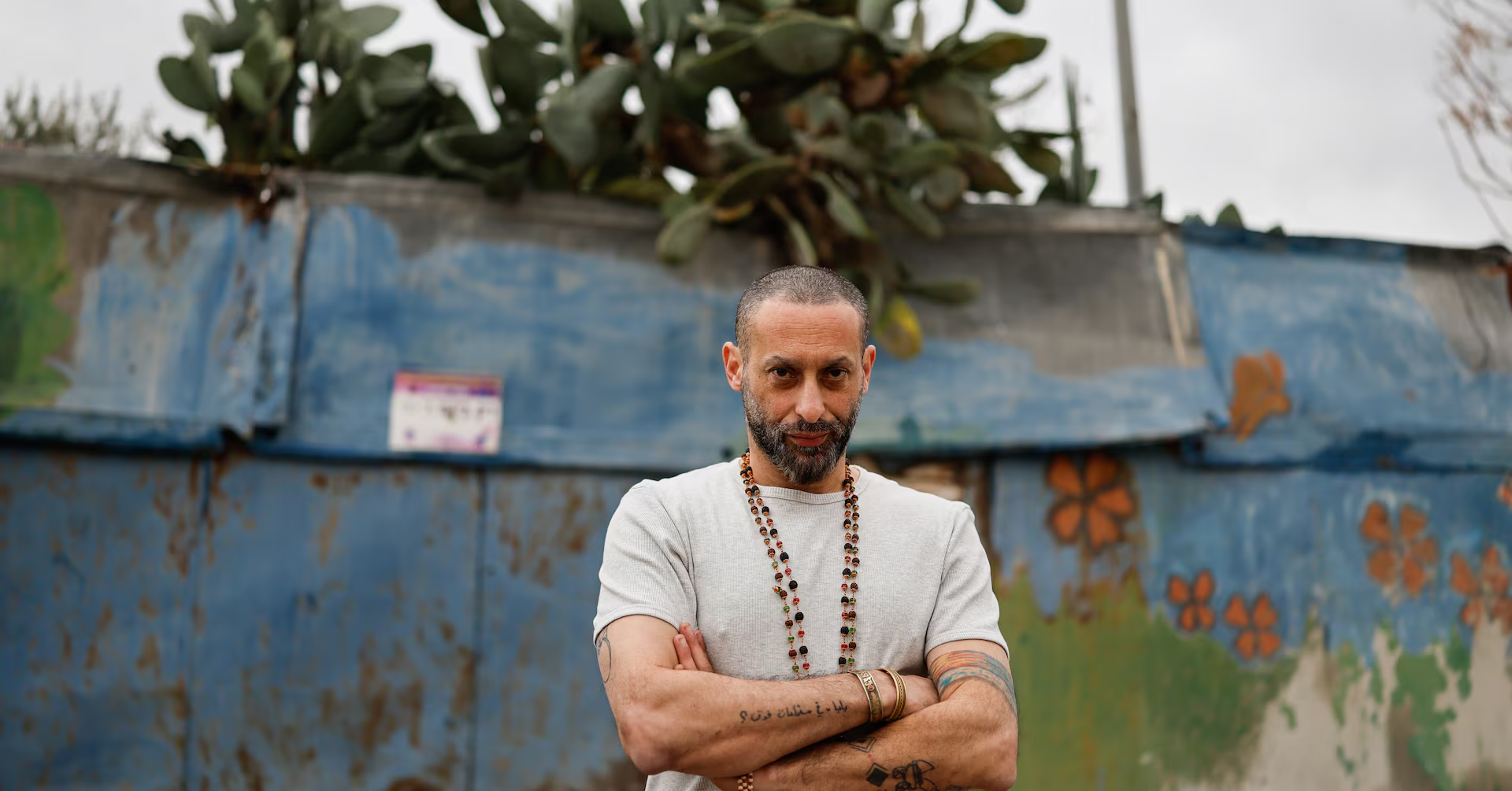
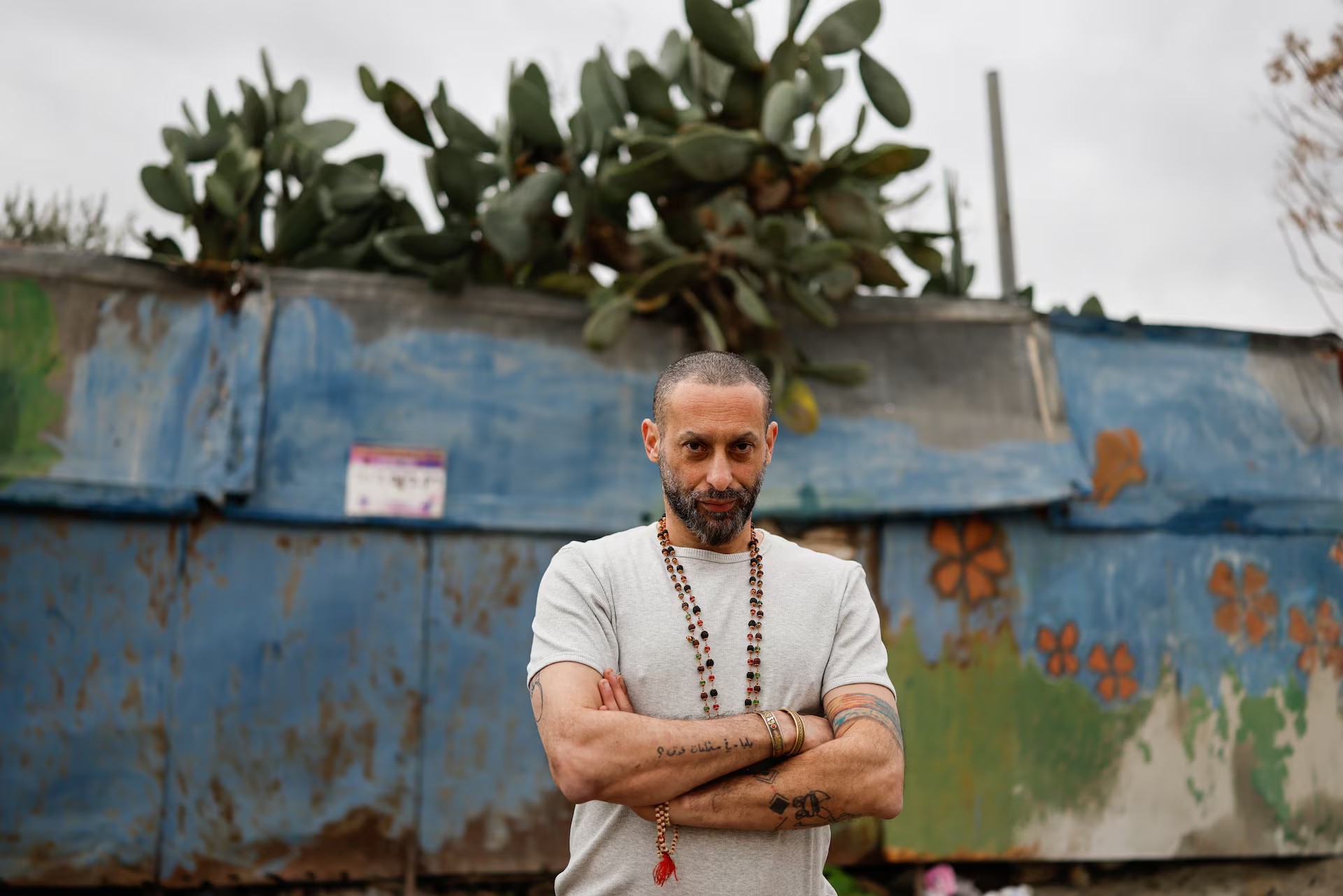
Tamer Nafar poses for a portrait near his home in Lod, Israel, January 14, 2026. REUTERS/Amir Cohen
“The only reason I can speak English is because of hip hop,” Tamer Nafar raps in his new album, “In the Name of the Father, the Imam & John Lennon.” “I owe my life to this culture / I can exchange cultures now, teach you about mine.”
Widely regarded as the godfather of Arabic hip-hop, Nafar this week released his first English-language album and will soon embark on his first solo European tour — the latest chapter in a career that has also spanned into screenwriting and acting, including his award-winning 2016 film, “Junction 48.” Although he completed much of the record before the pandemic, Nafar says the project remained shelved for years — until the war in Gaza gave it a renewed urgency.
Speaking with Reuters from his hometown of Lyd (or Lod, in Hebrew), a mixed Arab-Jewish city just 20 minutes outside Tel Aviv, Nafar discusses the influences behind his new album, the challenges of performing in Israel since the Oct. 7 Hamas attack in 2023, and whether he’ll repeat his call for his fellow Palestinian citizens of Israel to vote in the upcoming Israeli elections.
This conversation has been edited for length and clarity.
Album cover of “In the Name of the Father, the Imam & John Lennon.” by Tamer Nafar. Courtesy of Borkowski Arts/Handout via REUTERS
What was your relationship to music growing up?
If you see the cover of the album, that’s my dad. That was before he became a father. I knew my dad as a conservative, religious man. For the last two-thirds of my life, I knew him in a wheelchair.
My dad only had two CDs in his car: the Quran and the Beatles. He didn’t know how to speak English; he just liked the music. And even though he was conservative and he was in a wheelchair, he used to take us to clubs, just so we can perform. We used to lift him (down) the stairs and he would just be (surrounded by) half-naked women smoking joints, a lot of alcohol. He didn’t care. He was just proud watching us.
Before he became a father, he got interested in music and brought the first electronic guitar to Lyd back in the ’60s. He started a band and his brothers joined him and they became wedding singers. But then he got married and he had a lot of financial problems, so he had to quit. He found himself working in boilers and plumbing until he had an accident that (broke) his spine. And that was it for his music. But I can always see his face (light up) when we went to a studio. I’m proud that he saw us doing it as a profession.
You went on to found the first Palestinian hip-hop group, DAM, in 2000. What was that experience like, especially as a Palestinian growing up in Israeli society?
It’s really layered because I’m a human being first of all, then I’m an Arab and then I’m a Palestinian, then I’m a Palestinian living inside Israel. But even here, we have different levels. I’m not from the north (of the country). I’m from the city of Lyd. It’s a bit different; it’s disconnected, culture-wise. I started Arabic hip-hop back in ’99. Nowadays, you have dozens of rappers (and) all of them are from Haifa, from Acre. From Lyd, where it started, it’s only us.
When I released my first single, it was number one on the radio in the north. We don’t have a radio here. It took them a month to call me and tell me that it’s number one because they were looking in the north. They didn’t even think that art can come from Lyd, from the center. So no, it was unique; it was different.
Your new album has been years in the making, but you said it took the devastation of Gaza for you to feel “a deep urgency” about it. What made now the right moment to release it?
It’s that non-existing feeling. It took a while for the people and the world to notice Palestine, because of the Gaza catastrophe. It just felt like there was a threat on our existence.
Before Gaza, I was feeling (like I was) fading out because we, Palestinians who are living in Israel, suffer from one of the biggest catastrophes: Arab-on-Arab crime.
We’ve been losing a lot (of people). Five people were killed yesterday, three two days ago. And we’re only (a population of) 2 million. I just felt that we are ceasing to exist, physically. I lost my cousin a year ago, my wife lost her cousin a year ago. People are vanishing. So I just thought, before I vanish, I want to release more music; to exist in art.
Tamer Nafar poses for a portrait near his home in Lod, Israel, January 14, 2026. REUTERS/Amir Cohen
Tamer Nafar poses for a portrait near his home in Lod, Israel, January 14, 2026. REUTERS/Amir Cohen
Tamer Nafar poses for a portrait near his home in Lod, Israel, January 14, 2026. REUTERS/Amir Cohen
You’ve written about the challenges you’ve faced as a Palestinian artist in Israel. What has your experience been like since Oct. 7?
I used to have around 160 shows per year. Since Oct. 7, I only did two shows. It’s lonely, it’s heartbreaking. But somehow it makes you feel that, okay, then I’m doing the right thing. If I’m pissing off the wrong people, then I’m doing the right thing.
It isn’t something that came (about) suddenly. If you go back to 2015, when “Junction 48” was nominated, we managed to create a lot of buzz. We won the best movie for (the Berlin Film Festival), the best movie in Tribeca, and we were creating noise around the world. When we came here, we were (welcomed back) by the new Minister of Culture, Miri Regev, who decided that every time I’m going to do a show, she’s going to try and stop the show. Back then, she didn’t manage to shut down shows. And everybody was like, “Oh, you beat her, you won!”
Then a year after, I had less shows. Why? Because producers and halls starting self-policing. If I want to rent a hall to do a show, it’s like, “It’s going to make the minister mad, so maybe not.” She didn’t have to cancel shows anymore, you know? She just planted (fear).
So it’s not like it came out of the blue. Six months before Oct. 7, I had a show in front of 5,000 people and in the middle of the show, 12 policemen tried to stop the show. You can see the video, (in which) the policeman (is) saying, “I’m stopping it because he’s inciting against Israel,” or something like that. When Oct. 7 happened, I tried to do a few shows. The police canceled it the same day, at the beginning with excuses. (Now,) they don’t need excuses. (Editorial note: Israel’s police spokesperson did not immediately respond to a request for comment.)
Tamer Nafar of Dam, an Palestinian hip-hop group, performs during a concert in the West Bank city of Bethlehem February 17, 2007. REUTERS/Eliana Aponte
You’ve used your platform to advocate on a number of issues, from combating violence against women to encouraging Palestinian citizens of Israel to vote in the 2019 elections. As Israel prepares to return to the polls this year, how are you thinking about participation now?
I have no idea. I mean, honestly, I don’t know. Sometimes you go like, “Yeah, I’ll participate to make a change.” But at the same time, changing what? I don’t feel like being part of this game. But at the same time, I’m really worried about the future of the Palestinians here, beyond the massacres and the big things that we cannot control. I don’t believe it could (make) a huge change, but sometimes you need small changes just to stay alive so that tomorrow can come and you can see a better view.
Me myself, I think I will vote — not because I believe it’s a democracy, (but) because that’s the only tool I see for now. Do I think it’s going to stop the massacre in Gaza? No. Do I think it’s going to stop settlements? No. Do I think that it’s going to stop the massive tsunami of Arab-on-Arab crime here? No. It’s like an Advil to what we are facing now.
Beyond your tour, you also have a novel coming out later this year. What can you tell us about “Three Gs”?
The first novel, it’s in English, is going to (be released) around December. I call it an imaginary memoir. It’s (about) three generations in Palestine: One is my dad writing his memoir, back in the ‘50s, ‘60s, and ’70s. I’m the second generation, and there’s another third memoir, but it’s going to be written around the year 2040 by my unborn daughter. So it’s just three generations in Lyd.
The second one is coming out in 2027. It’s too (early) for me to talk about it, but I’m working with an amazing Lebanese illustrator, Tracy Chahwan. There’s a lot to accomplish.
The perspectives expressed in Culture Current are the subject’s own and do not necessarily reflect the views of Reuters News.
Sign up here.
Editing by Jennifer Hicks and Aurora Ellis
Our Standards: The Thomson Reuters Trust Principles., opens new tab