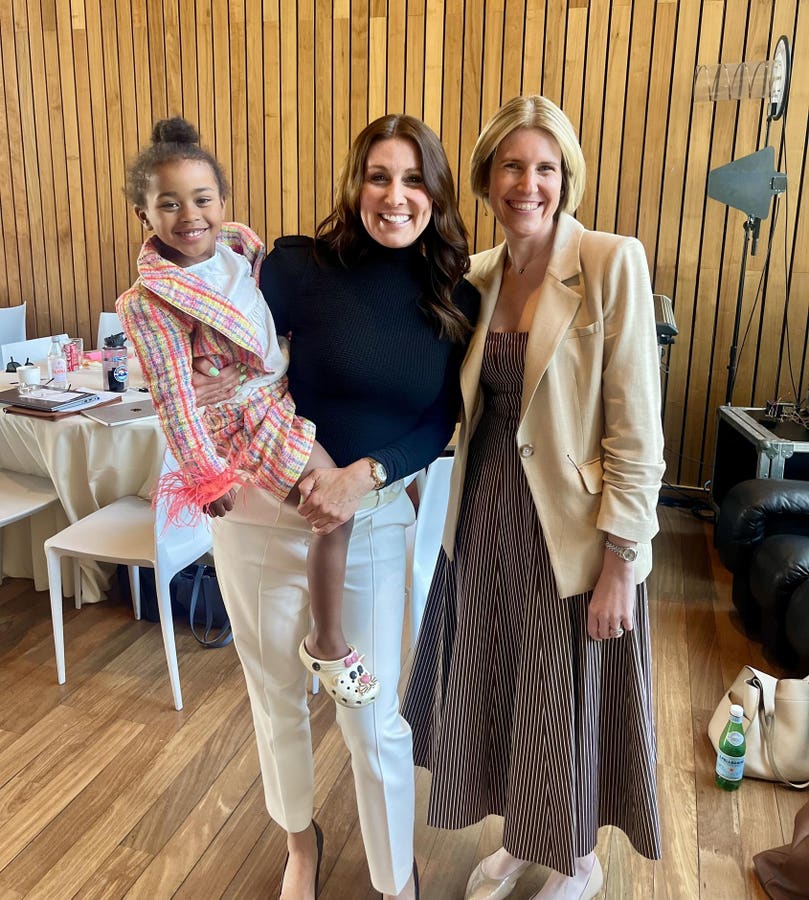
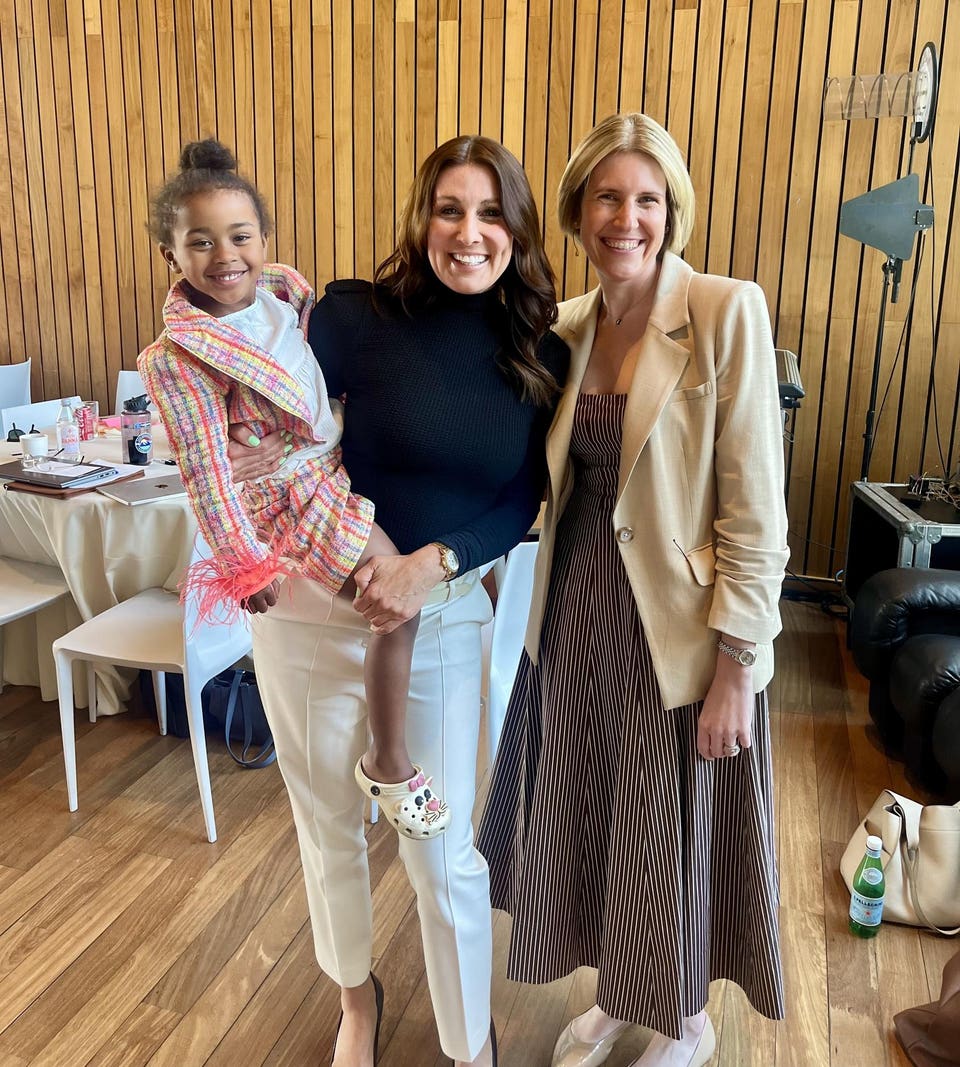
1Mind founder Amanda Kahlow with her daughter, pictured alongside investor Cassie Young of Primary Ventures
Amanda Kahlow
Like many great entrepreneurs, Amanda Kahlow’s journey started on a whim. She was 21 years old when she sold a jeweler a kiosk she didn’t know how to build. She hit Pearl Street in her hometown of Boulder on a mission to help her father sell his DIY website builder by selling local shop owners on a radical idea at the dawn of the web: that their storefronts could live online, open to everyone, anytime, anywhere.
It was a short-lived role for Kahlow, who was fired by her father soon after, but it awoke the entrepreneur within. Now an exited founder, having left her Unicorn 6Sense in 2020, she’s onto her next big bet, her startup 1mind. She has raised $40 million to date from backers like Young, with a bold goal: that AI can make people, not just systems, superhuman. I sat down with founder Amanda Kahlow and investor Cassie Young to talk about what that really means, the journey to here, and why this moment and their relationship feels different.
Selling the Roadmap
Kahlow starts by telling me that her father-daughter employer-employee relationship was short-lived, because her father “fired” her for agreeing to sell a shop owner a Kiosk, a product that, much to his dismay, did not exist.’ Investor Cassie Young cuts in with a quick correction. “She was selling the roadmap,” Young laughs.
It’s an offhand remark, but it captures exactly why Young and Primary Venture Partners raced to back Kahlow’s new company, 1mind. In an industry consumed by pattern matching, it is clear the relationship between these two women has been less transactional and more like a friendship from the start.
The Unlikely Path to Sand Hill Road
Kahlow is quick to point out that she is not your typical venture-backed founder. She did not grow up anywhere near Sand Hill Road and its exclusive networks. Instead, she describes a childhood “below the poverty line,” relegated to remedial classes, and years spent convinced she was the family mess-up, while her older brothers were the smart ones. “I did a fair share of drugs before I was 13,” she admits, noting that she genuinely believes her parents expected it was more likely she would end up in jail than a boardroom.
Exposure to the world of digital changed that forever. Her father’s website builder gave her a product to sell; Forrester, which she joined as a young graduate, gave her a new level of access. As a young analyst in San Francisco, she created a website scorecard service just as major corporations were scrambling to define digital quality. The offering turned into an overnight multimillion-dollar practice. Yet despite generating millions in revenue for the firm while earning just $36,000, she was told a raise would have to wait six months. Instead, she resigned, brought clients like HSBC and Chevron with her, and spent the next 16 years building a services business that embedded deeply inside Fortune 500s.
From Service to Software: The Birth of 6sense
Kahlow describes the work as lucrative but began to feel hollow. “Every time I built these reports, I’d think, I’m just lying,” she says. “I tell them a lie, so they can tell their higher-ups this works.” Then, she wondered, what if I help companies look forward instead of back? That reckoning became her first company, 6sense.
The Vocabulary of Venture Capital
Yet she shares that, before she grew it into a multi-billion-dollar Unicorn, like many women trying to raise money, she felt the hard knock of doors in her face. Kahlow did not speak the language of Venture capital. She tallies “60-some” investor meetings, which ended with admiration for her revenue but with inertia toward her product, until finally a candid investor told her the truth: she needed a technical co-founder. She took this on board and reemerged with a team of engineers and firepower, forming the 6sense engine, building a platform that turns intent data into signals, quickly winning market share from Go-to-market leaders and revenue teams.
Cassie Young on Kyle Hagge podcast – the Leadership Traits the Top 1% of Executives Use to Climb the Ladder -2025
Kyle Hagge
Cassie Young is a General Partner at Primary Venture Partners, with two decades of operating experience. She was one such customer. While she had not met Kahlow, she was a huge fan of her product. On International Women’s Day 2024, an associate on Young’s team tipped her off that Kahlow was starting something new. Young immediately pursued the opportunity. Kahlow’s response was blunt. The seed round for her new venture, 1mind, was oversubscribed, but she said, “I like the idea of a woman on my cap table.” Kahlow added, “If you can meet with me tomorrow, I’ll take the meeting.”
They met virtually on a Saturday afternoon. Young, a die-hard Duke basketball fan, still laughs that it’s the only time she was late to a Duke-Carolina tip-off because it was too critical a conversation to rush. Young shares that while Amanda might not see herself as the obvious VC choice, she ticked all the boxes of a founder she looks to invest in. She boils this down to three critical questions she asks herself.
Cassie Young on her Investment Non-negotiables
First, “Can this founder sell stock? Not literally, but narratively. Can they articulate a future so compelling that people want to buy in immediately? I saw the moment we met that Amanda is off the charts at this,” Young says. Second, “do people want to work with this person?” Young shares that again and again, she heard the same refrain about Kahlow, that there was a line of former 6sense employees waiting for Kahlow to start her next thing so they could follow. And lastly, is there an obsession with product quality? Amanda kept saying, this is the worst version of our product you will ever see even as she pitched,” young muses, “that’s what I call a learning machine.”
More than metrics, what stands out to Young is the depth of character. She shares a saying that has become shorthand for how she thinks about non-conventional founders: “Chips on shoulders put chips in pockets.” It’s not pedigree she is looking for, but grit, and the stickiest kind is often forged in the outside lanes.
A Founder Who Learned to Use Her Instincts
And the chips, in this case, have certainly followed. Kahlow says 1mind has already surpassed the “triple, triple, double” growth benchmark, an assessment Young explains is used to spot “unusually fast expansion and early retention” companies. However.Kahlow shares that it is also its own best customer, with 80% of its pipeline now generated via AI superhumans.
Amanda Kahlow CEO 1mind
1mind
For Kahlow, this time around, she is taking a different approach to investors. “At 6sense, I called them the night before the board meeting,” she says. “I didn’t use them as partners. I didn’t look at them as my bat phone.” With 1mind, she is shifting gears. “Cassie’s been a partner for the first time in my life,” Kahlow says. “She taught me how to have a relationship with a VC where I can fully trust and open up.”
This relationship matters because Kahlow has never fit the familiar template of innate social capital, high-polished, Ivy-League-coded archetype venture capital has repeatedly backed. Instead, her prowess comes from a less rehearsed but highly convincing likability and a tenacity to see around corners and sell a vision that does not yet exist.
The Case for an AI Go-To-Market Superhuman
That all leads to 1mind. Kahlow calls it a “go-to-market superhuman”—an AI designed to cut through broken sales handoffs, so buyers finally get one seamless, intelligent conversation, not a maze of people and delays.
Young shares that at first, some of her peers thought the idea sounded wrong, skeptically questioning if this was about “buying from avatars.” But what they failed to understand is this isn’t a bet on hype. It’s a bet on repair. It’s a bet on a woman who
“We want to give people information in a conversational way, when they’re active and engaged,” Kahlow says.
Years ago, that same instinct made her look reckless. Today, it’s the type of pattern recognition that investors like Young are betting will redefine the future of go-to-market strategies.