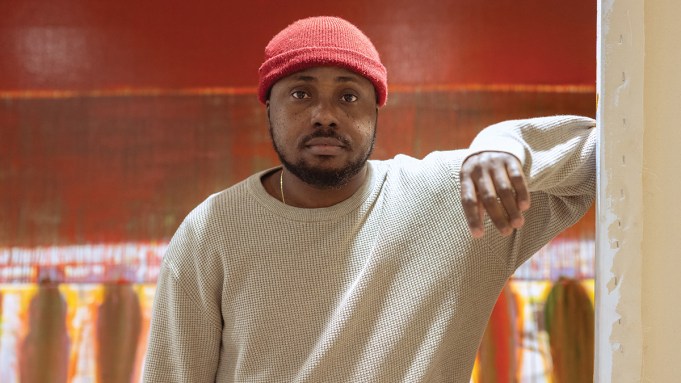
Gideon Appah is giving a tour of his studio on the outskirts of Accra, Ghana, meandering through room after room, each lined with canvases in various states of progress. There’s a yellow sketch of a drummer boy dressed in masquerade regalia; another unfinished work of a woman lying on a beach blanket; and a third of a ghostly, abandoned building. Appah prefers to paint in batches. “I use the energy of one work to confront the other,” he says.
Then he arrives at a part of the building that houses works from his former studio, which went up in flames in 2020. Many pieces were lost entirely, and these rescues—coated in sooty residue—may be beyond salvaging. But like the mythical phoenix, Appah has clearly risen from the ashes. In 2022, he signed with the mega-gallery Pace, and an exhibition of his new work is on view at the New York flagship through February 28.

Blue Pool, 2023, oil on canvas.
Damian Griffiths
In the past, Appah has plumbed memories of his childhood home, paged through old family photo albums, and researched newspaper archives for images of dancers and acrobats from the years immediately after Ghana achieved independence in 1957, all in search of material for his paintings. For this latest group, he found contemporary inspiration in the coastal town of Takoradi. But the thread running through all his subjects is Ghanaian culture.
“I’m actually using the present to confront the past and the past to confront the present day,” Appah says.
His distinctive style developed out of an interest in depicting water, especially figures in the sea. Initially he relied on acrylics, but they weren’t giving him the desired effect. So he started experimenting with oils, which proved to be more fluid. Eventually, he arrived at a technique that begins with multiple layers of acrylic, followed by layer upon layer of oil. “I like the process of dripping paint,” he notes. “You add a lot of depth. It makes the painting very luminous on the surface. They look glazed sometimes.”
House with an Empty Pool, 2025, oil on canvas.
Robert Glowacki Photography
Appah often punctuates his images with a strong color—orange or ultramarine blue—to provide what he describes as “some kind of magic.” He is also known for rendering figures in stark-white swimsuits. When asked why, he admits with a laugh that he has posed the same question to himself, but “I just can’t really figure out why.”
Appah has been drawing since childhood, when he would use charcoal, often directly on the walls of his grandparents’ house. His father was living and working in the Netherlands. “By the time he came back, I was already grown,” he says. But his mother supported his creativity, and Appah received his B.F.A. from the Kwame Nkrumah University of Science and Technology in Kumasi, Ghana, in 2012.
He also became an astute student of the commercial art world, using his phone to keep abreast of international galleries. Among the “little steps” he says he took to get noticed: joining Black Star—an incubator for young artists—and participating in group shows in Ghana and South Africa. Gallery 1957, an influential contemporary-art space in Accra (and now London), gave him what was to be his breakout exhibition in 2019.
Detail of Night Catch (Prise de Nuit), 2025, oil and acrylic on canvas.
Courtesy of Pace Gallery and the Artist
When Courtney Willis Blair traveled to the capital looking for fresh talent on behalf of New York’s Mitchell-Innes & Nash, Appah recalls, “She came to my studio and saw my stuff. She didn’t show too much excitement.” Willis Blair must have a good poker face: She ended up offering him his U.S. debut. “We did a beautiful show,” he says. “We sold out.”
Appah couldn’t attend in person—it was 2020, the pre-Covid-vaccine era—but the exhibition caught the attention of other galleries, including Pace. In 2024, he made up for the missed trip with the inaugural Watermill Center Visual Arts Fellowship in the Hamptons. There, as in Accra, he alternated between four hours of painting and brief rest breaks, sometimes working well into the night.
Last year, he shot a short film, called Beyond the Shadows, in Takoradi, which he showed in Paris and brought to Pace. There were “bodies splashing into water and the locals with the boats, pulling fish from the sea,” he says. “Before I knew it, I started to paint some of them.” Seeing both the film and the canvases illuminates how the imagination and the physical world intertwine in his work.
A work in progress.
Courtesy of Pace Gallery and the Artist
Perhaps the biggest test Appah has set for himself is one of scale. Artists often start small because materials are expensive. But when Appah was young, he read that big pieces are a sign of confidence, so he went for it. Now, he’s pushing himself to make a diminutive painting as compelling as an enormous one.
“It can get frustrating,” he admits, from fitting the composition into the reduced frame to mastering control of a tiny brush. But he’s determined: “It’s for the challenge.”