Vachnadziani Winery reInterprets Georgia’s Winemaking Heritage
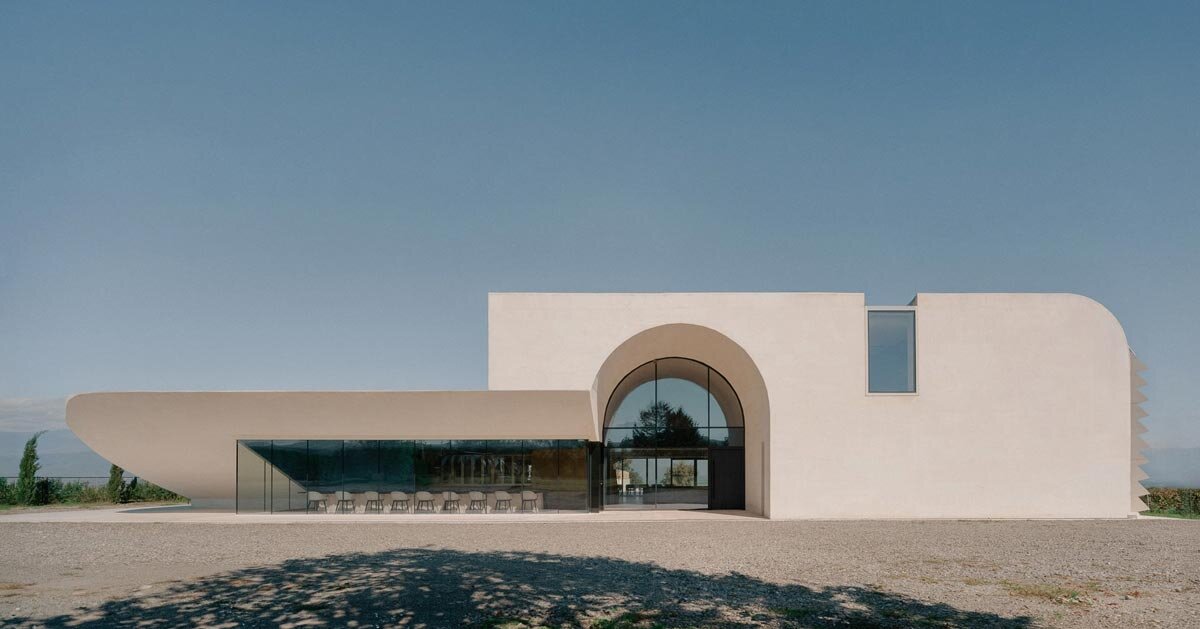
Laboratory of Architecture #3 builds Vachnadziani Winery in Georgia’s Alazani Valley, a region historically associated with viticulture and framed by the Caucasus Mountain range and surrounding vineyards. The project engages with the cultural significance of winemaking in Georgia, where production and consumption are traditionally linked to ritual, heritage, and place. These references inform the architectural approach without relying on literal historical reproduction.
The program combines a working winery with hospitality functions, including a small hotel, reception area, conference facilities, and a restaurant. The building is oriented north toward the Caucasus range, with a primary staircase extending from the main volume down into the vineyard and production zone. The winemaking facilities are embedded within the sloped terrain, reducing their visual presence and allowing the building to read as a freestanding estate rather than an industrial structure.
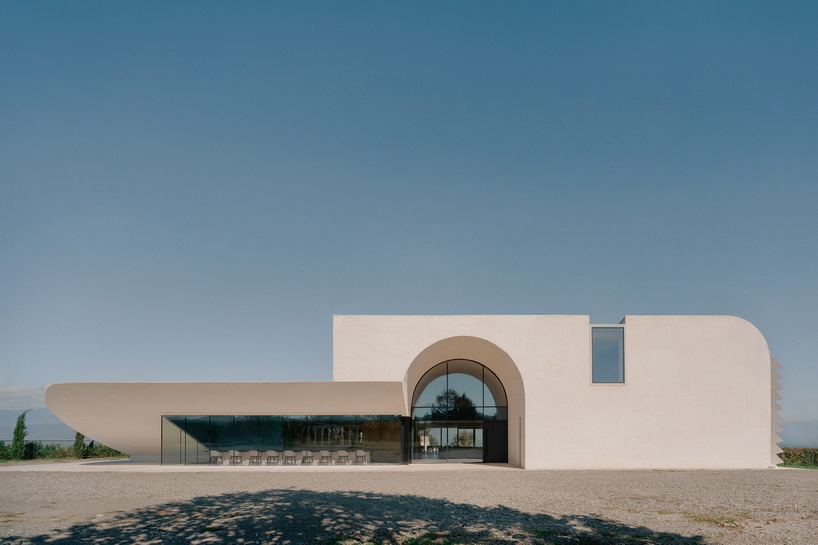
The main facade faces a reservoir positioned in front of the building. From a distance, the structure appears as a single, carved mass, while closer inspection reveals a composition of distinct volumes separated by deep recesses and shadowed joints. The architectural language is defined by monolithic forms intersected by arched openings, referencing both historical tectonics and contemporary construction methods.
all images by Grigory Sokolinsky
Vachnadziani Winery’s design balances Solid Volumes and Voids
Tbilisi-based practice Laboratory of Architecture #3 composes the building’s form in order to emphasize a balance between opposing conditions. Solid volumes establish a strong connection to the ground, while projecting elements and voids introduce a sense of suspension. This contrast is reinforced through material treatment, with hand-finished surfaces expressing tactility and weight, and smoother, reflective finishes creating visual lightness and environmental integration.
Interior spaces are organized around a central double-height hall that functions as the primary lobby. Spatially, this room references the proportions of a medieval hall, while accommodating contemporary circulation and gathering. A prominent staircase occupies the space, with a fragmented geometry that echoes motifs expressed on the eastern facade. The interior palette is restrained and monochromatic, combining wood and plaster surfaces. Subtle color accents are introduced through small inserts, drawing from Georgian fresco traditions. In the hotel rooms, layered textiles and drapery define a more intimate spatial atmosphere.
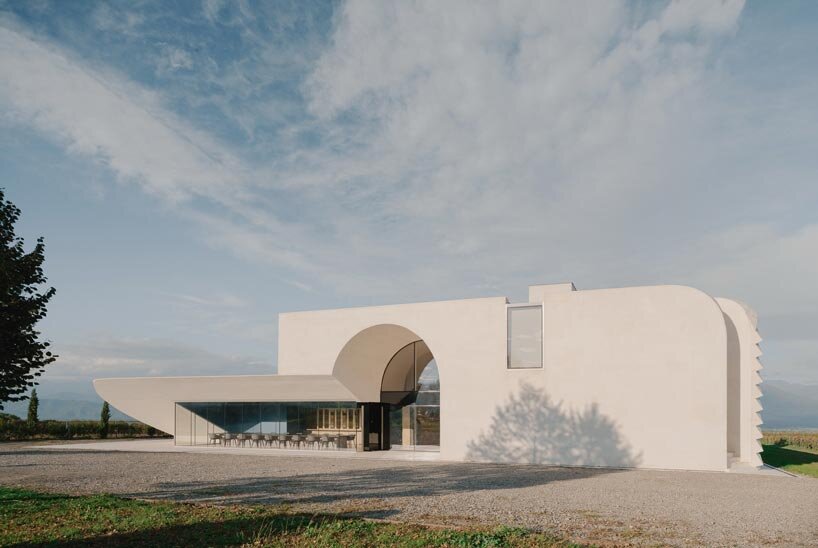
Vachnadziani Winery is located in Georgia’s Alazani Valley, surrounded by vineyards and the Caucasus Mountains
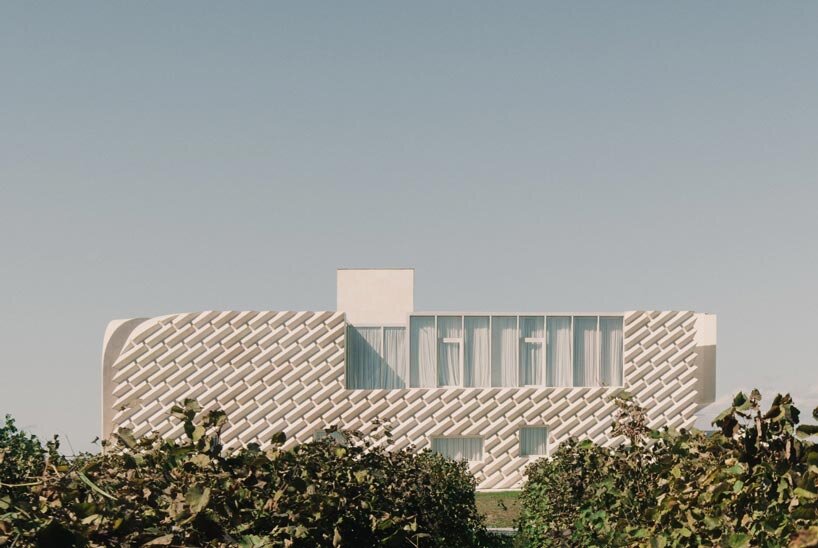
the building reads as a freestanding estate rather than an industrial structure