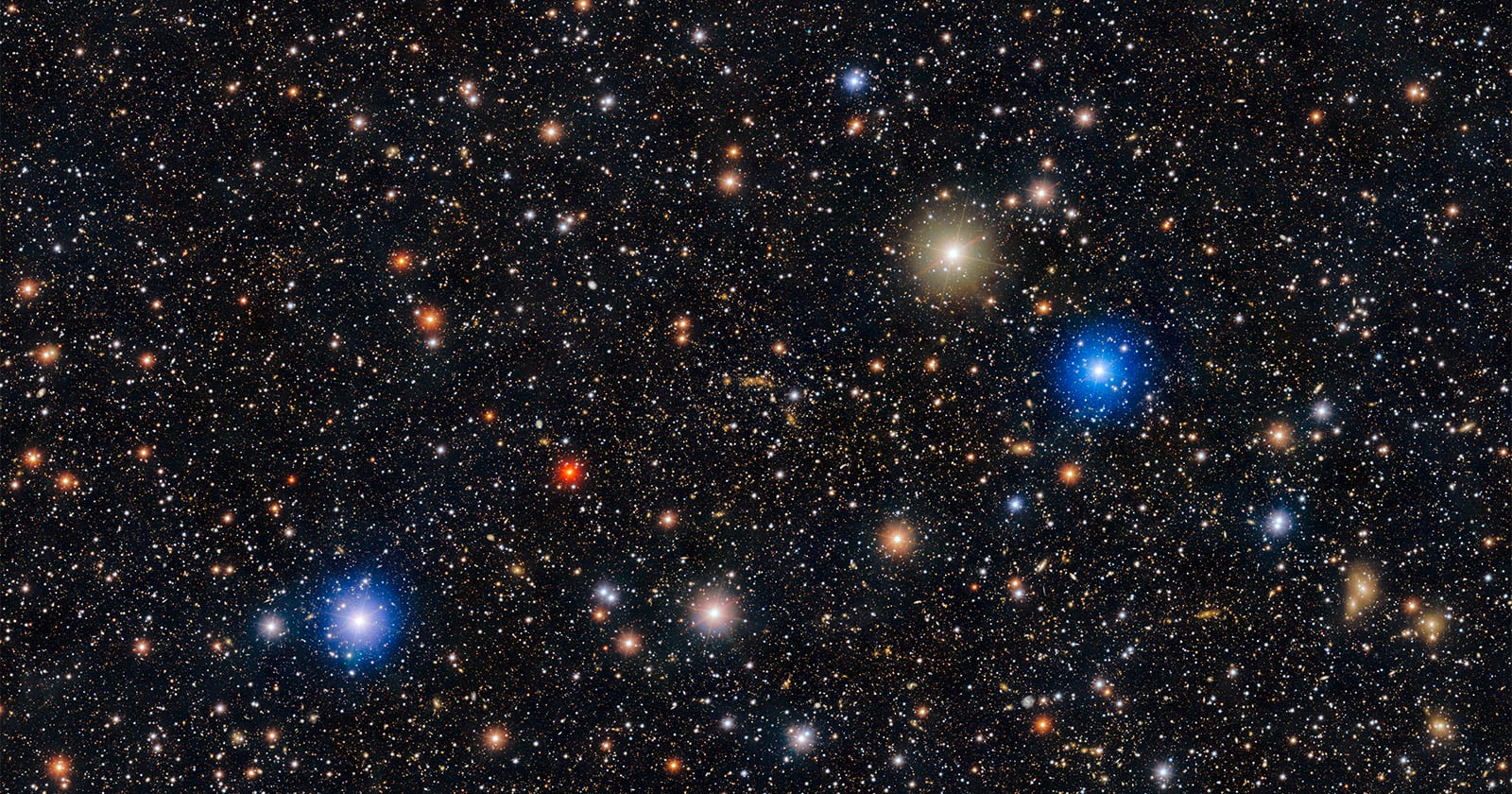
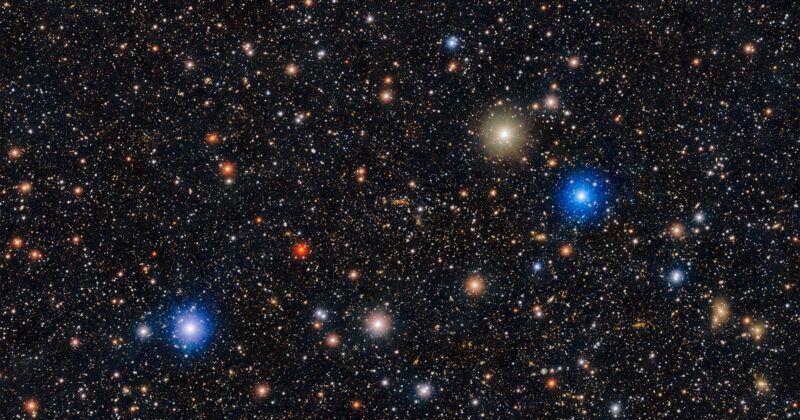
 The Bullet Cluster is made up of two galaxy clusters that are colliding, one moving through the other, about 3.7 billion light-years away in the constellation Carina. These galaxy clusters act as gravitational lenses, magnifying the light of background galaxies. This phenomenon makes the Bullet Cluster a compelling piece of evidence supporting the existence of dark matter.
This image was taken with the 570-megapixel U.S. Department of Energy-fabricated Dark Energy Camera (DECam), mounted on the U.S. National Science Foundation Víctor M. Blanco 4-meter Telescope at Cerro Tololo Inter-American Observatory (CTIO), a Program of NSF NOIRLab. | Full-size, zoomable version
For the first time, a single experiment combines four different methods of studying dark energy and the dark Universe. At the heart of the experiment is the 570-megapixel Dark Energy Camera. Combined, the four experiments have delivered the clearest image yet of how dark energy shapes the Universe.
The Dark Energy Survey Collaboration, comprised of global teams of scientists, spent six years performing a deep space, wide-area survey of the night sky using the 570-megapixel Dark Energy Camera, built by the Department of Energy, mounted to the NSF Victor M. Blanco 4-meter Telescope at NSF Cerro Tololo Inter-American Observatory (CTIO) in Chile. For nearly 760 nights over 2013 to 2019, the DES Collaboration captured rich data from 669 million galaxies, all billions of light-years away from Earth. The survey covered one-eighth of the entire night sky.
Now, after many subsequent experiments, data analysis, and further data collection, the DES Collaboration has released the results from that six-year survey, delivering a model of the Universe’s expansion history that is “twice as tight” as past analyses. In the world of cosmology, that is a significant improvement in understanding and a monumental achievement.
The collaboration includes, in addition to the super high-res photos, data from weak lensing and galaxy clustering probes, which are two techniques scientists can use to measure the Universe’s expansion history. The collaboration also includes measurements using baryon acoustic oscillations (BAO), Type-Ia supernovae, galaxy clusters, and weak gravitational lensing. These plans were set into motion 25 years ago when the Dark Energy Survey was first proposed. The latest research is covered in a new research paper, which has been submitted to Physical Review D. This massive paper reflects work from 18 other supporting research papers.
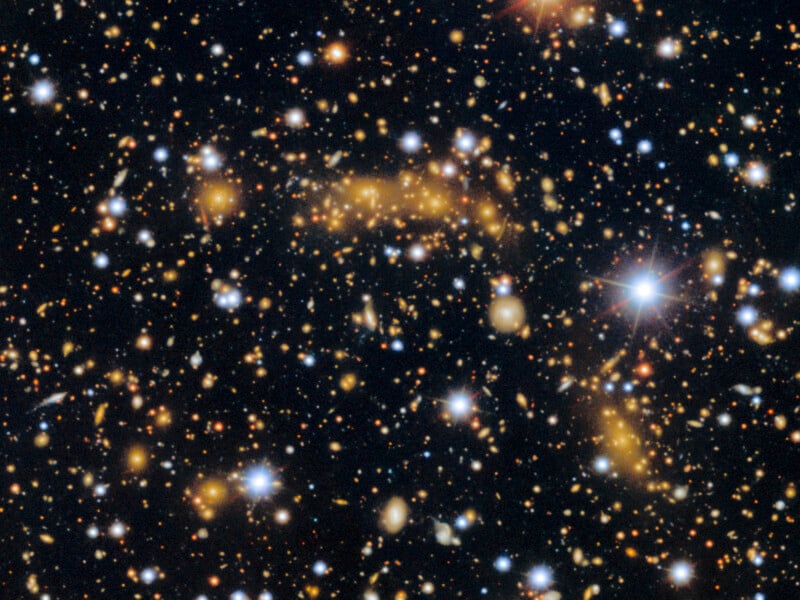 100% crop
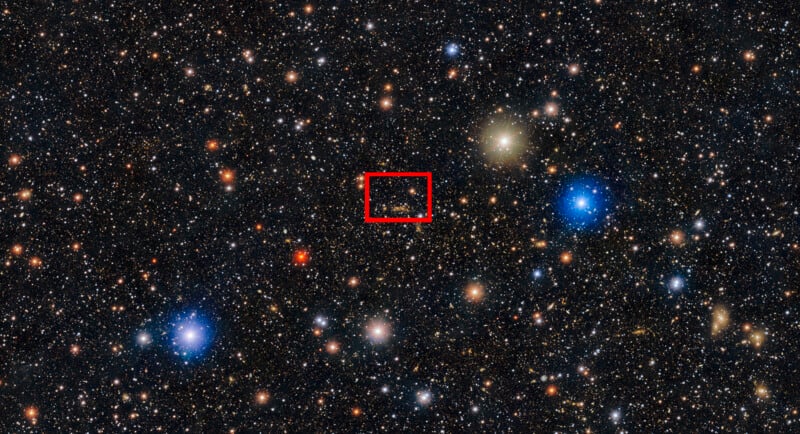 The red area shows where the 100% crop above came from
“It is an incredible feeling to see these results based on all the data, and with all four probes that DES had planned. This was something I would have only dared to dream about when DES started collecting data, and now the dream has come true,” says Yuanyuan Zhang, assistant astronomer at NSF NOIRLab and member of the DES Collaboration.
The research has significantly narrowed down the possible models that explain the Universe’s history and behavior.
“These results from the Dark Energy Survey shine new light on our understanding of the Universe and its expansion,” explains Regina Rameika, Associate Director for the Office of High Energy Physics in the DOE’s Office of Science. “They demonstrate how long-term investment in research and combining multiple types of analysis can provide insight into some of the Universe’s biggest mysteries.”
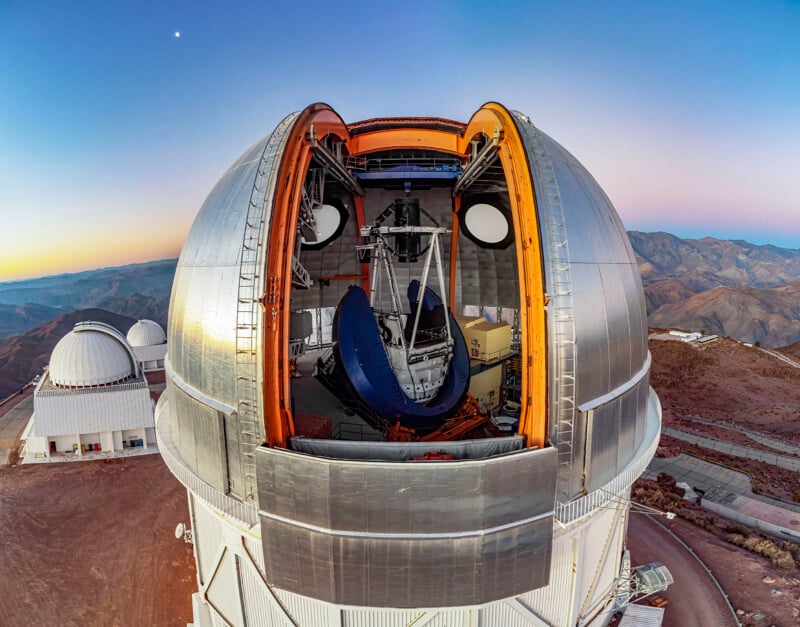 ‘The Víctor M. Blanco 4-meter Telescope has pristine access to wide open skies of the Chilean Andes from its perch at Cerro Tololo Inter-American Observatory (CTIO), a Program of NSF NOIRLab. To the upper left of the telescope is the ‘evening star’, actually the planet Venus. Below on the left are the SMARTS 1.5-meter Telescope and SMARTS 0.9-meter Telescope (furthest back).’ | Credit: CTIO/NOIRLab/NSF/AURA/T. Matsopoulos
Although rigorous studies into dark energy and dark matter are a relatively recent chapter in astrophysics and science, the first clue that dark energy existed was discovered a century ago. Astronomers noted that distant galaxies appeared to be moving away from Earth. In fact, the farther away a galaxy, the faster it appeared to be receding. This was the first crucial evidence that the Universe was expanding.
However, given that the Universe “is permeated by gravity,” astronomers long believed that the Universe would eventually reach a point at which it could no longer sustain its expansion, meaning it would slow down.
In 1998, two independent teams of cosmologists determined, using distant supernovae, that the Universe’s expansion is truly accelerating rather than slowing. To explain these findings, the cosmologists proposed some unknown force that drives the accelerated expansion of the Universe: dark energy.
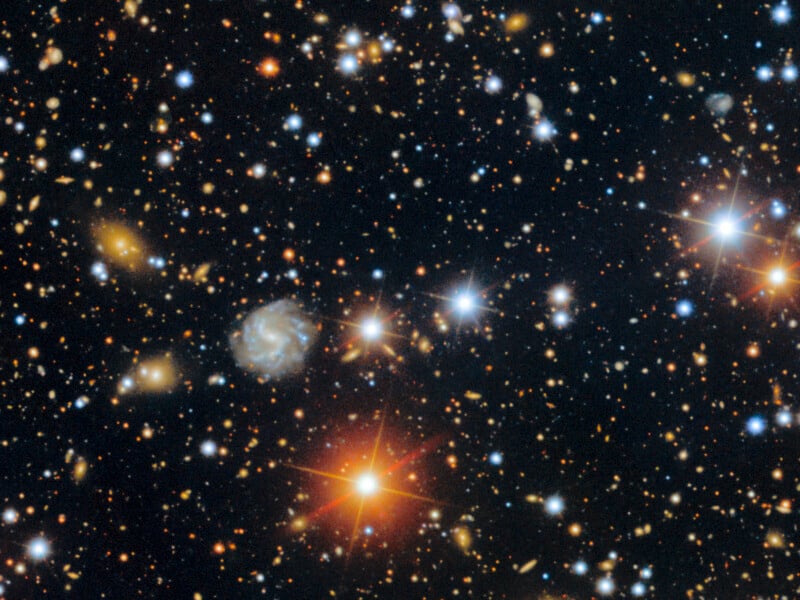 100% crop
These days, astrophysicists believe that about 70% of the Universe’s mass-energy density is dark energy.
As its name suggests, dark energy cannot be directly observed. However, its impact can be, which is exactly what the Dark Energy Survey Collaboration has been doing.
“For the latest results, DES scientists greatly advanced methods using weak lensing to robustly reconstruct the distribution of matter in the Universe. Weak lensing is the distortion of light from distant galaxies due to the gravity of intervening matter, like galaxy clusters,” NOIRLab writes. “They did this by measuring the probability of two galaxies being a certain distance apart and the probability that they are also distorted similarly by weak lensing. By reconstructing the matter distribution over six billion years of cosmic history, these measurements of weak lensing and galaxy distribution tell scientists how much dark energy and dark matter there is at each moment.”
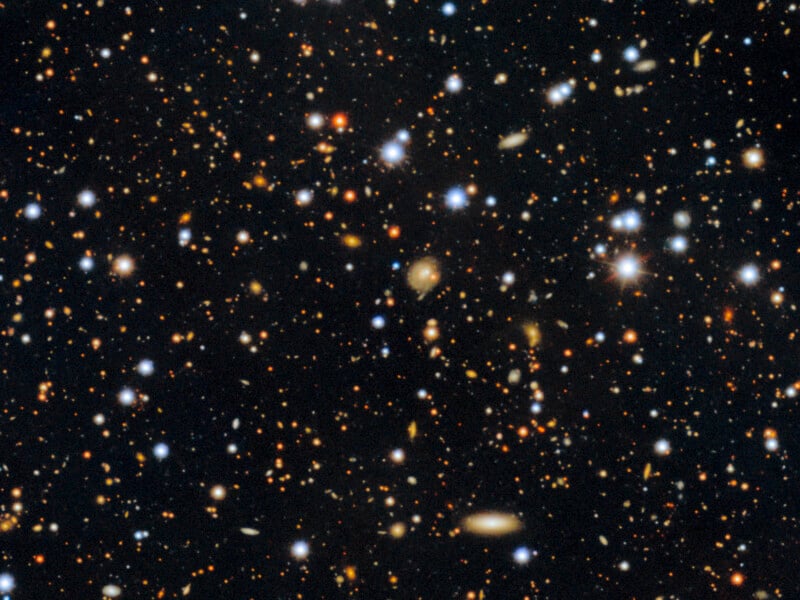 100% crop
 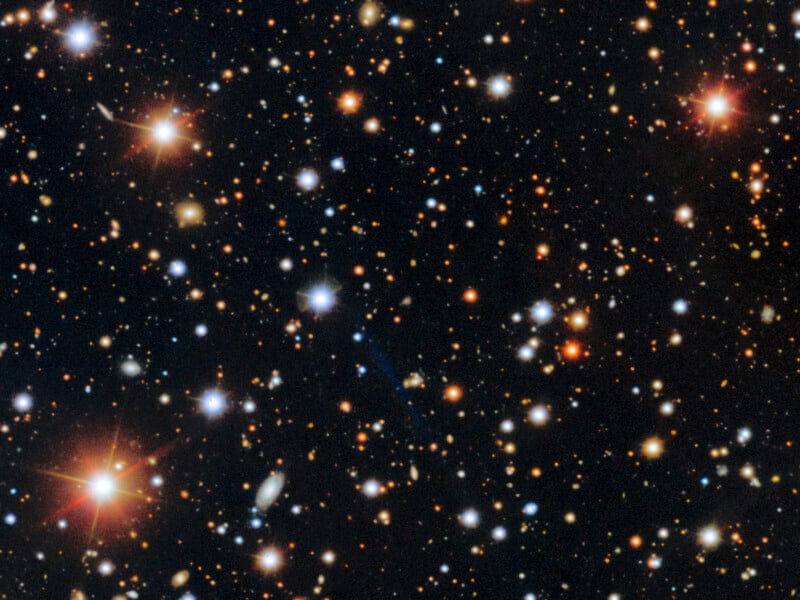 100% crop
While the latest results narrow the scope of viable models that explain the nature of the Universe and mostly support the standard model of cosmology — Lambda cold dark matter — scientists note that there is still one parameter that is off. There is not yet enough evidence to rule out the standard model completely, but something still isn’t lining up.
There is more work to be done, particularly by the brand-new NSF-DOE Vera C. Rubin Observatory, which houses the world’s largest camera. PetaPixel saw the telescope first-hand, and the observatory’s first images are exceptional. The Vera C. Rubin Observatory is in the midst of a decade-long Legacy Survey of Space and Time, which will catalog about 20 billion galaxies across the southern hemisphere of the night sky. Its data will be implemented into the Dark Energy Survey and, if all goes as expected, further refine humanity’s understanding of dark energy and the history of the Universe.
“DES has been transformative, and the NSF–DOE Vera C. Rubin Observatory will take us even further,” adds Chris Davis, NSF Program Director for NOIRLab. “Rubin’s unprecedented survey of the southern sky will enable new tests of gravity and shed light on dark energy.”
Image credits: CTIO/NOIRLab/DOE/NSF/AURA. Image processing: T.A. Rector (University of Alaska Anchorage/NSF NOIRLab) & M. Zamani (NSF NOIRLab). Relevant research has been analyzed and collected in a newly submitted research paper, “Dark Energy Survey Year 6 Results: Cosmological Constraints from Galaxy Clustering and Weak Lensing,” by the DES Collaboration.