While Paris buzzes with the glitz of Haute Couture Fashion Week, another kind of fashionista is stealing the spotlight — in the wilds of Zambia. Forget designer gowns and runways; these trendsetters are sporting nothing but blades of grass… and a surprising sense of style.
A fashion trend happens when individuals imitate a behavior just because others are doing it — even if it serves no practical purpose. Think of dressing up your dog in a scarf. Humans are naturally drawn to this kind of mimicry, much to the delight of social media influencers everywhere.
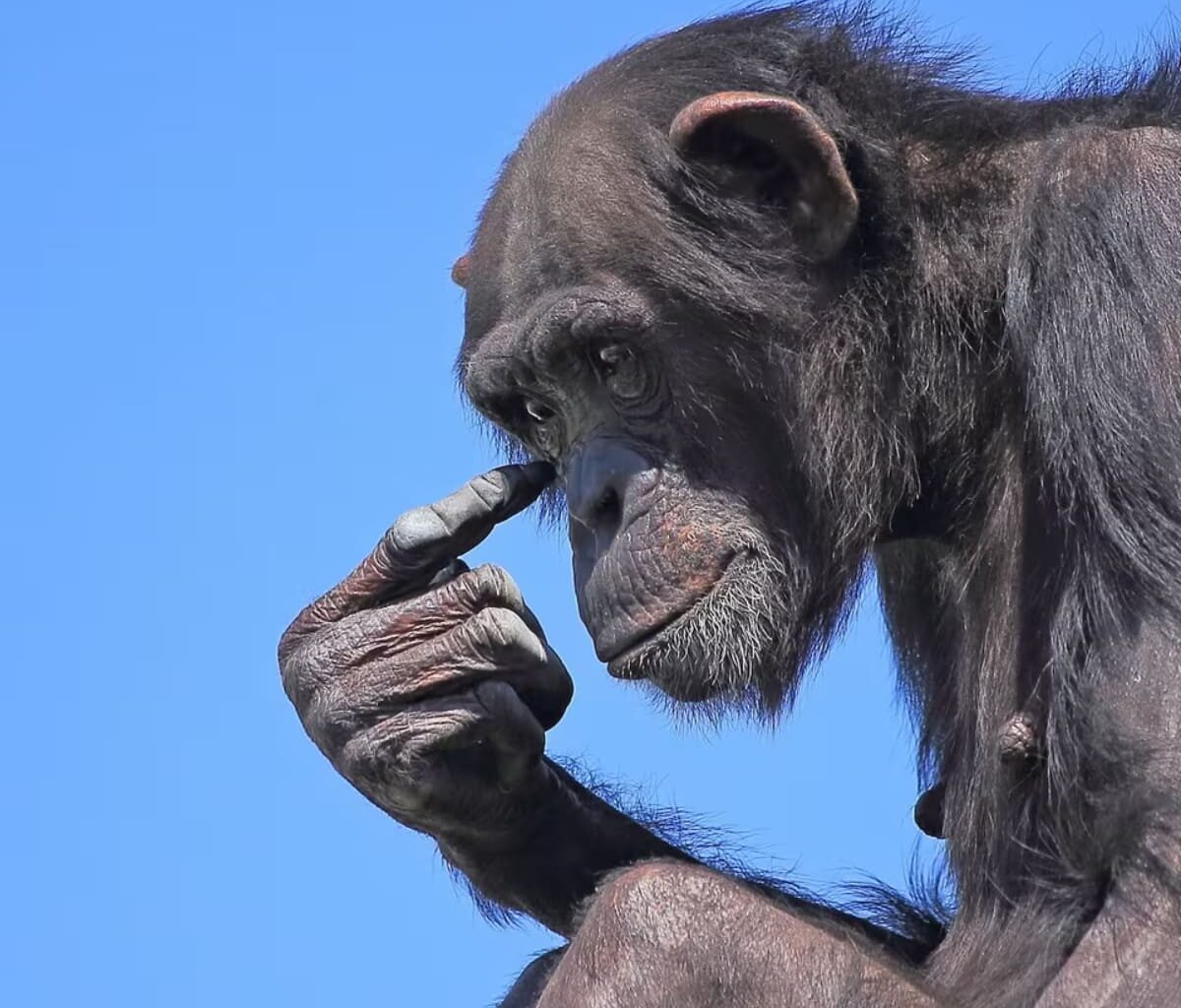
But this time, the copycats aren’t human. Scientists from Utrecht University in the Netherlands and Durham University in the U.K. say they’ve witnessed this very phenomenon among chimpanzees.
Did you know? Orcas have shown a similar behavior — wearing dead salmon on their heads, as if setting a trend of their own.
The story began in the 2010s at Zambia’s Chimfunshi Wildlife Orphanage. Julie, a female chimp, started the fad by sticking a blade of grass in her ear. Soon others followed, and the quirky behavior spread throughout the group — even continuing after Julie’s death.
Subjects were 94 chimpanzees at the Chimfunshi Wildlife Orphanage Trust, a sanctuary in the north-western part of Zambia. Grass-in-ear behaviour copied by group members: https://t.co/dR84qctFgH #chimpanzees pic.twitter.com/Hz0Spj4Wmq
— Patricia Teixidor (@pateixidor) April 2, 2021
The trend spreads to a new group of chimps
Now, in a study published in Behaviour, researchers reveal that another group of chimpanzees at the same sanctuary — one that had never met the first — has begun copying the habit. Only this time, things got even weirder.
Under the influence of Juma, a male chimp, some of them started dangling grass from their backsides — again, with no apparent reason. “I’m not concerned about the why,” says Edwin van Leeuwen of Utrecht University. “What fascinates me is that the chimpanzees copy one another’s behavior.”
The researchers traced the source of inspiration to something rather funny: both groups shared the same caretakers. These humans, it turns out, sometimes stick blades of grass or even matchsticks in their ears to clean them — all while their sharp-eyed chimp friends watched closely.
Think humans are the only ones who copy strange trends just to fit in? Think again!🦍 A new study involving @DurhamPsych reveals how a fascinating fad swept through a group of chimps @Chimfunshi.
Read more: 👉 https://t.co/dqhn1lIkWZ#DUresearch #DUinspire pic.twitter.com/5soNEEZie0— Durham University (@durham_uni) July 8, 2025
What this “chimp fashion” says about culture
The scientists note that this kind of playful imitation only appears in captivity, where chimps have more leisure time than their wild counterparts. In nature, survival comes first — finding food, avoiding predators, and focusing on practical tasks.
Yet imitation has a deeper purpose. It may serve as a social gesture — a way of acknowledging another individual, strengthening bonds, and reinforcing a sense of belonging. It’s not so different from the subtle ways humans mirror each other’s habits.
These findings from Chimfunshi Wildlife Orphanage could reshape the discussion about cultural evolution in animals. While some argue that humans are uniquely advanced because we imitate one another, even in trivial ways, this study challenges that view.
“Our research shows that chimpanzees can copy each other’s small, seemingly pointless behaviors,” concludes Jake Brooker from Durham University. “That’s why we felt it was important to share these new observations.”
Maybe next time we talk about fashion trends, we should look not to Paris — but to the forests of Zambia.

Nathalie Mayer
Journalist
Born in Lorraine on a freezing winter night, storytelling has always inspired me, first through my grandmother’s tales and later Stephen King’s imagination. A physicist turned science communicator, I’ve collaborated with institutions like CEA, Total, Engie, and Futura. Today, I focus on unraveling Earth’s complex environmental and energy challenges, blending science with storytelling to illuminate solutions.