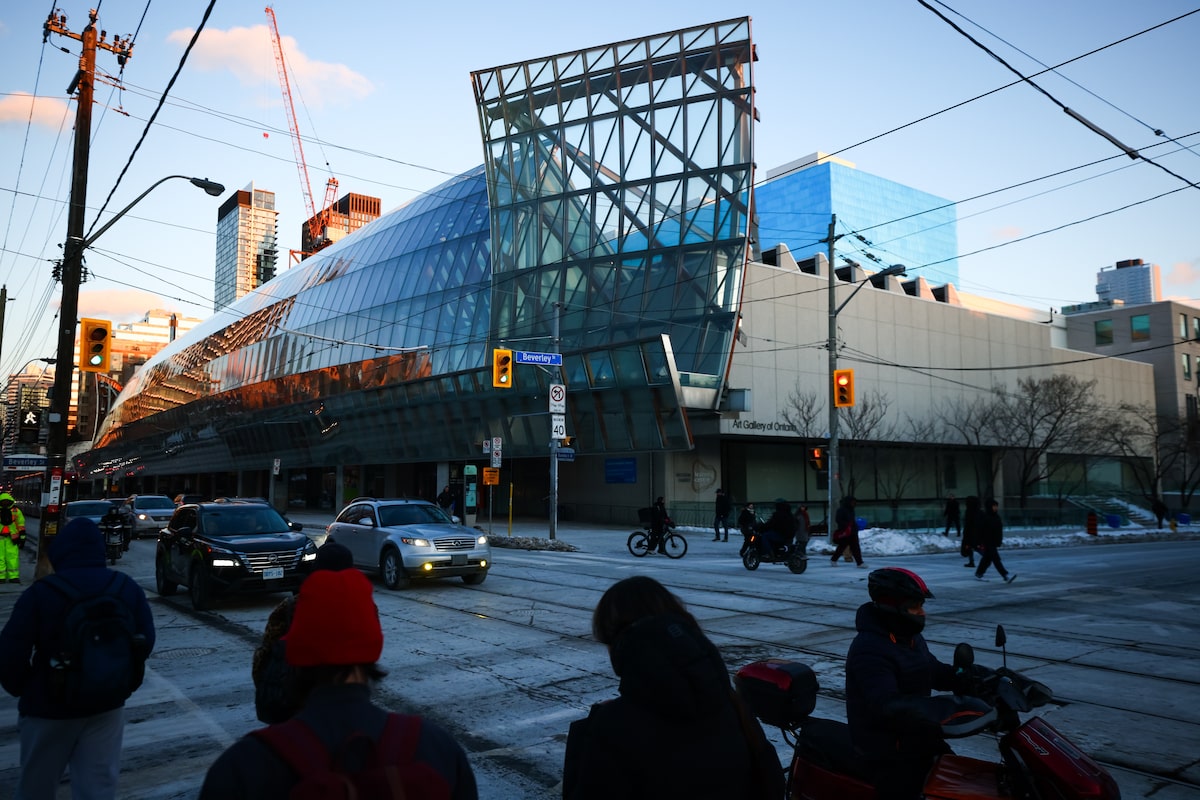
The Art Gallery of Ontario, in Toronto, on Jan. 20.Cole Burston/The Globe and Mail
The internal push to prevent the Art Gallery of Ontario from acquiring a work by photographer-activist Nan Goldin last year – which has led to four resignations – was prompted by the philanthropic executive Judy Schulich, according to documentation reviewed by The Globe and Mail.
The Globe reported last week that the Toronto gallery’s modern and contemporary collections committee narrowly voted to not acquire Ms. Goldin’s video work, Stendhal Syndrome, after a heated discussion during a meeting in May, 2025. In the meeting, some committee members alleged that the Jewish-American artist’s views on Israel were “offensive” and “antisemitic,” according to an internal memo from AGO director and chief executive Stephan Jost that was revealed by The Globe last week.
Documentation of the meeting, subsequently reviewed by The Globe, shows that Ms. Schulich, a committee member, AGO trustee and long-time donor, led off the meeting’s discussion about Stendhal Syndrome. It says she described the artist as a liar and propagandistic, and argued that committee members’ feelings were not included in the acquisition discussion. She said that the work was not as important as others by Ms. Goldin, the documentation adds. She also expressed concern that the Ontario government might cut off funding if the AGO bought an American artwork.
The decision to decline an artwork in connection with its Jewish artist’s views on Israel has prompted significant dissension, resignations and a wholesale governance review at one of North America’s largest art institutions – while raising questions in the art world about the influence of powerful donors, and whether the political views of artists should affect the way their work is received.
AGO rocked by resignations after failed Nan Goldin acquisition
Modern-and-contemporary curator John Zeppetelli, who had advocated for the acquisition of Stendhal Syndrome, resigned from his full-time position following the vote, as did two volunteer members of the committee who were dismayed with how the events unfolded. The gallery then hired a third party to conduct a governance review, promising that future committee discussions will focus on the AGO’s acquisition criteria.
A third volunteer committee member resigned on Friday in connection with the non-acquisition, according to a source who The Globe is not naming because they were not authorized to describe the situation publicly.
In 2024, Ms. Goldin gave a speech at Berlin’s Neue Nationalgalerie in which she shared her “moral outrage at the genocide in Gaza and Lebanon.”
The widely celebrated photographer and activist levelled criticism at Israel for the tens of thousands of deaths reported since it launched its war on Hamas in 2023, after the group’s Oct. 7 attacks that left 1,200 dead in Israel and 251 others taken as hostages. (Ms. Goldin did not respond to comment requests.)
Ms. Schulich is the executive vice-president of the Schulich Foundation, which bills itself as one of Canada’s largest private foundations, and which was seeded by her father, the billionaire entrepreneur Seymour Schulich. She has a keen interest in art, having studied the market at Christie’s in New York. She sits on many gallery boards.
2024: Art Gallery of Ontario’s associate curator of Indigenous art, Taqralik Partridge, departs
Between 2019 and 2024, she and venture capitalist David Stein jointly donated at least half a million dollars to the AGO, gallery records show – outside of the foundation, which has also supported the gallery.
Ms. Schulich did not respond to repeated requests for comment. Her name began circulating on social media last week following The Globe’s initial report of the decision not to acquire Stendhal Syndrome.
An unnamed person in the meeting, the newly revealed documentation also shows, likened Ms. Goldin to Leni Riefenstahl, the controversial Second World War-era German filmmaker who was a major contributor to Nazi propaganda.
The heated discussion that followed included support for Ms. Goldin from some committee members, who felt that refusing to acquire her work amounted to “censorship,” according to Mr. Jost’s memo.
The committee eventually voted 11-9 to not acquire the work, according to a source.
AGO spokesperson Laura Quinn told The Globe last week that “Personal political views were brought into the conversation. This is not intended to be part of the process.”
The gallery’s trustees are required to sign a code of conduct, a copy of which was obtained by The Globe. It asks trustees to confirm they will “behave in a manner consistent with the best interests of the AGO and with AGO values regardless of personal viewpoints.”
Subsequently asked if Ms. Schulich’s comments at the committee meeting – which prompted the discussion that led to four resignations and forced the AGO to conduct a governance review – reflected this code of conduct, Ms. Quinn sent a short statement to The Globe and Mail.
The statement highlighted the gallery’s publicly available acquisition policy and the governance review following the May, 2025, meeting. “The AGO is confident that all information related to this meeting was fully reviewed and that the resulting recommendations will ensure that AGO committee policies are strictly followed going forward,” Ms. Quinn said.
The decision happened even as the AGO, one of North America’s biggest art institutions, already houses three of Ms. Goldin’s works.
The gallery is publicly funded, receiving $26.3-million from all three levels of government in its last fiscal year, the vast majority from Ontario; monetary donations and bequests accounted for $11.3-million, and the AGO Foundation provided another $11-million.
Ms. Schulich was first appointed to the AGO board by the Ontario government during its 2016-17 fiscal year; her current three-year term expires in May.
Mr. Zeppetelli is still working with the AGO for the next few months in a reduced capacity as a guest curator, co-organizing an exhibition of work from the Italian artist Diego Marcon that is scheduled to open in June. He did not respond to numerous requests for comment.
The AGO initially intended to co-acquire Stendhal Syndrome with the Vancouver Art Gallery and Minneapolis’s Walker Art Center, which wound up purchasing the work together without the Toronto institution. It has been on display in Vancouver since November.