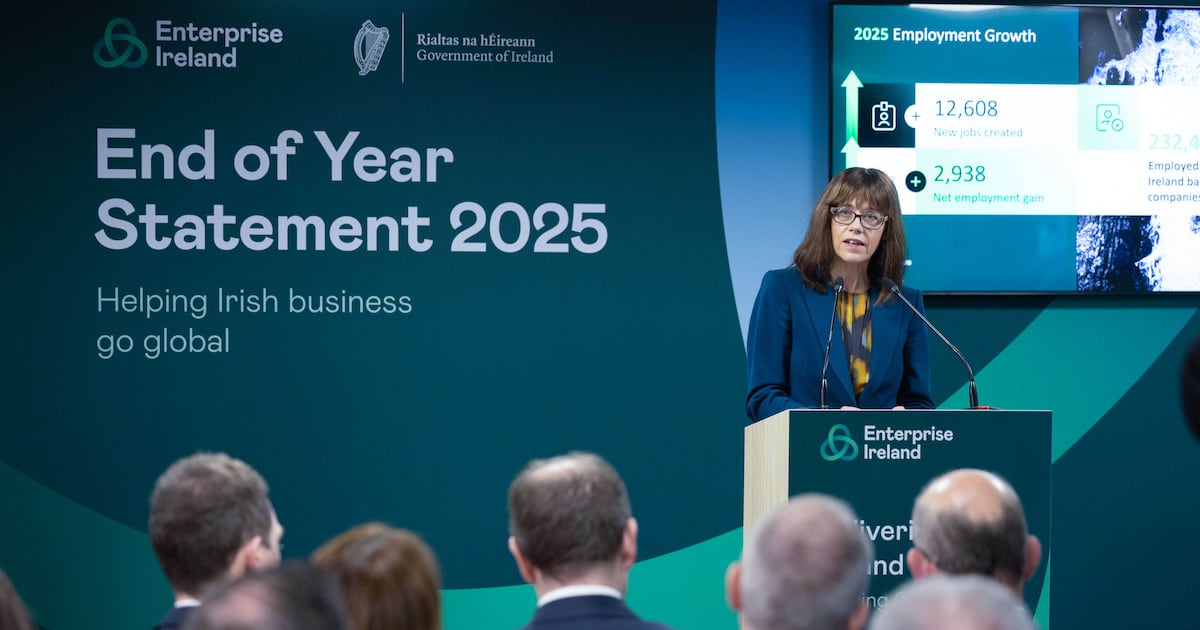
The number of new jobs supported by Enterprise Ireland in 2025 hit its lowest level in the years after the pandemic amid a “cautious hiring environment”.
Enterprise Ireland’s end of year results for 2025 showed total employment at companies supported by the agency increased to 232,425 last year with 12,608 new jobs created.
The jobs growth translates into a net increase of 2,938 jobs created. Both the new jobs created and the net employment gain at Enterprise Ireland companies are the lowest for any year since the pandemic.
In the years since the pandemic, the number of jobs created peaked at 20,342 in 2021, but by 2024 had slipped to 15,741 roles created. In 2025, that figure fell to 12,608 jobs.
Accounting for the number of positions which were eliminated in these years, the net increase in jobs peaked at 12,841 in 2022. That figure fell to 6,212 by 2024, but more than halved in the past year to 2,938.
Responding to these figures, Enterprise Ireland chief executive, Jenny Melia acknowledged that the numbers of job increases were lower in 2025 but pointed to consistency in the number of lost jobs.
“Our job losses are very much on par with where they were last year and, in fact, are lower than in one of the previous three years,” she stated, continuing to say that companies working with Enterprise Ireland had engaged in “over hiring at the end of 2024, anticipating some big projects that were going to come through”.
“In the past 12 months, we have certainly seen a more cautious hiring policy,” with client companies “holding off hiring until they absolutely need to”, instead maximising efficiency in their businesses, she said.
Job losses, the EI boss said, were seen in the construction sector amid a gap between completions and commencements of projects, as well as in Irish beef processors.
These sectors “have seen some impact of tariffs in the US, with companies either losing contracts or not being able to make a sufficient margin in terms of the negotiation with the customer, or with projects being put on hold”.
“Irish businesses have faced an extraordinary series of global shocks in recent times and today, we continue to operate in an environment of shifting global trade dynamics,” she said, warning that “volatility will continue” in 2026.
Enterprise Ireland directly invested almost €50 million in equity in Irish companies, leveraging a total of €440 million in 2025. Individual Enterprise Ireland investments ranged from €100,000 to €2 million, reflecting the agency’s new investment strategy.
This approach moves beyond early-stage funding to multi-stage investing, enabling larger funding rounds and providing greater support for scaling companies.
The agency said companies it supports in the food and sustainability sector now employ 69,295 people (up 0.6 per cent) with an additional 2 per cent working in the industrial and life sciences sector, which employs 101,747 people.
The technology and services sector employs 61,383 people, up 0.8 per cent. Climate tech and renewable energy performed strongly, with employment increasing by 6.5 per cent.
The housing sector saw employment increase by 4 per cent and employment in the high-tech construction sector increased by 2.5 per cent. The fintech and financial services sector grew by 4.9 per cent.
Ms Melia said “these figures demonstrate the strength and adaptability of Irish businesses in a challenging global environment”.
Ms Melia said one the agency’s key priorities for the next year and beyond is to support Irish entrepreneurs to scale globally.
Europe is now the biggest destination for EI client companies’ exports, having surpassed the UK in recent years, and the state agency views the US as an “incredibly important market”, which accounts for a fifth of all exports.
Despite the ongoing economic instability, Enterprise Ireland said it will not be changing its “ambitious” job creation targets for 2026.