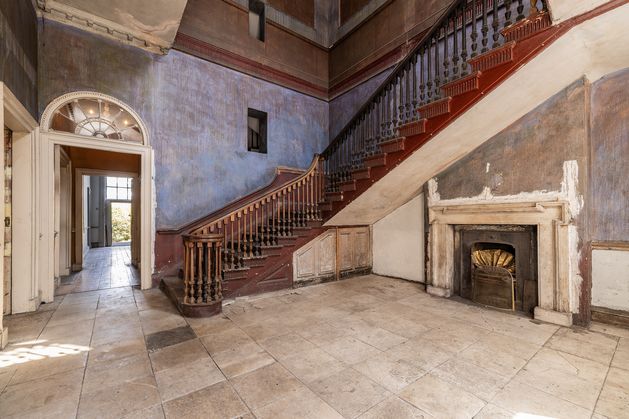
The four-storey over basement former house and studio of artist Alice Hanratty in central Dublin is as big as 10 standard family homes
Asking price: €1.75m
Agent: Movehome (01) 8844690
Any Dubliner worth their salt will tell you their city is famed for its Georgian terraces, and that the original and finest examples are to be found at Henrietta Street in Dublin 1.
In fact, we’re very lucky to have Henrietta Street at all. Designed in the early 18th century to cater for Ireland’s wealthiest, it entered the 20th century providing slum homes for our very poorest. Its abandonment and dereliction from the 1960s meant that these extraordinary homes almost didn’t make it into the 21st century at all.
Henrietta Street couldn’t tell its tale of two cities today (No14 is now a tenement museum); were it not for the motley crew of far-seeing conservationists who stepped up when few could understood why; when banks wouldn’t pay out mortgages for them and insurance companies wouldn’t quote for them.
Among its saviours was Irish print and etchings artist and activist Alice Hanratty, who passed away in June at 86.
Hanratty rescued No4, a four storey over basement house, from destruction when she purchased it back in 1978 as a derelict; when Mountjoy Square looked like broken teeth and even Harcourt Street in Dublin 2 was festering with ruination.
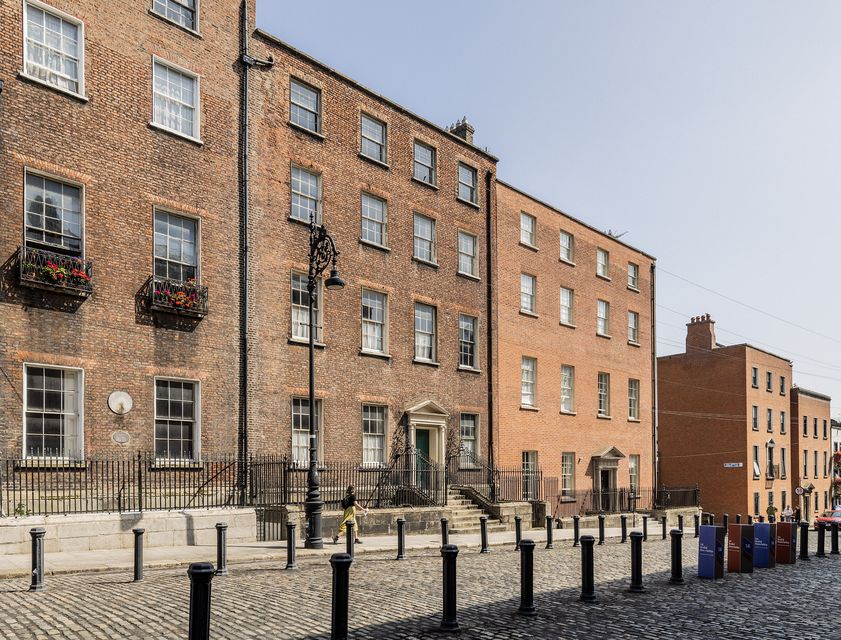
The exterior of No4 Henrietta Street
Henrietta Street’s other champions include the late architect and conservationist, Uinseann Mac Eoin who bought Nos 5 – 7 in the 1960s when they were due for demolition.
An Taisce member Ian Lumley in tandem with developer Pat Wigglesworth did the honours for No3, which they bought for €510,000. Barrister Fergus Ryan has shouldered restoration work at No7 and Michael Casey was brave enough to buy and live in No13.

A fully refurbished reception room in nearby No7
Dublin City Council invested €5m turning No14 into a museum. The 1911 Census tells us that the house had over 100 people living in it at that time.
All are today part of the street’s epic story which, as journalist Frank McDonald quipped, has mostly been “a tale of riches to rags.” Strumpet City was filmed here, as was the 2011 documentary/reality series, The Tenements.
But Henrietta Street had the very grandest of beginnings. It was laid out by Luke Gardiner in 1720 with designs by architect Edward Lovett Pearce, in turn inspired by the classic Italian churches of Andrea Palladio.

Reception room with period detail
Named after Henrietta Crofts, Ireland’s one time ‘first lady’ as wife of the Lord Lieutenant, the Duke of Bolton; it was designed to be Ireland’s most exclusive enclave bar none when built between 1724 and 1755.
Lovett Pearse died after just three were completed, and finance minister Nathaniel Clements stepped in to take over, and indeed, took the showiest (No7) for himself. Other first residents included the Earl of Leitrim, Viscount Molesworth, the Earl of Shannon, Lord Mountjoy (Gardiner) and Archbishop Hugh Boulter among others.
Blackrock born artist Alice Hanratty blazed a different trail. Her recent obituary describes her as “an inspirational artist, educator and member of Aosdána, who is remembered for her commitment to her students, her passion for her medium and her strong sense of social justice.”
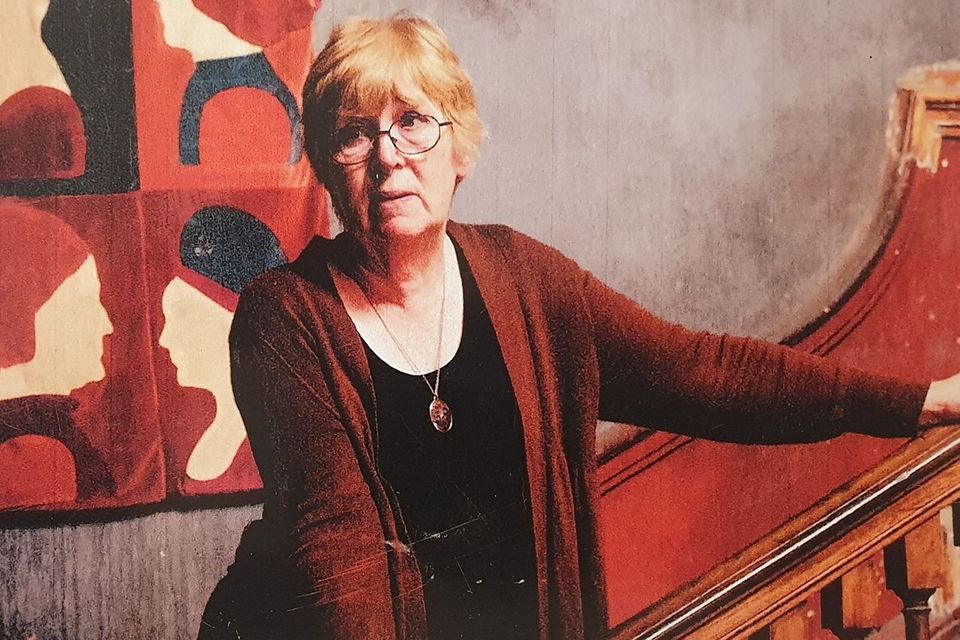
Artist Alice Hanratty, the former owner
Born in 1939, she studied at the National College of Art and Design (NCAD) and then Hornsey College of Art in London, where she specialised in printmaking. After travelling in Africa, she returned in the 1970s to join the Graphic Print Studio and to teach at NCAD.
She went on a strike against departmental intervention in how the college was teaching, and was fired as a result. She later taught at DIT.
Although known for her printmaking, etching was Hanratty’s favoured medium. Her work has been included in solo and group shows at home and abroad.
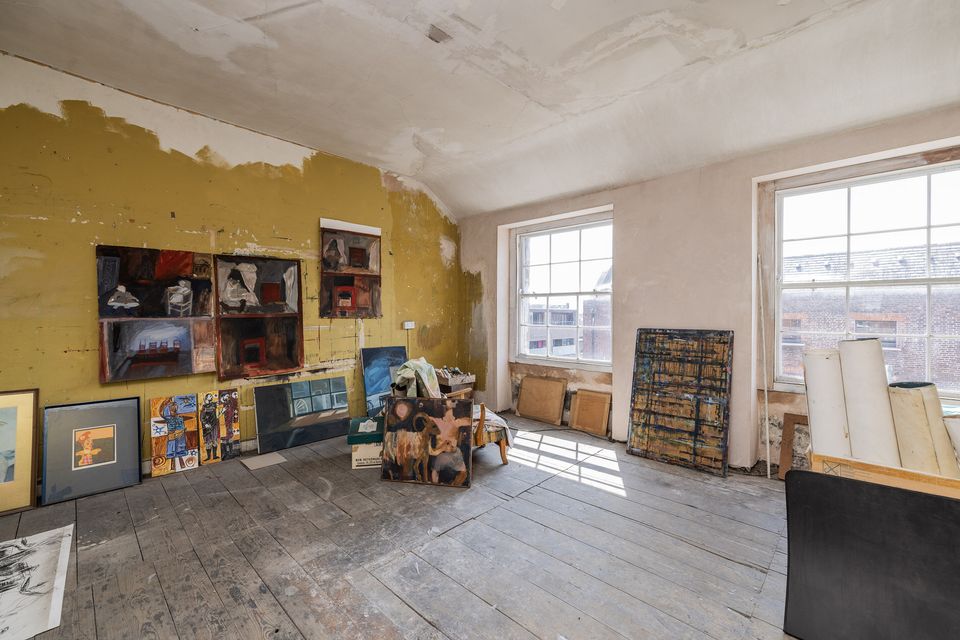
Alice Hanratty’s art studio on the top floor
Hanratty’s purchase of No4 was spurred by conservation. In the 1980s, she was joined there by her partner, the communist and long-time trade unionist Sé Geraghty.
Geraghty got the roof sorted and imported his 7,000 volume collection of books, which detractors dubbed the “Red Library of Henrietta Street.”
Connoisseurs of fine art, classical music and opera, the couple hosted gatherings of the Dublin Grand Opera Society. He died in 2006, while Hanratty continued her work until her passing this summer.
The benefactors of her estate are now bringing No4 to market for the first time in almost 50 years.
Also called Farham House, it was built for John Maxwell, the first Baron Farnham and his wife Judith. Completed around 1745, the terraced four-bay, four-storey house sits over a raised basement which runs out under the street.
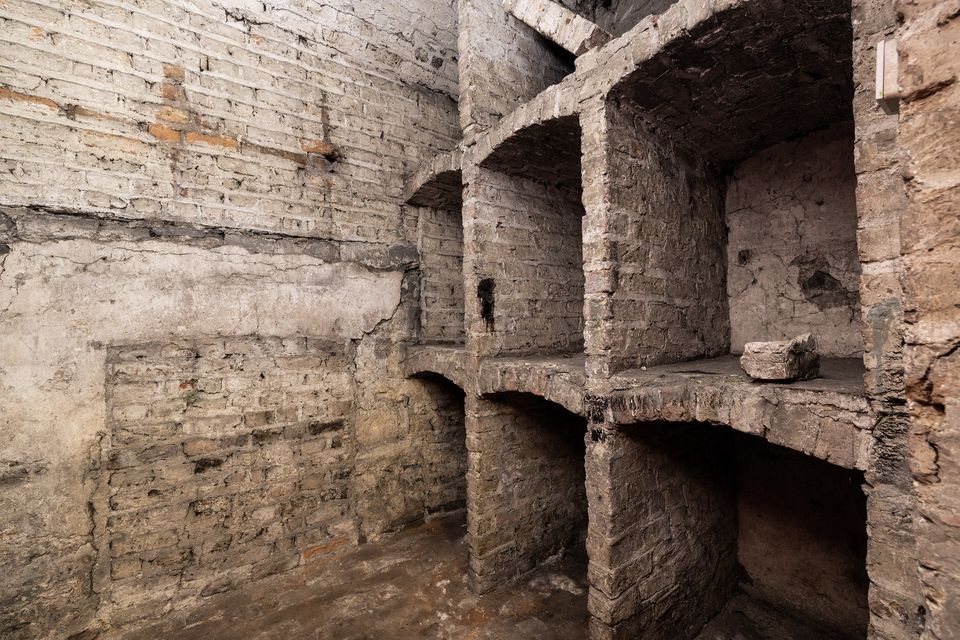
The basement storage vaults
The family lived here for over a century, during which it was altered slightly for a family wedding in the 1780s. Back then its art collection included a Rubens and a Rembrandt.
In 1849, No4 became HQ for The Commission for Encumbered Estates and by the early 20th century it was a barracks for agents of the Property Defence Association.
The private militia was sent out to defend landed estates threatened by anti eviction activists. When the PDA departed, it was divided up as tenements before being abandoned, and then acquired by Hanratty in the late 1970s.
Hanratty did her job well. Today, the national heritage buildings archive describes No4 as “an important part of Dublin’s Street of Palaces.”

An aerial shot of Henrietta Street and the surrounding area in Dublin
Number 4 is now for sale through Movehome, with an asking price of €1.75m. It has 22 main rooms laid out over five floors. Robust for its age and circumstances, it is somewhat paused in its development.
The agents estimate that restoration would cost in the order of €1m. At 10,010 sq ft, No4 is the equivalent size of 10 average family homes. Consider that Kenah Hill, a period home (also 10,000 sq ft) in Killiney, Dublin (albeit fully restored), is now asking €10.75m.
Inside No4 is the grand hall and original mahogany staircase, believed to be Dublin’s oldest in situ. There are some original elaborate marble chimney pieces, and lots of original wall panelling and ceiling stucco work.
Its vast rooms are now empty and unfurnished, although this serves to show off their magnitude and ambition. To understand what’s possible here, consider the restored rooms at No7 where owner Fergus Ryan has done an incredible job.
If you think you can to write the next chapter at No4, contact Movehome for a visit.