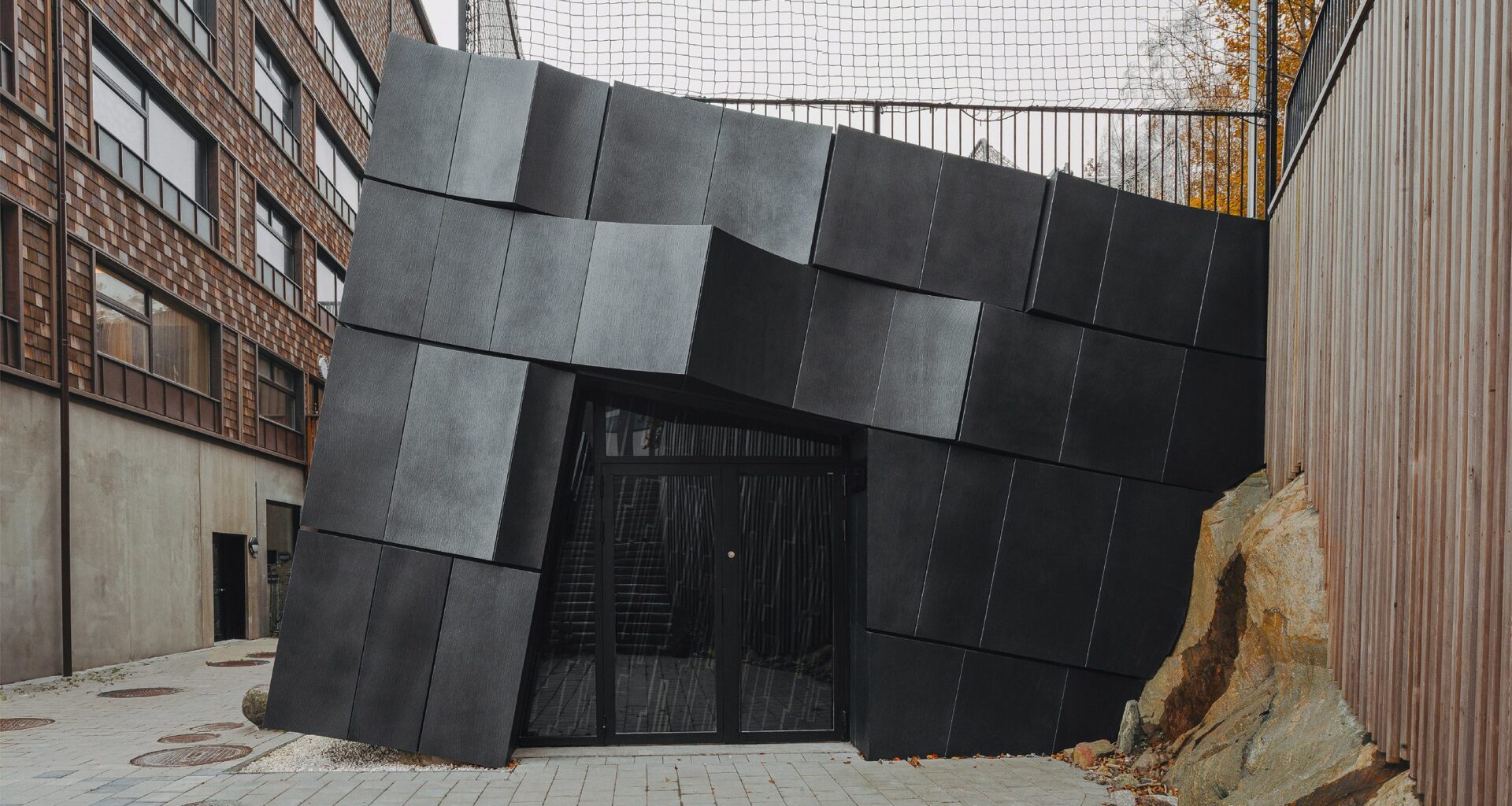
Black-metal panels cloak the sloping form of The Mountain Chamber, the entrance to an artificial cavern in Gothenburg designed by local studio Erdegard Arkitekter.
Located beneath a residential and commercial development called Kallebäcks Terracer, the cavern is believed to have been created by the Swedish military before being used as cold storage by a dairy company.
Property company Wallenstam tasked Erdegard Arkitekter with creating an entrance structure that would declare its presence to the surrounding neighbourhood, transforming the unusual space into a unique venue.
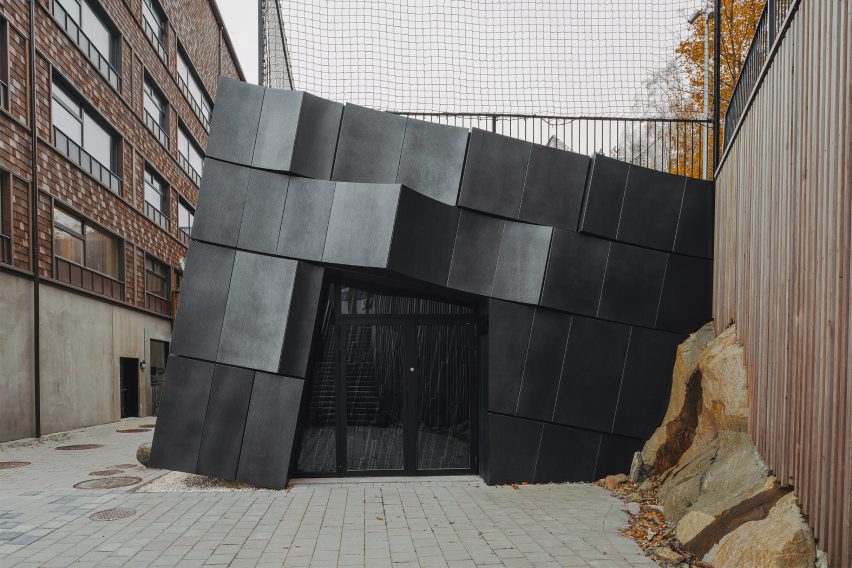 Erdegard Arkitekter has completed an entrance to an artificial cavern in Gothenburg
“The core concept was about creating a threshold between ground level, the everyday, and the subterranean,” Erdegard Arkitekter architect Ida Modin told Dezeen.
“The architecture prepares the visitor for descent into the mountain both spatially and psychologically,” she added.
“Rather than treating the entrance as a purely functional structure, the project frames the transition itself.”
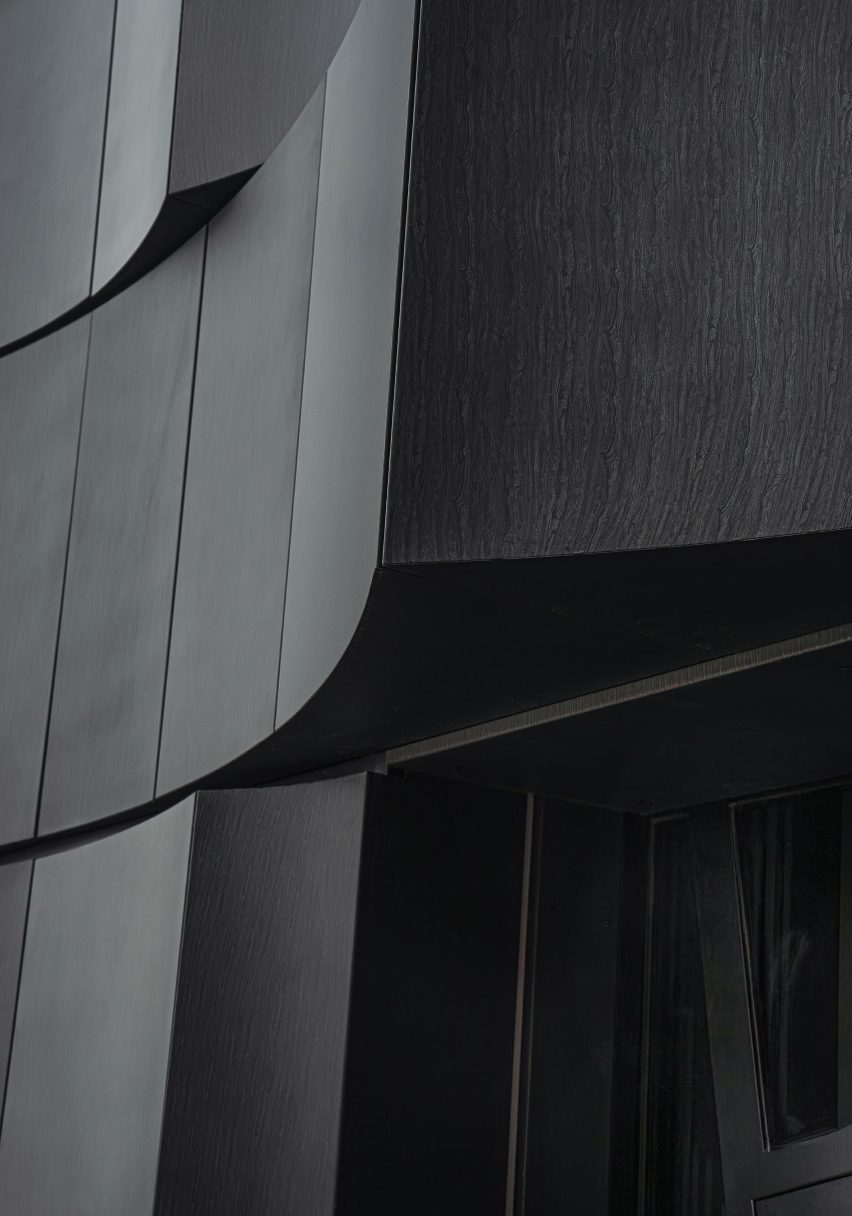 Black metal panels cloak the sloping form
The exterior of The Mountain Chamber, which was tilted to appear as though sinking into the ground, is clad in a series of curving metal cassette panels, arranged to evoke the “extruded and stacked” character of natural rock formations.
These metal elements were finished using hydro dipping, giving them both their black colour and a subtle textured effect that was enhanced by the insertion of lighting into the gaps between panels.
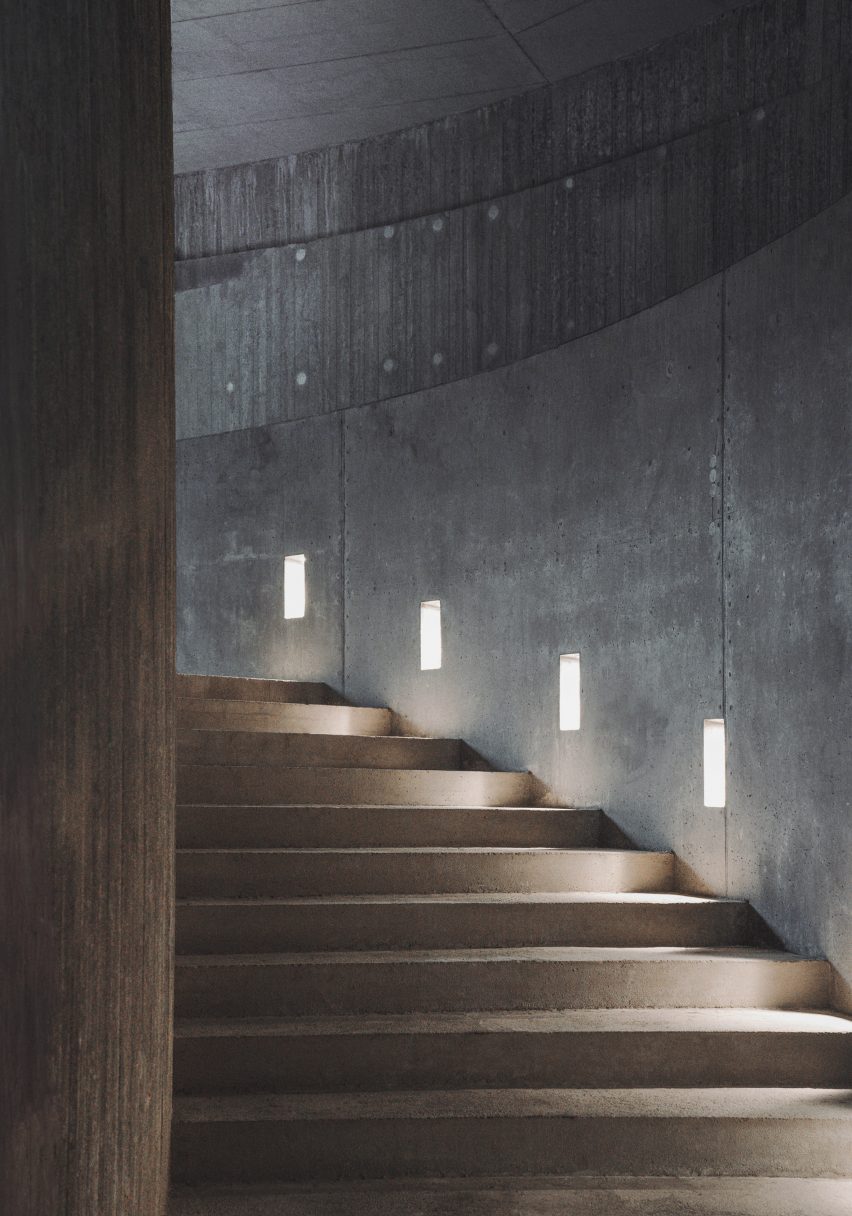 A curving staircase leads down to the cavern
Hydro-dipping, also known as water transfer printing, is a surface-coating technique in which printed designs are transferred to a three-dimensional surface using a water container.
“The meticulously designed facade system is a sculptural interpretation of rock formations – extruded and stacked,” Modin told Dezeen. “We were also inspired by science fiction.”
Cava Arcari performance space by David Chipperfield captured in new photos
“The facade needed to be robust due to the exposed conditions and high humidity from the mountain. Early studies explored timber, but it was ultimately deemed unsuitable for long-term durability,” Modin added.
“Hydro-dip technology was introduced at the client’s initiative,” she continued. “While it has primarily been used for military equipment and within the automotive industry, we thought it was interesting to explore the technology in a facade.”
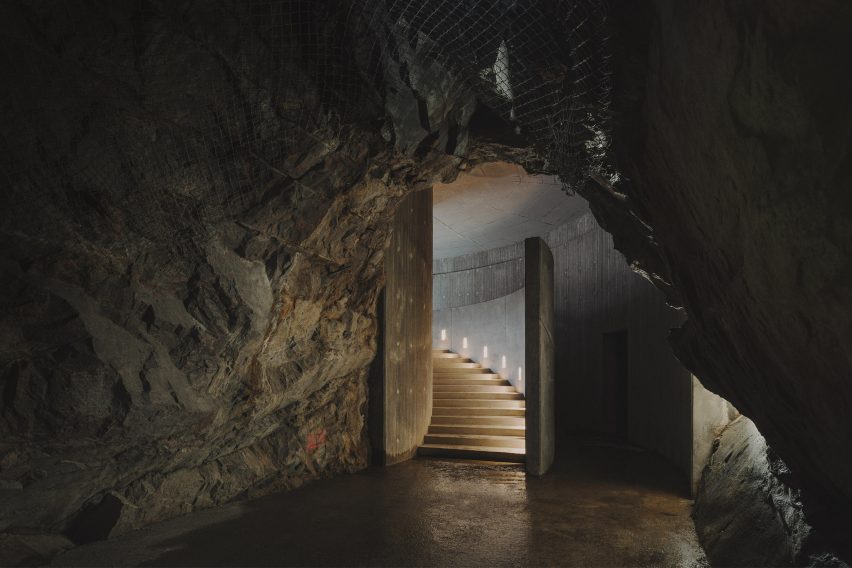 Its concrete form follows the existing shape of the cavern
Once through the glass doors of The Mountain Chamber, a curving staircase flanked by walls of exposed concrete with inset lighting leads into the cavern. Here, the concrete walls give way to the carved rock surfaces.
To preserve as much of the existing rock as possible, this concrete form follows the cavern’s shape, which was surveyed using 3D scans, and integrates technical systems and a service bench.
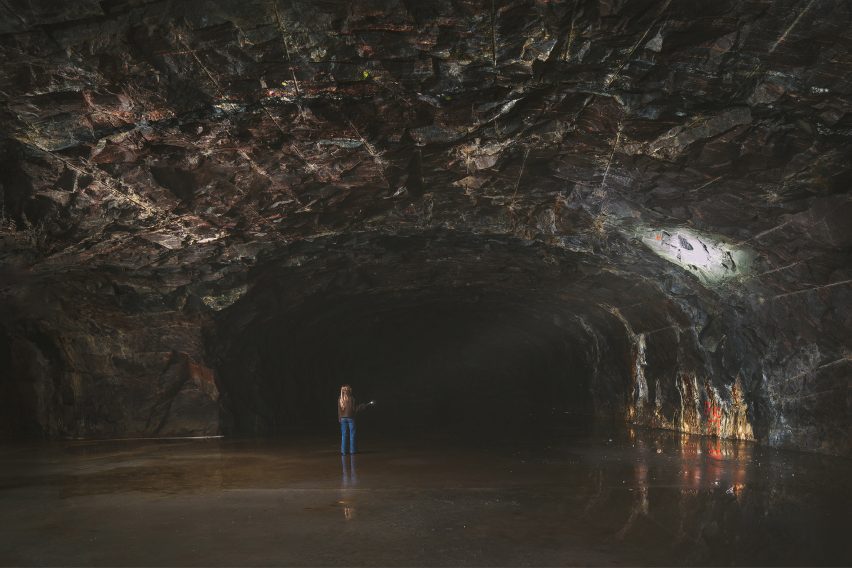 The cavern is located beneath a residential development
Other projects in Gothenburg recently featured on Dezeen include the renovation of the city’s iconic, cathedral-like “fish church”, which was completed by White Arkitekter, and the “open and free” Frihamnskyrkan church by Elding Oscarson.
The photography is by Anna Kristinsdóttir.