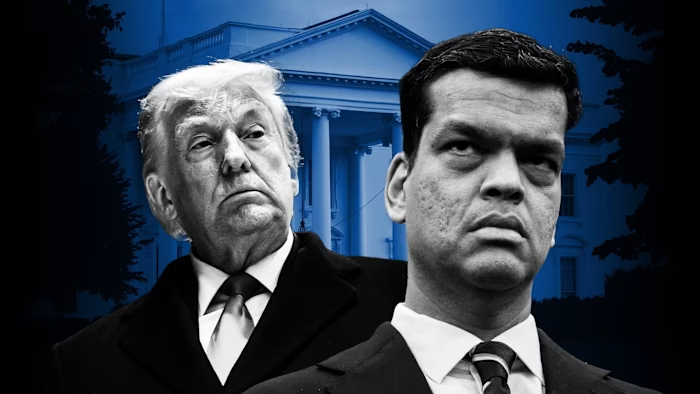
At a White House party last month, Donald Trump singled out Sriram Krishnan. “[People] ask me who the hell he is,” said the US president. “And yet without him things, certainly on AI, would not function well.”
Before his appointment as Trump’s AI adviser in December 2024, Krishnan was an engineer and venture capitalist largely unknown outside Silicon Valley.
Over the past year, he has been instrumental in shaping the administration’s light-touch approach to tech regulation, according to multiple Washington insiders and West Coast investors.
Krishnan’s efforts include authoring a bill on “Woke” AI, guiding new rules on chip exports to China and helping draft an executive order to frustrate state-level regulation.
He is motivated by a desire to “fight China and fight AI ‘doomers’”, said a person familiar with his thinking. Another ambition, said others, is a desire to be “in the room” where decisions are made.
In an era where tech is vital to national security and the economy, the 42-year-old provides the “connective tissue between Silicon Valley and Washington”, said Brad Gerstner, founder of investment firm Altimeter.
 From left, AI adviser Sriram Krishnan in the Oval Office with Ted Cruz, Donald Trump and Howard Lutnick © Alex Wong/Getty Images)
That has earned him praise in tech circles and criticism from Republicans who see him as the embodiment of Silicon Valley’s efforts to co-opt Trump’s agenda.
Born and educated in Chennai, India, Krishnan moved to California in the mid-2000s to work at Microsoft, before stints running product teams at social media companies Facebook, Twitter and Snap.
He developed close ties with Silicon Valley’s elite. Elon Musk and Mark Zuckerberg were early guests on “The Good Time Show”, a podcast Krishnan and his wife, Aarthi Ramamurthy, launched in 2020.
Krishnan has leveraged his contact book to great effect. He is in multiple group chats on Signal and WhatsApp, rallying tech executives around Trump policy positions, according to multiple people in those discussions.
Krishnan, a pro-wrestling fan, helped to broker a White House meeting last summer between Trump and WWE star Paul Levesque aka Triple H, according to people with knowledge of the matter. He also connected former UK prime minister Boris Johnson and Musk in 2024.
When Musk bought Twitter for $44bn in 2022, he asked Krishnan to join a group of trusted lieutenants in a secretive “war room” to overhaul the company. Also in the room was tech investor David Sacks, now Trump’s AI and crypto “tsar”.
 WWE star Paul Levesque, aka Triple H, at the White House last summer. According to people with knowledge of the matter, Sriram Krishnan helped to broker the meeting © Anna Moneymaker/Getty Images
Sacks played a role in persuading Krishnan, who had just left venture capital firm Andreessen Horowitz, to join the administration in 2024.
Andreessen’s outspoken brand of tech-boosterism has taken root on Capitol Hill during Trump’s second term. Its billionaire co-founder Marc Andreessen helped source candidates for Musk’s Department of Government Efficiency, while former partner Scott Kupor has become Trump’s HR chief.
Andreessen dispatched Krishnan to London in 2023 to open a UK office. His brief was to encourage the UK government into softer positions on tech regulation, particularly of cryptocurrencies, to provide a bulwark against former president Joe Biden’s firm approach to the sector, according to people familiar with the matter.
Krishnan quickly gained access to leading figures in British politics, including former Conservative prime minister Rishi Sunak and current Labour chancellor Rachel Reeves, added the people.
“He is a brilliant courtier. He did a fantastic job of giving Marc Andreessen what he wanted and he has brought that same skill to his work in the administration,” said one entrepreneur who has worked with him. “He is very good at understanding and imitating his master’s voice.”
Former colleagues pushed back on the idea that Krishnan is a cipher for the firm’s views, but his Silicon Valley credentials and connections have made him a target for members of the Maga movement.
Shortly after Krishnan’s appointment, he faced death threats over his support for skilled migration to the US. Laura Loomer, the Maga influencer, denounced Krishnan as a “career leftist” who was part of a group “trying to get into Trump’s admin to enrich themselves”.
 Maga influencer Laura Loomer denounced Sriram Krishnan as a ‘career leftist’ © USA Today Network via Reuters
Chris Lehane, OpenAI’s head of global affairs, said Krishnan’s “political philosophy generally aligned with the administration”, while his technical knowledge gave him credibility in the Valley.
“He recognised that the clay is very soft right now and he can help mould,” added Lehane, who counselled Krishnan on taking the role.
Trump has made winning the AI race a central mission of his second administration, rolling back Biden-era curbs on the “irresponsible use” of AI.
The president has released an action plan emphasising the need to “harness the full power of American innovation” by slashing “red tape and onerous regulation”. Krishnan wrote large sections of the plan, according to people with knowledge of the matter.
Accompanying the action plan was an executive order to curb “woke AI”, preventing federal agencies from procuring AI models “that sacrifice truthfulness and accuracy to ideological agendas”.
Last month, Trump was flanked by Krishnan, Sacks and commerce secretary Howard Lutnick as he signed another executive order pushing back against efforts in states including California and Colorado to regulate AI companies — a blow to prominent Republicans such as Florida governor Ron DeSantis who have argued for local guardrails.
As well as drafting sections of both orders, Krishnan worked to mollify Republicans and Democrats concerned about the impact of AI.
“He does his best to peace make. That’s his superpower,” said Martin Casado, a senior investor at Andreessen. “VC is a relationship business, and he’s the best of the best.”
Along with Sacks and Lutnick, Krishnan also helped clear the way for US chip companies, including Nvidia, to sell more chips to the Middle East and China, said people with knowledge of the matter.
They appear to have won an argument within the Trump administration over softening export controls, believing that allowing Nvidia to sell older generations of chips will hamper China’s efforts to reduce reliance on US technology.
Recommended

Krishnan has provided a pragmatic counterbalance to the more pugilistic Sacks, added Casado. “Sacks is a polemicist, 100 per cent . . . it was a very smart and very shrewd appointment. It allows Sacks to be Sacks because Sriram is so even handed.”
Unlike Sacks, who hosted a major fundraiser for Trump ahead of the election, Krishnan is not overtly political, preferring to focus on policy, according to people who know him.
That detached posture will be harder to maintain. Labour groups have expressed concern about AI’s impact on jobs, while Christian evangelicals in Trump’s base have railed against its effect on families. The president’s America-first foreign policies are likely to colour negotiations with allies about using US technology, said people familiar with the matter.
Krishnan and Sacks “don’t come at this with a vendetta”, said Josh Gruenbaum, the former KKR director who is now Trump’s procurement chief. “They are working for the president, they know what the president’s agenda is,” he added.
The entrepreneur who knows Krishnan expressed it differently: “If JD Vance came in with a different view he’d read that quickly. If [the Democrat California Governor Gavin] Newsom came in maybe he would too . . .
“In the tech world, we’re so keen to valorise independent thinking, but in diplomacy no one expects diplomats’ personal views to be well known.”