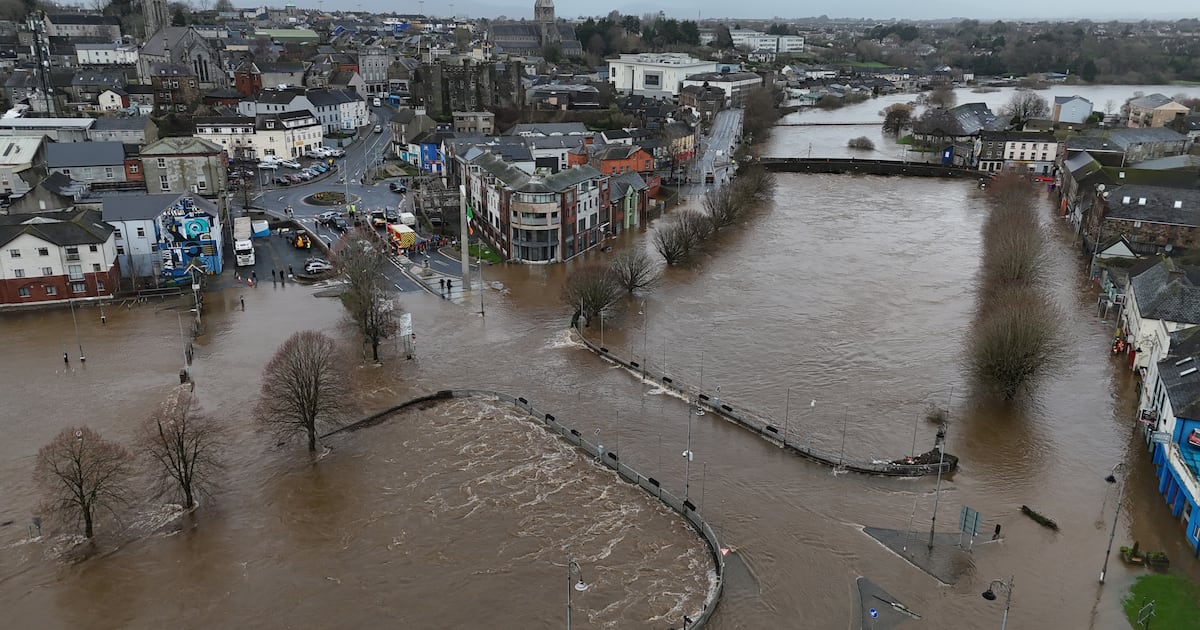
Dozens of homes and businesses in Wexford, Dublin and Wicklow were damaged in significant flooding that also caused serious disruption to road, rail and air travel following a deluge of rain during Storm Chandra on Tuesday.
Counties in the east and southeast were the worst affected by the storm and rainfall. The river Slaney in Wexford and Dodder in South Dublin burst their banks, causing widespread flooding, while many locals in Co Wicklow reported damaging water entering their homes.
Met Éireann forecasters warned the worst is not over and said flood risks will “persist for the rest of the week”, due to continued rainfall and slow drainage. However, Wednesday is due to be a bright and breezy day with sunny spells.
While nationwide status yellow weather warnings were in place on Tuesday, professor in geography at TCD Mary Bourke, who has studied floods extensively, said that while the coloured warnings are useful, they are on too broad a scale. “There were people in the yellow zones that had orange and maybe even red conditions,” she said.
The amount of rainfall in previous days meant the rain that fell during the storm wasn’t able to soak into the ground, leading to the floods, said Prof Bourke.
“The missing piece of the jigsaw is adding up all the factors that contribute to flooding … People got no notice that their river was going to flood. That’s an area we absolutely have to improve on … The information was there, but it wasn’t joined up,” she said.
While flood defences were needed, “nature-based solutions” were also required so the ground can “soak up heavy rain and slow the flow of rivers and stop the flooding”, she said.
Houses in Bunclody, Co Wexford have been flooded after the river Slaney burst its banks during Storm Chandra. Video: Reuters
Met Éireann rainfall data and OPW water level gauges show that some of the areas worst hit by the floods received almost half their average rainfall for January in one 24-hour period. The Phoenix Park got 40mm of rain in 24 hours up to 9pm Tuesday night, which is two-thirds its average rainfall for the full month of January.
Meanwhile, water levels in rivers reached or neared record levels documented over the past 20 years during the storm. The Slaney at Enniscorthy reached levels just fractionally below those during the New Year’s Eve floods caused by Storm Frank in 2015. Those floods devastated the town and prompted calls for the immediate introduction of flood defences, which are still not in place.
Provisional readings show the river Fane, which burst its banks in Co Louth, reached levels never before recorded. South Wicklow, where people were evacuated when the Aughrim river flooded, got more than one third of the area’s average monthly rainfall total for January in one day.
The sudden flooding incidents were “indicative of a country without the necessary infrastructure to cope with the changing climate”, said Labour spokesman on climate Ciarán Ahern.
The long-mooted flood relief works in Enniscorthy, with an estimated cost of €51 million, will include the construction of flood defence walls, the widening and deepening of the river Slaney, and the removal of the Séamus Rafter Bridge with the construction of a new road and pedestrian bridges.
Taoiseach Micheál Martin said the Department of Social Protection will assist households affected by flooding and “provide immediate needs payments and other supports where required”.
He added that the Department of Enterprise would look at a business support scheme for those affected.
Mr Martin said Dublin, Wicklow, Wexford and Cork were “significantly disrupted” but there were “flooding impacts across the country”.
He said Bunclody and Enniscorthy, Co Wexford, in particular, had experienced severe flooding and local authority teams were on the ground assisting homes and businesses.
A family with a young baby had to be rescued by boat from a flooded property near the quays in Enniscorthy, Co Wexford, on Tuesday by a local volunteer group.
Shane O’Connor, chairman of Slaney Search & Rescue in the town, said it was an extremely stressful situation for the parents of the young child.
“They were stranded in their apartment in Templeshannon Quay. Their baby is just a few months old. They had limited supplies in there for their child and they were also in fear of their power going.”
Mr O’Connor said they managed to get the couple, their child and a grandmother of the infant into the boat within 10 minutes.
Harry O’Connor, who founded Slaney Search & Rescue 30 years ago, said he doesn’t foresee flooding ever stopping in the town.
“There is always an excuse why it [the flood relief scheme] doesn’t happen,” he said.
Cars drive through flood water on the N11 northbound in Co Wicklow. Video: Nick Bradshaw
Meanwhile, Cllr Jackser Owens said people often talk of the “once in a generation” flood of 1965 when residents near the quays in Enniscorthy had to escape through their upper windows due to rising floodwaters.
He said nothing has been done for the town since that flood occurred.
“We are having a terrible time. It is unbelievable to go through this again,” he said.
Up to 30 homes and in excess of 20 businesses in the town were left under several feet of water on Tuesday after the river Slaney burst its banks.
Conor Swaine, who operates the local Btwenty7 cafe, said several shops in the town have “about a metre and a half of water” in them following the flooding.
About 2,500 homes, farms and businesses remained without power as a result of the storm on Tuesday night, said an ESB Networks spokesman.
Meanwhile, Dublin Fire Brigade responded to incidents in Kilternan, Hunters Wood, Firhouse, Sandyford and Rathfarnham. About 20 flights were affected at Dublin Airport, with further disruption possible later in the week.