Researchers at Oak Ridge National Laboratory (ORNL), US Department of Energy’s largest multi-program science and energy laboratory, have developed a modular 3D printing extrusion system that increases throughput without adding tool weight. The system merges multiple smaller extruders into a single material stream using specialized nozzle blocks, enabling adjustable output, precise deposition, and multi-material printing within a single bead.
The research was conducted at ORNL’s Manufacturing Demonstration Facility and funded by the DOE’s Office of Critical Minerals and Energy Innovation through the Advanced Materials and Manufacturing Technologies Office, with additional support from the SM2ART Program in collaboration with the University of Maine.
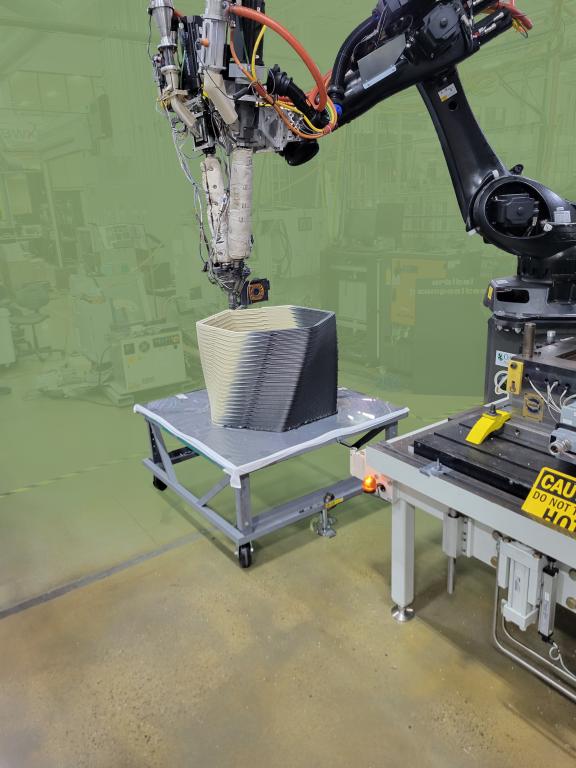 Modular Multi-Extruder System. Image via ORNL.
Throughput Challenges of Large Extruders
Large extruders are heavy and require robust—and often expensive—gantries or robotic systems for movement. At higher output levels, accuracy can decrease in low-volume tasks, leading to inconsistent material flow. This can make printing small components or tapered designs more difficult, often requiring slower speeds to prevent heat buildup that could cause warping or print failure.
ORNL’s system offers an alternative by allowing smaller extruders to be activated or deactivated without affecting print quality. It also supports simultaneous multi-material printing within a single bead, reducing the need to swap equipment.
“By enabling smaller-scale extruders to match the output of larger systems without the burden of extra weight — and by achieving unprecedented multi-material extrusion within the bead — this system is poised to redefine extrusion-based additive manufacturing,” said ORNL researcher Halil Tekinalp, who led the project. “These advancements will help strengthen U.S. manufacturing competitiveness and expand access to cutting-edge production technologies.”
Nozzle Design for Multi-Material Printing
The system uses a patent-pending aluminum bronze nozzle block, designed for strength and thermal conductivity. Its internal structure merges two molten polymer streams from parallel extruders, allowing a variety of large-scale pellet feedstocks to be processed across multiple configurations. This design has been shown to consistently double flow rates, with the potential to triple, quadruple, or more. A Y-shaped nozzle reduces central porosity and streamlines extrusion.
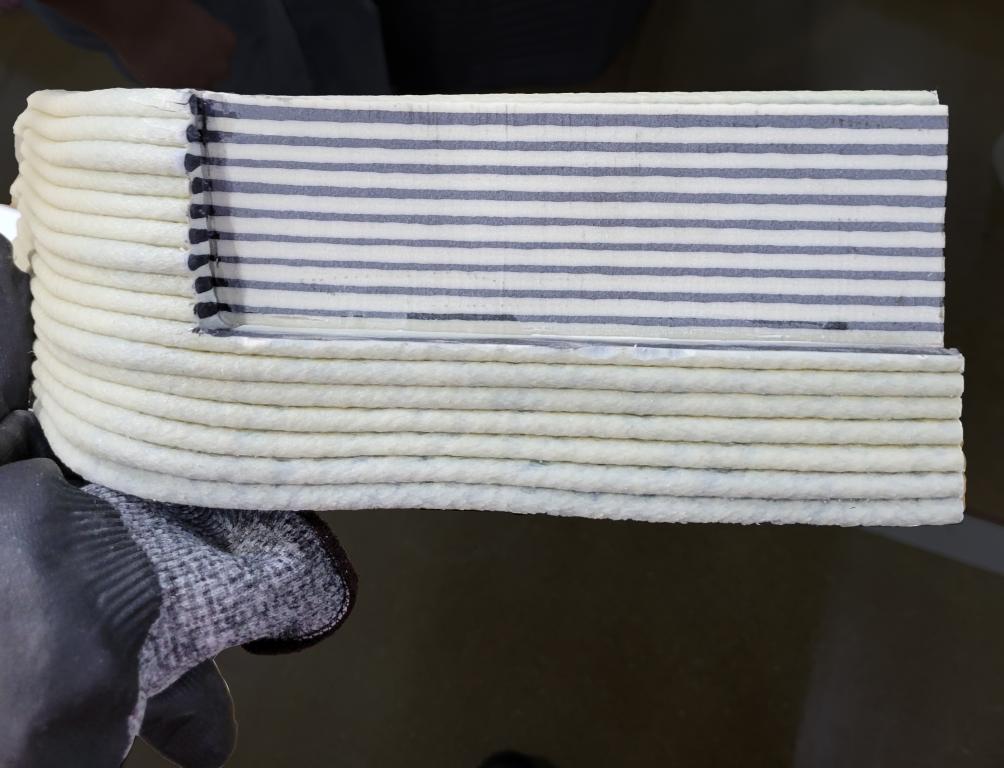 The modular multi-extruder system features a patented nozzle capable of producing core-coated strands: one material encasing another. Photo via ORNL.
Researchers have also developed a nozzle capable of producing core-and-sheath beads, where one material surrounds another. This allows materials with different mechanical or functional properties to be combined within a single bead. The design can improve interlayer adhesion and address delamination issues that can occur in polymer additive manufacturing.
Potential Applications and Testing Status
The system can produce parts that combine different material properties in a single piece, with potential applications across multiple industries. In aerospace, it could be used for crash-safe panels or radar-absorbing components. In energy, applications include flame-resistant enclosures or modular battery supports. Defense uses range from lightweight shelters to protective panels, while civil engineering could involve reinforced bridge decks or vehicle bumpers.
Testing so far has focused on large-scale, pellet-fed polymer extrusion, showing improved throughput, consistent deposition, and multi-material control. However, the system has not yet been evaluated for specific end-use materials, long-term durability, or certification in regulated industries. Its capabilities are limited to extrusion-based 3D printing and do not address throughput challenges in other manufacturing processes.
Industry Approaches to Scaling Extrusion
Throughput in extrusion‑based additive manufacturing has traditionally been constrained by tool weight, control, and deposition consistency, which limit practical speed increases. ORNL’s modular approach aligns with ongoing industry efforts to develop flexible, multi-extruder architectures.
At Formnext 2025, BigRep showed systems, including the VIIO 250, that use dual Smart Manufacturing Extruders (SMX) operating at high temperatures and capable of processing engineering and reinforced materials, with features like “Twin Mode” for simultaneous dual‑extruder printing to increase throughput. Also reported from Formnext 2025, Prusa Research and Bondtech introduced the INDX Smart Toolhead, a dual‑extrusion feeder/tool changer that can switch materials rapidly, supporting multi‑material workflows without major downtime.
The 3D Printing Industry Awards are back. Make your nominations now.
Do you operate a 3D printing start-up? Reach readers, potential investors, and customers with the 3D Printing Industry Start-up of Year competition.
To stay up to date with the latest 3D printing news, don’t forget to subscribe to the 3D Printing Industry newsletter or follow us on Linkedin.
Featured image shows Modular Multi-Extruder System. Image via ORNL.