PUBLISHED : 28 Jan 2026 at 04:52

- Small
- Medium
- Large
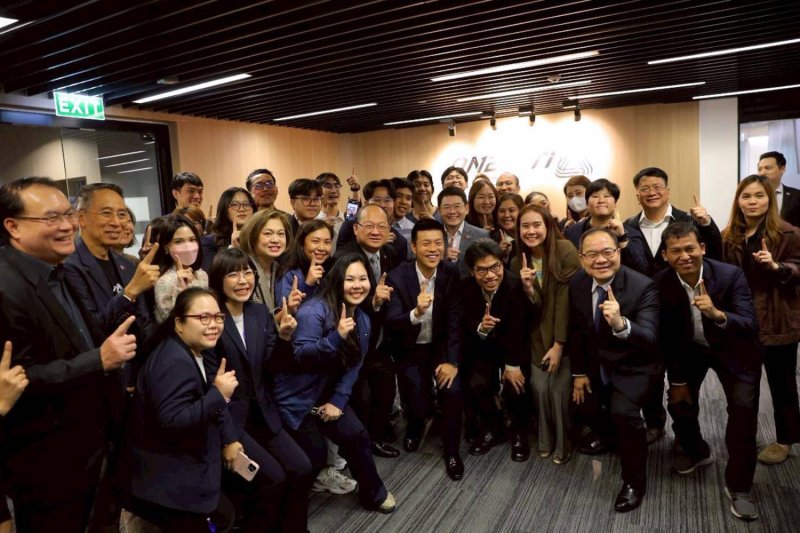
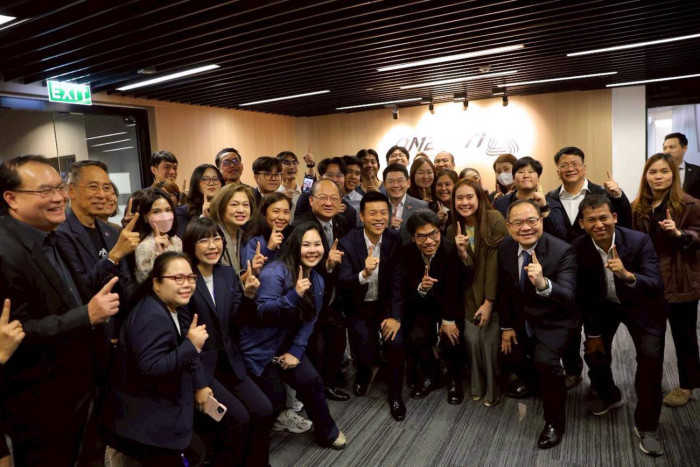
Natthaphong Ruengpanyawut, leader of the People’s Party, fifth from right, front row, and his team pose for a photo with Kriengkrai Thiennukul, president of the Federation of Thai Industries, sixth from right, and FTI executives after discussions on economic policy at the FTI headquarters in Bangkok’s Sathon district on Tuesday. (Photo courtesy of People’s Party)
The People’s Party (PP) has pledged to roll out an ambitious “first 100-day” economic plan worth 250 billion baht if elected to form the next government.
The plan aims to revive Thailand’s economy by boosting liquidity for entrepreneurs, tightening fair competition and stimulating domestic demand, while continuing the current co-payment scheme.
Party leader Natthaphong Ruengpanyawut outlined the proposal after a meeting on Tuesday with executives of the Federation of Thai Industries (FTI). He said the initial phase would focus on plugging structural economic loopholes and restoring fairness for Thai businesses and workers.
Mr Natthaphong said a PP-led government would immediately crack down on substandard products and foreign-operated online shops that distort competition on digital platforms. Failure to address the issue, he warned, would directly undermine Thai entrepreneurs and labour.
On the stimulus front, he said the government would accelerate economic activity on both the consumption and production sides through domestic spending mechanisms, including the continuation of the co-payment scheme.
Under the same policy framework, the party plans to inject 250 billion baht in liquidity through three key mechanisms: 100 billion baht in first-home loans to support home ownership and the real estate sector; 50 billion baht in SME loans to improve access to formal credit and reduce reliance on informal lenders; and 100 billion baht in “transformation loans” to upgrade production and services towards digital and AI-driven industries.
These measures would be supplemented by a 15-billion-baht “SME receipt lottery” scheme to boost small retailers’ sales, and a 10-billion-baht “Half-Half Made in Thailand” scheme to support domestic manufacturing, particularly through the replacement of electrical appliances.
Mr Natthaphong said the measures could build on existing industrial development initiatives promoted by the FTI, including the “aFTi Go Digital & AI” programme.