Getting your audio player ready…
The comet the world knows as Halley’s Comet may owe its “first to spot the pattern” credit to someone far earlier than Edmond Halley: an 11th-century English monk. New interdisciplinary research argues that the monk Eilmer (also known as Aethelmaer) of Malmesbury linked two appearances of the same comet – centuries before Halley calculated its return. If the claim holds, it reframes a famous scientific milestone as something medieval thinkers were already inching toward.
In the Leiden University account, astronomer Simon Portegies Zwart and British Museum scientist Michael Lewis point to a passage preserved by the 12th-century chronicler William of Malmesbury, suggesting Eilmer recognized the comet he saw in 1066 as the same one he had witnessed decades earlier, in 989.
A Medieval Mind Spots a Cycle
Edmond Halley famously showed that comets seen in 1531, 1607, and 1682 were the same object, returning about every 76 years – a breakthrough that helped turn comets from omens into predictable celestial visitors.
But the Leiden team argues Eilmer had already made a simpler – yet startling – leap: linking his 1066 sighting with an earlier one. That leap matters because it suggests medieval observers weren’t merely recording wonders; they were beginning to interpret long-term patterns from historical memory and written tradition, writes the Leiden University release.
For Ancient Origins readers, it also fits a familiar theme: the Middle Ages were steeped in “signs,” yet monasteries were also places where records were kept, copied, compared, and sometimes surprisingly well-reasoned – especially when a spectacle in the sky seemed to echo political catastrophe on Earth.
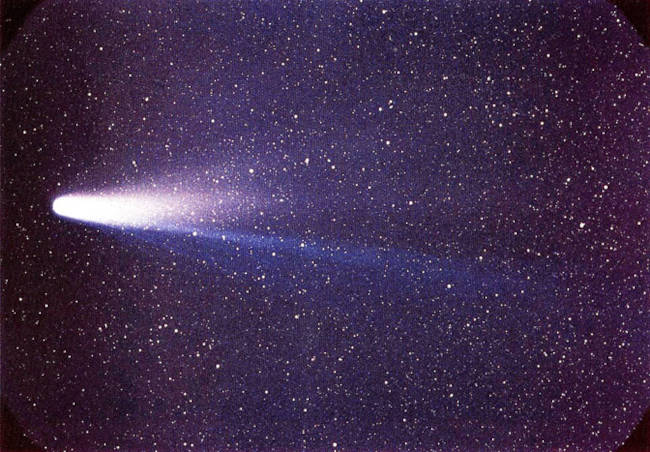
Comet 1P/Halley as taken March 8, 1986 by W. Liller, Easter Island, (Public Domain)
1066: The Comet, the Tapestry, and the Omen
The 1066 appearance is one of the comet’s most culturally loaded returns. The comet was observed in China for more than two months, and – according to the Leiden summary – was at its brightest on 22 April 1066, becoming visible in Brittany and the British Isles by 24 April.
That timing dropped it straight into the tense months leading to the Norman Conquest. NASA notes that the comet’s 1066 appearance became entwined with the Battle of Hastings, and the Bayeux Tapestry preserves what is often called the first illustration of the comet – stitched into a propaganda-rich narrative of regime change.
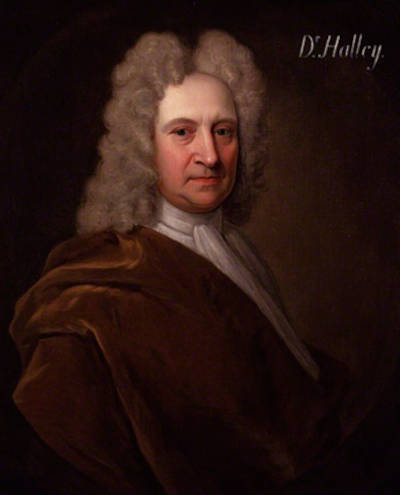
Edmond Halley portrait by Richard Phillips. (Public Domain)
Rename it—or rethink how we name discoveries?
Portegies Zwart and colleagues argue the comet should be reconsidered for renaming, since its periodic nature may have been recognized long before Halley. Portegies Zwart called the work “great fun” but also “challenging” due to its interdisciplinary nature, adding: “Nevertheless, we plan to carry out further research into this kind of periodic comet.”
Still, Halley’s role remains pivotal in the modern scientific sense: NASA explains that he used Newtonian ideas to compute comet orbits and correctly predicted the 1758 return – why the comet became “Halley’s” in the first place.
In other words, this isn’t just a naming spat. It’s a reminder that the history of knowledge often runs through monasteries, manuscripts, and memories, long before it reaches equations.
Top image: Men staring at Halley’s Comet on the Bayeux Tapestry (Scene 32). Source: Myrabella/Public domain
By Gary Manners
References
Lewis, M. 2026. Halley’s Comet wrongly named: 11th-century English monk predates British astronomer. Available at: https://www.universiteitleiden.nl/en/news/2026/01/halleys-comet-wrongly-named-11th-century-english-monk-predates-british-astronomer
NASA. 2021. 955 Years Ago: Halley’s Comet and the Battle of Hastings. Available at: https://www.nasa.gov/history/955-years-ago-halleys-comet-and-the-battle-of-hastings/
NASA. n.d. 1P/Halley. Available at: https://science.nasa.gov/solar-system/comets/1p-halley/
Phys.org. 2026. Halley’s Comet wrongly named: 11th-century English monk predates British astronomer. Available at: https://phys.org/news/2026-01-halley-comet-wrongly-11th-century.html