
“Nobody knows anything,” the great screenwriter William Goldman said of Hollywood. By which he meant that you can team the greatest stars with the greatest director and writer and still cook up a turkey.
Conversely, a film can also become the most unexpected success. K-Pop Demon Hunters wasn’t on most people’s radars before it landed on Netflix in the summer of 2025. It’s now a smash hit, powering past 500 million views on the streamer just before Christmas.
It has been such a success that Sony Pictures Animation, the studio behind it, decided also to release it in cinemas. An action-adventure-musical animation based on a mixture of Korean pop culture and myth, the film cleared a healthy $25 million at the US box office, despite being something you could just as easily have watched from your sofaplex rather than paid to see at the cineplex.
Chris Appelhans and Maggie Kang’s movie features some home-grown involvement. Ireland and Northern Ireland have become, jointly and separately, moviemaking powerhouses over the past two decades, with productions from Star Wars to Blue Lights making the most of the island’s locations, actors, artists and other talent.
We’re also exporting some of those artists to the wider world, which is why James Carson is talking to The Irish Times from his home in Vancouver – another movie powerhouse location.
Carson, who is originally from Belfast, is a CG supervisor at Sony Pictures Imageworks, a spin-off that produces computer graphics for live-action special effects as well as for animation.
He’s one of the huge team of animators and technical wizards who, starting with nothing more than some pencil sketches and computer code, have built a wild, complex and thrilling animated world and populated it with characters who will inevitably be your kids’ next Halloween costumes.
[ What is K-pop and why is it everywhere?Opens in new window ]
So how do you do it? Leaving aside K-Pop’s huge success, how do you go from nothing to amazing, while never leaving your desk?
“Before clients come to us, they’ve worked on the movie already. They’ll have concept art and imagery, and it’ll all have a lot of intention in it,” says Carson, who next month will be talking about his work at Rendr, Belfast’s creativity and tech festival.
“So they’ll come to us with the ideas, and then we have to start to interpret it, and we kind of have to say to the clients, ‘You’ve had your ideas. Now we need to understand it to make it work.’”
The process of creating on-screen animated characters isn’t easy. You might assume that a sketch of one of the characters would simply be fed into a computer and told to move about, but according to Carson it’s a series of one step forward, two steps back.
“It’s a constant, iterative process,” he says. “Sometimes we go too far in one direction; sometimes we haven’t gone far enough. So while it starts with still images, and working with them, in the background the animation is always working up.”
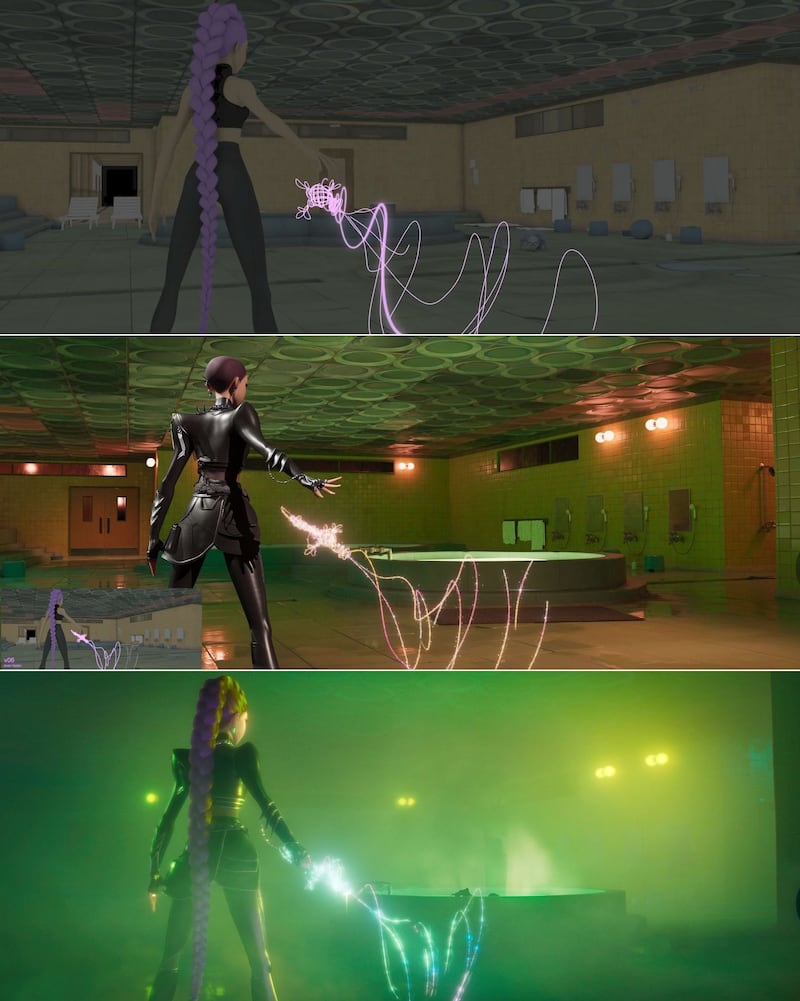 K-Pop Demon Hunters: a shot goes through test phases (top and middle) before reaching its final version (above). Photographs: Sony Pictures Imageworks
The process is also incredibly multilayered. It’s not just a case of drawing a first picture and then adding a second that’s slightly different, repeating the process until you’ve created the illusion of life. Modern CG animation has different teams working on movement, shadow, colour, background and even light.
The last of these is Carson’s speciality: creating lighting effects for animated characters that exist only in a computer but look like they would in the real world, or at least similar enough so that we get drawn into the action rather than being left at one remove by an uncanny valley.
Lighting is “pretty much the final pixels of what the movie will look like”, he says, “but then there’s the animation department, and they’re also finding the shape language, and the body language, and how the characters move. And the clients are constantly busy with this through several of the departments, and we’re all trying to get a bit of their time and find the look of the movie that way.”
While K-Pop Demon Hunters credits two directors – Appelhans and Kang – it effectively has hundreds, as each team of animators and artists takes the script, the voice tracks laid down by the actors, and the directors’ instructions and works their own magic from that starting line.
What makes it work, according to Carson, is that the teams – unlike the backflipping, kicking and punching stars of the film – keep their feet on the ground when it comes to working out how things should look.
“It could be easy to wander off into something that’s not grounded, but I think one of its main strengths is we actually do VFX, which is the grounded stuff,” Carson says.
VFX are visual effects that enhance live-action footage. K-Pop Demon Hunters, on the other hand, is a film in which eyes become popcorn dispensers and demons sprout from the bodies of air stewards. Yet you can see his point: there’s enough realism in the images to sell the crazy, mythical stuff.
Carson says much of that comes from working in special effects for live-action films, including the upcoming Project Hail Mary, a sci-fi blockbuster starring Ryan Gosling.
[ 50 films to see in 2026: Dune and Toy Story 5 among big releasesOpens in new window ]
“It’s about matching the real world and matching what they shot on set,” he says. “It’s a skill set that has overlap with animation such as K-Pop. But, yeah, you really are just building up from nothing. And lighting is a huge part of that, of creating the mood of the movie and its storytelling capabilities, and that’s actually what I enjoyed most about it.”
All animation is hard work – an animated feature can take four years to make, whether it’s done in a computer or drawn by hand – but one sequence stands out to Carson as the hardest of all in K-Pop: an all-action fight sequence in a bath house.
“There’s lots going on there. There’s tonnes of demons, there’s volumetrics for the steam of the bath house, and then a lot of effects, because there’s a lot of weapons, and then all those weapons have effects coming off them, and then it’s just a lot of dynamic camera moves.
“I would say that was probably one of the more challenging ones, because where the challenge comes is actually a little earlier, where the clients are asking us to develop certain tools so that a sequence like that can actually be filmed. Once we have those tools it’s a little easier to apply those across sequences.”
The bath-house fight is a bravura sequence that combines fantastical creatures, humans, steam, tiles, reflective surfaces, glowing swords, shiny leather, hair and balletic camera movements.
Each shot – the computer-constructed equivalent of one of the 24 frames that make up a second of traditional animation – requires multiple passes to build up the layers of structure, shape, movement and lighting, and even to match the performances to the actors’ voices.
 James Carson of Sony Pictures Imageworks
Could you do this at home? Way back in 1995, after all, when Pixar Animation Studios created the smash hit Toy Story, its high-end computers would have been the equivalent of family laptops now.
That’s true enough, according to Carson (whose credits also include Spider-Man: Across the Spider-Verse, In Your Dreams and The Meg), but the complexity, fluidity and precision of the animation has risen since then, so now you’d need something that would easily be hundreds or even thousands of times more powerful than a regular PC.
“If you try and do this stuff on a home computer, it’s totally doable, but you’re only able to look at one thing at a time, and then you have to wait five more minutes for it to render again,” he says. “Whereas what we can do is launch five renders at once and get them all back at the same time. As the technology improves, the asks and the requests also improve.
“So it’s a constant upping of the ante, where they want more because they know that technology can do more, and therefore we push the technology harder. What we actually use is like a very high-end PC computer. There’s nothing we use that’s not commercially available to just about anyone, but we have lots and lots of these PCs, all tied together to create what we call render farms.”
A render farm is a collection of computers that animators can use to divide the processing work involved in rendering – which raises an obvious question for anyone working in a creative industry: is AI a demon to be slain or just a tool to be used?
“It’s a tool,” Carson says. “I really don’t see it as a threat. What we’re being asked for, it’s very specific, and clients and directors want to build upon the image. They don’t want it to then become a new image again and give new notes. They want to build upon that, and improve upon it.
“And AI doesn’t really give us that. It’s just, ‘Here’s a new version of that same prompt you gave me a minute ago.’ As a tool, it has a ton of possibilities, but as a way to produce the final image, I think we’re okay for a while.”
Rendr takes place in Belfast on Thursday, February 12th, and Friday, February 13th; James Carson talks about K-Pop Demon Hunters at 5pm on the first day of the festival