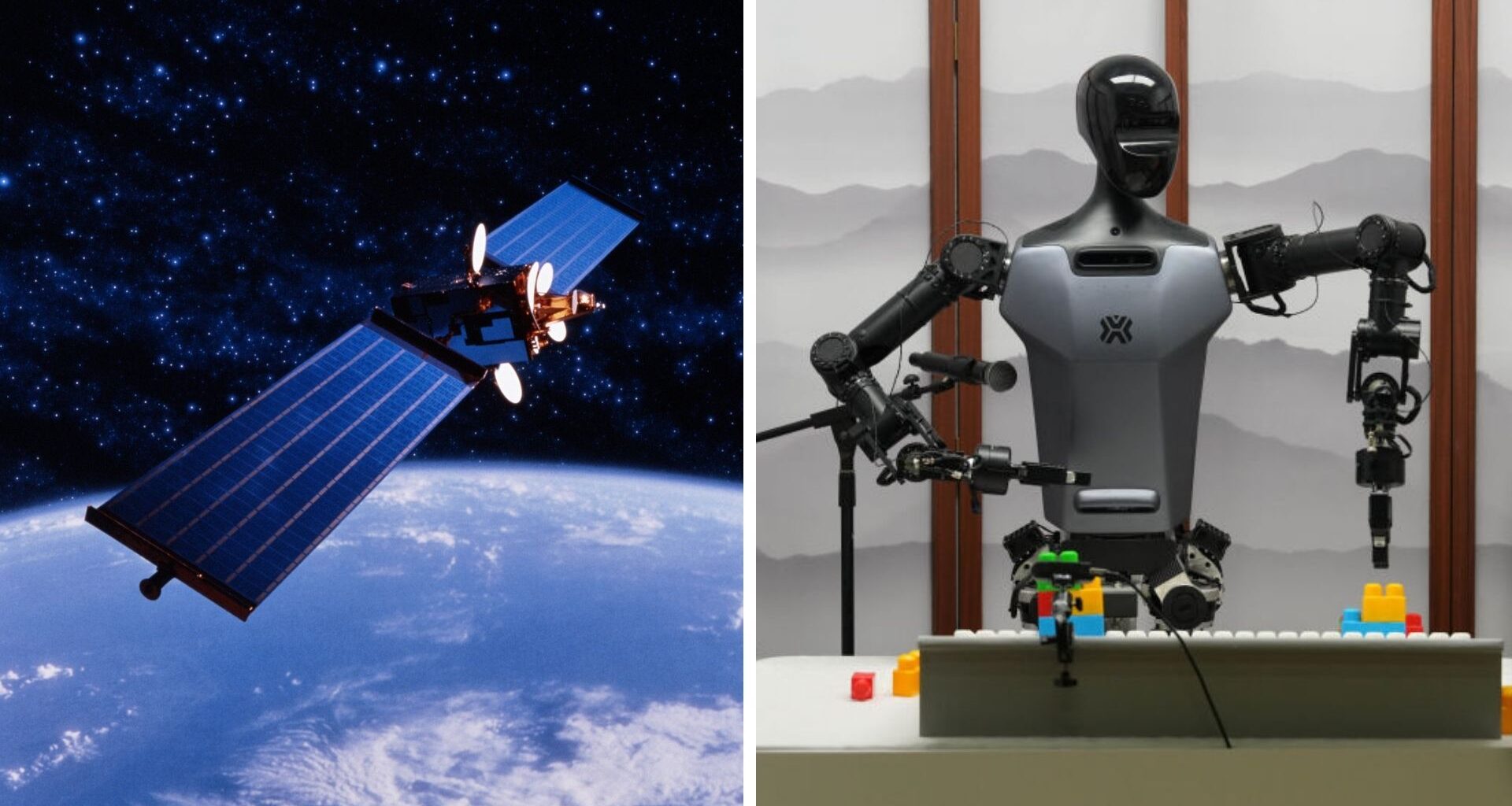
X-Humanoid’s “Embodied Tien Kung” robot became the “world’s first” humanoid to establish a direct link with a low Earth orbit satellite. The robot allegedly achieved this feat at the 3rd Beijing Commercial Space Industry High-Quality Development Promotion Conference on January 23.
The humanoid reportedly established a connection with GalaxySpace’s new wing-array integrated internet satellite and transmitted visual data in real time.
The test represented China’s first multi-terminal, multi-link connection using a new phased-array flat-panel LEO internet satellite, maintaining stable performance without support from ground-based networks.
About the demo
The team assigned the robot a real-world task: retrieving a symbolic project completion certificate placed inside a driverless vehicle. The vehicle traveled on its own from the government service center to the newly completed Rocket Avenue.
As a GalaxySpace internet satellite passed overhead, the “Embodied Tien Kung” robot identified the right moment to connect. It ran system checks before establishing a communication link directly with the LEO satellite.
Smartphones and computers were also connected to the established network, demonstrating that the satellite could handle multiple devices.
With the satellite connection active, the humanoid walked to the unmanned vehicle, picked up the certificate, and carried it to another building. While in action, everything the humanoid did was turned into data – including joint movements and the video from its forward-facing camera.
Upon arrival, the “Embodied Tien Kung” robot presented the “Joint Project Completion Acceptance Certificate” to the project leader, a representative of Ezhou Star Arrow Company.
Satellite data transfer
The data sent to the satellite hundreds of kilometers above Earth was relayed back down to the command center almost instantly, allowing operators to study the robot and its activities in real-time, both from its first-person view and from an external monitoring perspective.
The test showed that a humanoid could perform a real physical task while connected via a satellite link, which could be useful in remote areas, disaster zones, or other places where traditional networks are unavailable.
By enabling the robot to connect via satellite rather than a traditional ground-based internet, the system overcame the usual geographic limits that restrict where robots can operate.
The experiment developed a model that could be applied across many industries, enabling robots to operate in remote or low-signal environments for tasks such as inspections, emergency response, field exploration, and mining.
In these high-risk environments, robots could take over dangerous work, improve efficiency and scheduling, and make autonomous systems more practical and useful in the real world.
Not the ‘world’s first’ for the first time
Interestingly, this isn’t the first time Tien Kung became the first humanoid to achieve a particular feat. In February 2025, it climbed 134 outdoor steps to the summit of Haizi Wall Park in Beijing, becoming the first robot to navigate such complex outdoor terrain.
Together, these demonstrations highlight ongoing testing of humanoid robots in increasingly varied and demanding real-world conditions.