A decades-old idea is quietly regaining attention in theoretical physics: ancient structures embedded in the universe’s fabric could reshape current understanding of time. Long dismissed as fringe speculation, these models are being reexamined in light of emerging gravitational data.
Interest surged after radio signals from distant pulsars began revealing anomalies that standard astrophysics has yet to fully explain. Researchers are now rethinking whether overlooked phenomena from the early universe might still be detectable today.
Efforts to trace these disturbances have converged on a few possibilities. Among them is the hypothesis that one-dimensional topological defects—known as cosmic strings—may still stretch across the cosmos, leaving measurable fingerprints in the form of low-frequency gravitational waves.
These signals could do more than verify long-standing cosmological theories. Some scientists suggest they may point to exotic behaviors in space-time that border on the mechanics of time travel.
Evidence Builds Around Cosmic Strings and Gravitational Distortions
In 2020, the North American Nanohertz Observatory for Gravitational Waves (NANOGrav) reported timing fluctuations across dozens of millisecond pulsars. The consistency of these irregularities hinted at a potential source beyond local interference or internal pulsar behavior. The data, collected over 12.5 years, appeared to suggest a gravitational wave background at nanohertz frequencies, typically associated with extremely large-scale astrophysical phenomena.
Researchers initially proposed supermassive black hole mergers as the cause. However, theoretical work published in Physical Review Letters presented another possibility. Teams from CERN, King’s College London, and the University of Warsaw outlined models showing that cosmic strings, relics from the universe’s rapid inflation, could also produce gravitational radiation consistent with the observed signals.
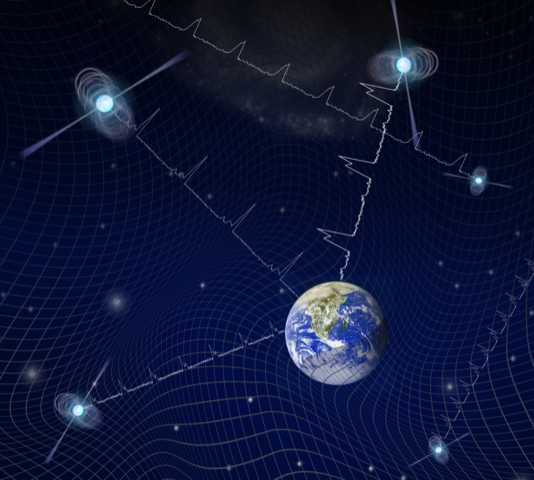 By monitoring the radio flashes from distant pulsars, astronomers have spotted a signal that could be the result of a background of gravitational waves. Credit: Tonia Klein/NANOGrav
Cosmic strings are predicted to form during symmetry-breaking phase transitions shortly after the Big Bang. These hypothetical filaments would be incredibly dense, yet thinner than a proton, and could span astronomical distances. Vibrations or collisions within a cosmic string network may generate gravitational wave patterns across a wide range of frequencies.
Theoretical physicist Ken Olum and others revisited a concept first introduced by J. Richard Gott in 1991. Gott’s model showed that if two infinite cosmic strings passed each other at relativistic speeds, their gravitational fields could bend space-time into a closed time-like curve. Such a loop would theoretically allow a traveler to return to a point in time before departure. The solution remains mathematically valid within Einstein’s field equations, though practical implementation is viewed as implausible due to the requirement of infinite string length.
String Theory and Superstrings Enter the Discussion
Complementing the classical cosmic string hypothesis is the concept of cosmic superstrings, which emerge from string theory. This framework suggests that particles are not zero-dimensional points, but instead are one-dimensional strings vibrating across ten or more dimensions. Under early universe conditions, some of these quantum strings may have stretched to macroscopic scales, making them detectable today.
Olum stated in an interview with Popular Mechanics that although cosmic superstrings are less likely to exist, they would be “relatively easier to detect” if they did. Their detection could serve as indirect evidence for string theory, which remains unconfirmed despite decades of mathematical development.
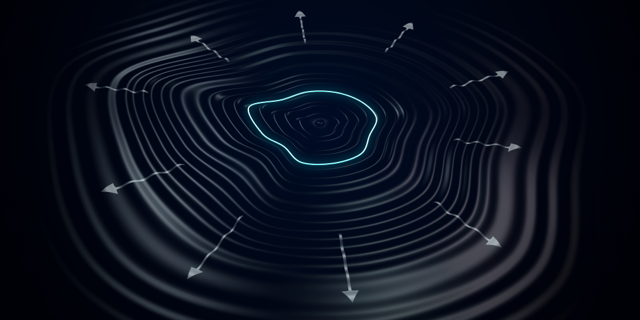 Cosmic strings that are closed into loops could produce gravitational waves at a wide range of frequencies, including those probed by NANOGrav. Credit: Daniel Dominguez/CERN
A signal detected by NANOGrav in 2020 did not resemble those previously associated with black hole activity. “It doesn’t look all that much like the signal we’d expect from black holes,” Olum said, “which is the intriguing thing about all this.” He added that the pattern could “perfectly” match expectations for cosmic superstrings. His remarks align with published interpretations in Popular Mechanics and reflect cautious optimism rather than confirmation.
If verified, such evidence would not only reshape gravitational wave astronomy but also offer support for unification theories that attempt to reconcile general relativity and quantum mechanics. The possibility of measuring or modeling closed time-like curves would carry implications far beyond theoretical interest, raising new questions about causality, temporal coherence, and the physical limits of space-time geometry.
Observational Gaps and Next-Generation Instruments
Despite growing theoretical support, no cosmic string has yet been observed directly. The absence of visual or experimental confirmation remains a key limitation. Projects like LIGO and VIRGO, though successful in detecting gravitational waves from black hole and neutron star collisions, lack the sensitivity to isolate signals at the nanohertz scale.
NANOGrav’s research continues in collaboration with global efforts such as the International Pulsar Timing Array. These arrays use pulsars as cosmic clocks, detecting slight changes in pulse arrival times that could be caused by space-time distortions. However, the collapse of the Arecibo Observatory in December 2020 reduced North America’s observation capacity significantly. Work is ongoing to replace its data stream through other facilities.
Looking ahead, the planned launch of the Laser Interferometer Space Antenna (LISA) in 2034 could provide critical new data. LISA’s design allows it to detect millihertz-frequency gravitational waves, which may enable a spectrum-based comparison of different theoretical sources, such as supermassive black hole binaries versus cosmic string loops.
Research groups continue to analyze frequency ranges, amplitude patterns, and polarization signatures to determine which scenario best fits the accumulated data. As pulsar timing arrays extend their observation baselines, even minor changes in correlation across the sky could tip the balance toward or against the cosmic string hypothesis.