
In the coastal forests of northern California, a rare and elusive predator has been quietly struggling for survival. Once thought to be extinct, this creature now faces numerous challenges due to habitat loss and overhunting. A recent study, published in Global Ecology and Conservation, has provided valuable insights into its habitat preferences and population. With only around 500 individuals remaining, this predator is the coastal marten, one of the rarest mammals on Earth.
Rediscovery of the Coastal Marten
The coastal marten, also known as the Humboldt marten, was once widespread from northern California to Oregon. However, by the 20th century, the population dramatically declined due to overhunting for their valuable pelts and destruction of their forested habitats. It seemed as though the species had vanished entirely, but in 1996, a small population was rediscovered in the coastal forests of northern California. This discovery marked a turning point for conservationists, offering a glimmer of hope for the species’ survival.
The coastal marten’s secretive nature and preference for remote, dense forests make it incredibly difficult to track, and for years, little was known about its exact population or habitat range. The recent study led by Sean Matthews and his colleagues sought to fill this knowledge gap using a range of innovative, non-invasive techniques. By deploying 135 remote cameras and 285 hair snares over a 400-square-kilometer area in northern California, researchers were able to gather critical data on the species’ current status.
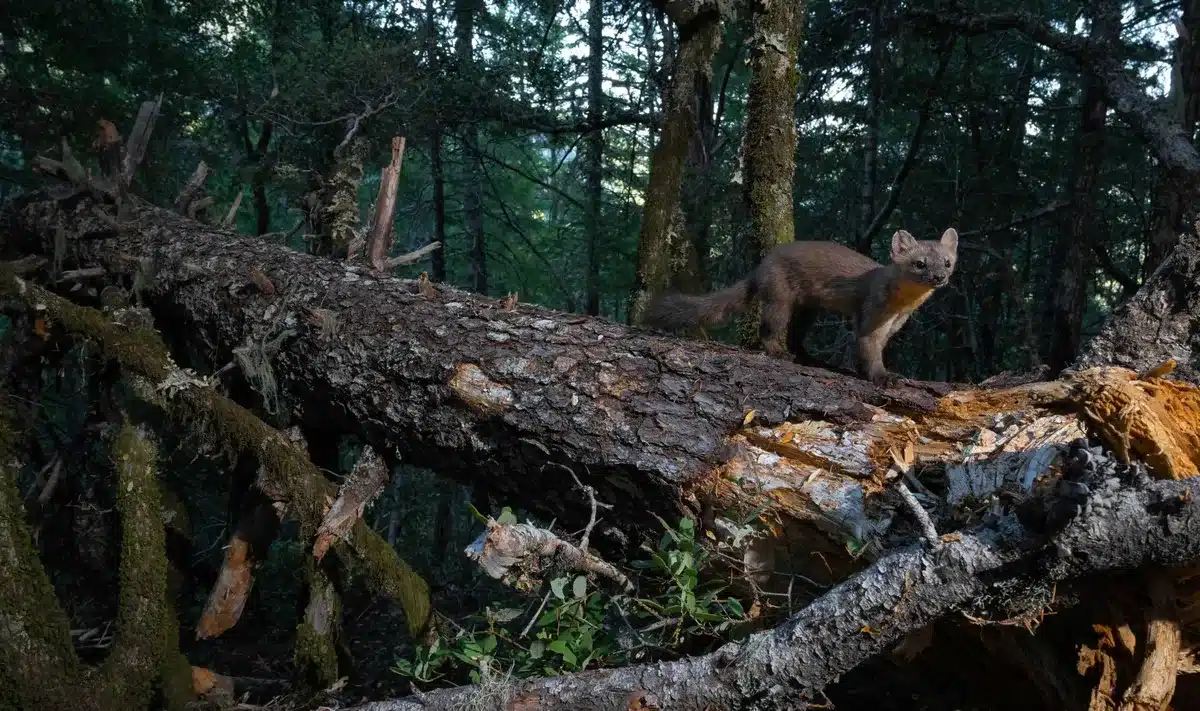 A coastal marten pauses on a Douglas fir. Credit: Oregon State University
The Challenges of Studying an Elusive Species
“There’s a lot we don’t know about this species, including information as basic as what forests do coastal martens still occupy, how many martens are there, and are these populations increasing,” says Sean Matthews. The difficulty of studying the coastal marten is not only due to its elusive behavior but also its preference for dense, difficult-to-access habitats. These factors make it challenging to track the species and gather comprehensive data on its population and range.
The study’s results, however, are promising. The researchers estimated that there are about 500 coastal martens remaining in the wild, inhabiting just 5% of their historic range. Genetic testing of hair samples revealed that the population is composed of 28 males and 18 females, with the population density estimated at roughly one individual per three square kilometers.
 Credit: Oregon State University
Habitat Preferences and Conservation Insights
Coastal martens are highly selective when it comes to their habitat. According to Erika Anderson, who led the study,
“Martens tend to select forest stands with greater than 50 percent canopy cover and lots of large-diameter trees, snags, and hollow logs.” This preference for complex forest structures is essential to their survival. “
Structural complexity with coarse woody debris helps them to hunt and also provides cover from predators and competitors.”
The study, published in Global Ecology and Conservation, found that coastal martens are most abundant in high-elevation, snow-laden forests and lower-elevation coastal forests with ravines and rivers. The animals rely on a combination of tall trees, fallen logs, and dense foliage to support their hunting and provide safety from predators. These habitat preferences highlight the need for effective forest management practices that protect and maintain the complex ecosystems the martens rely on.
However, these habitats are under threat from climate change and logging activities. As old-growth forests become increasingly rare, coastal martens face a growing risk of habitat loss, further endangering their survival. This finding underscores the importance of conserving these critical forest ecosystems to support not just the coastal marten, but also the diverse array of species that depend on them.