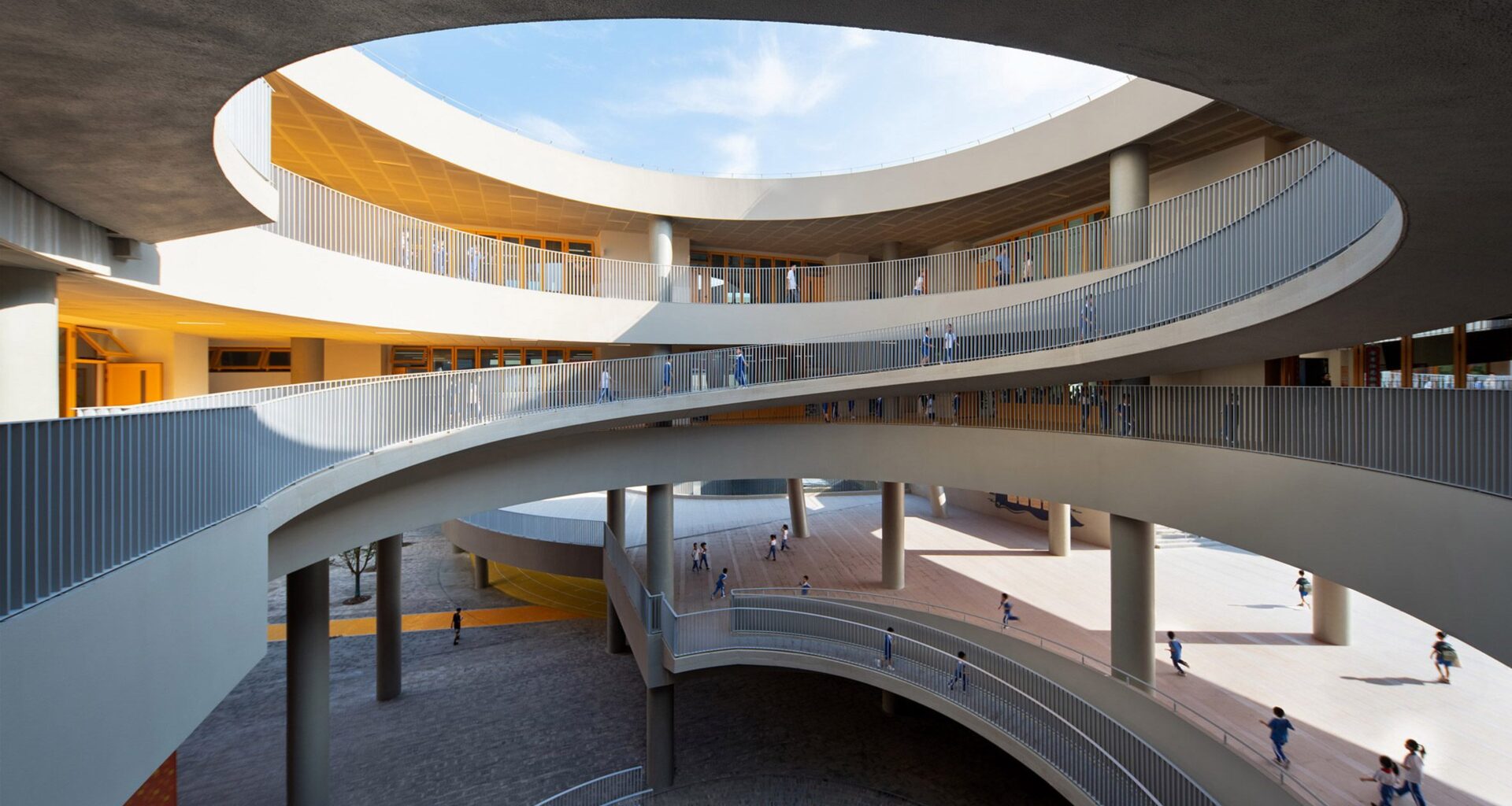
Chinese studio Urbanus designed the playful Hakka Academy Longgang Twin Stars in Shenzhen as a “visual resistance to the monotonous urban landscape”.
The academy is located close to a cluster of historic houses called Qixing Shiju Historic Residence, an example of the traditional Hakka walled village built by the Hakka people of southern China.
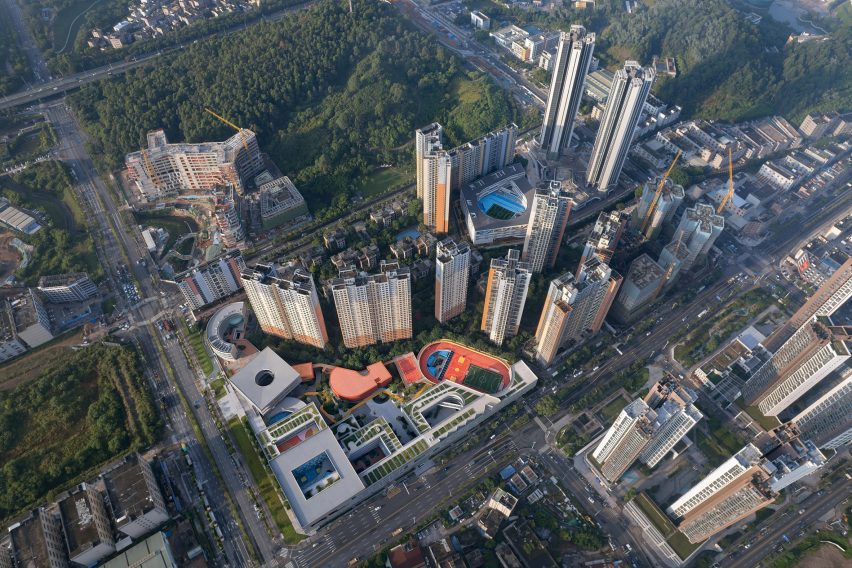 Hakka Academy Longgang Twin Star sit among residential and industrial buildings
Hakka Academy Longgang Twin Star comprises two schools, the Weilong School for primary and secondary students and the Weiwu School for primary students.
Both sit on a plot of land that also holds residential areas, industrial parks and what Urbanus described as an “urban village”.
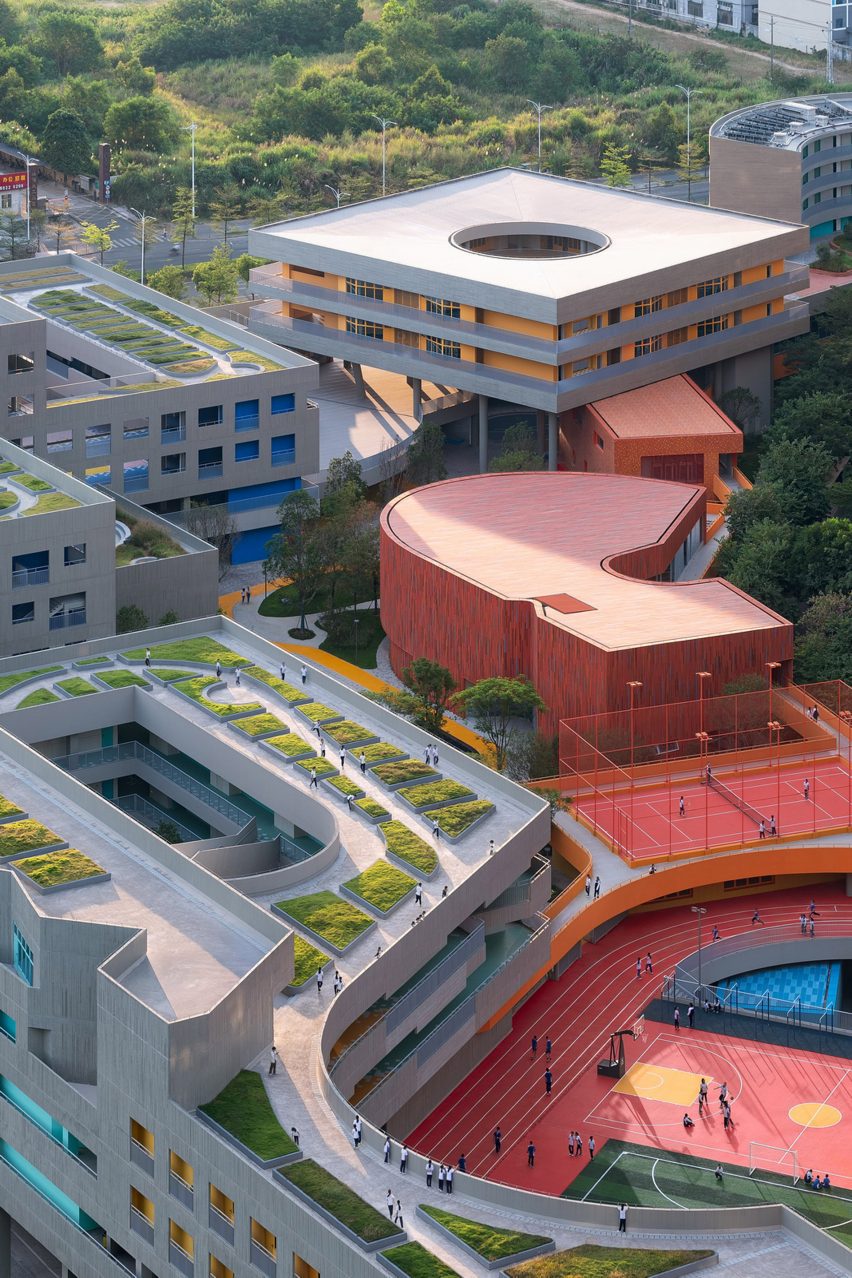 Urbanus designed the schools to sit on multiple levels
This setting influenced the design of the school buildings, which feature multiple different levels, walkways and sports courts.
“The irregular site boundaries enabled a unique interactive relationship with the surrounding neighbourhood,” Urbanus told Dezeen.
“Through meandering pathways and the strategic arrangement of functions, the winding perimeter transforms into an experiential, three-dimensional display interface.”
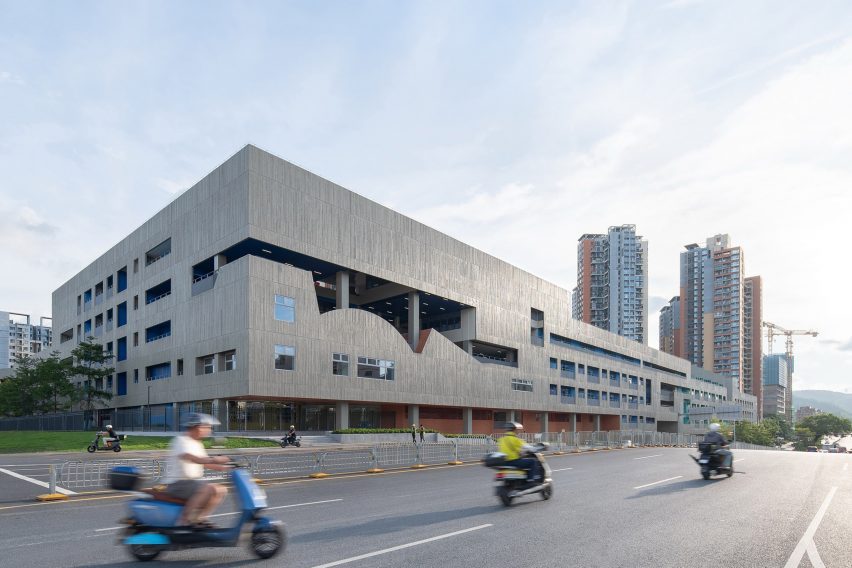 The Weilong School is by a main road
The architecture of the five-storey Weilong School, which sits next to a large road, “adopts the continuous, horizontal massing inspired by the Hakka walled houses,” Urbanus said.
Its design combines a number of different geometric shapes and features facades that are decorated with numerous cutouts.
Urbanus adds colourful rooftop additions to Shenzhen block
“Inspired by the traditional Hakka walled village, the design employs a solid boundary to provide shelter from external noise,” Urbanus explained.
“The playful, colourful cutouts in the wall offer glimpses into the vibrant internal life, striking a balance between inward seclusion and outward engagement.”
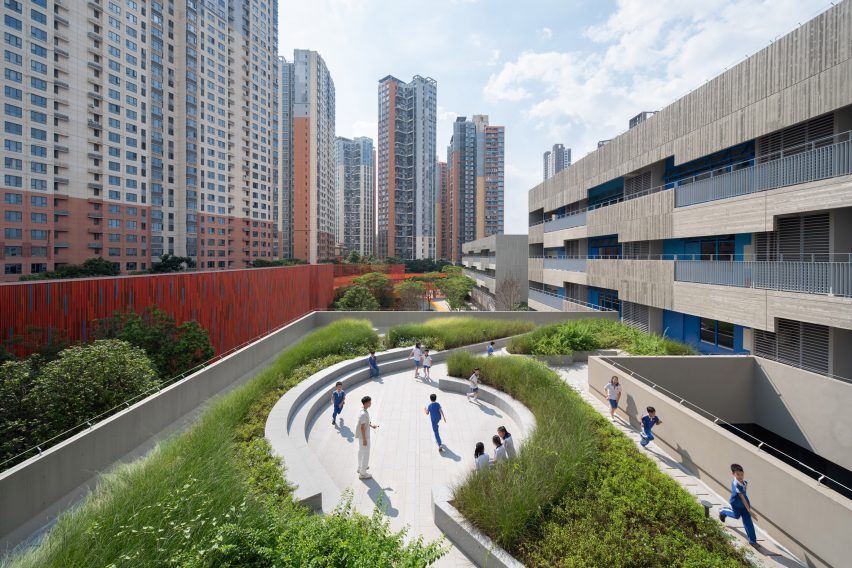 It features walkways, ramps and green spaces
The Weilong School is the larger of the two schools, with a floor area of 73,500 square metres. It was divided into “school units and corridor clusters” as a deconstruction of traditional walled houses, which are usually placed around a courtyard.
Here, Urbanus created circular ramps and passages for younger children to explore, while older kids can use the colourful sports courts or explore the gardens and greenery that surround the school.
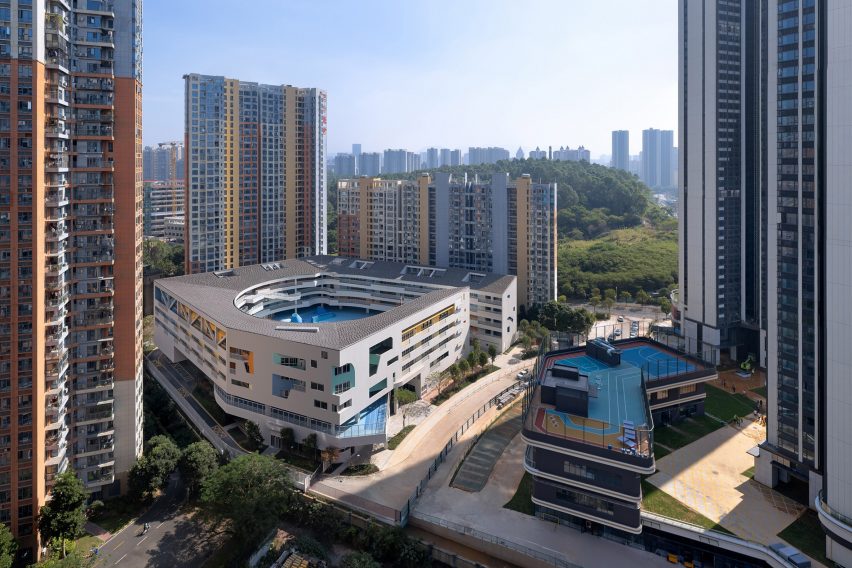 The Weiwu School sits between tower blocks
Meanwhile, the smaller Weiwu School has five storeys spread over a floor area of 25,800 square metres. Surrounded by high-rises, it was designed to maximise the use of the land.
Similar to the Weilong School, Weiwu School features a colourful central court for sports and games, which will also be used for community events to further connect the school with the surrounding neighbourhood.
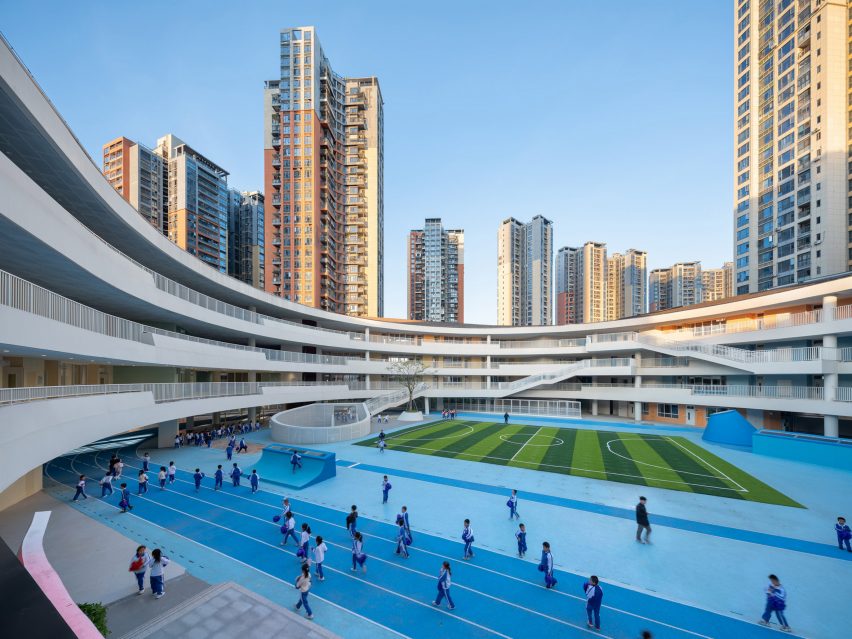 Weiwu School has a colourful central court
“Bright colours act as identifiers for different grades and functional zones, providing clear orientation within the diverse campus spaces,” Urbanus explained.
“They also act as a visual resistance to the monotonous urban landscape shaped by rapid urbanisation in the area.”
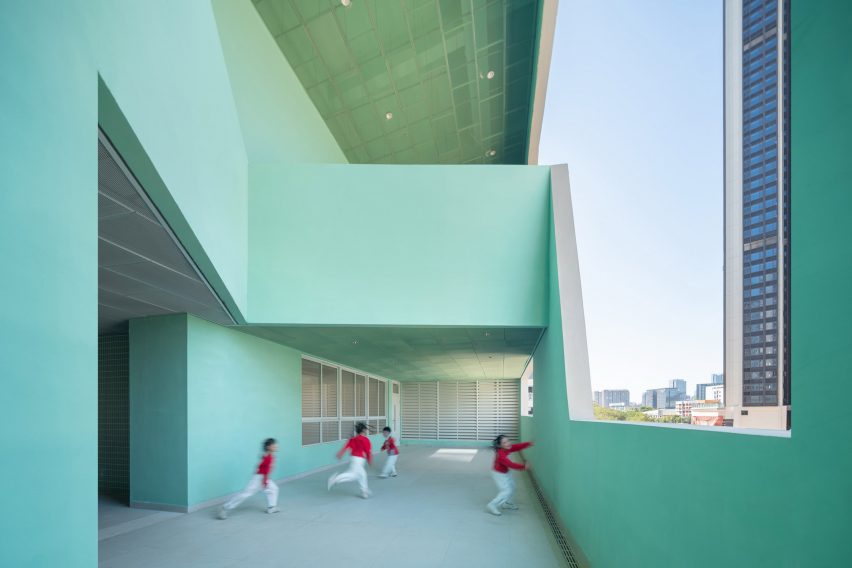 Urbanus wanted the school to “repair the existing urban fabric”
The studio aimed for the campus be a “catalyst for community culture”.
“By revealing and weaving together valuable cultural threads from the surroundings, it repairs the existing urban fabric to create a more desirable urban space and way of life,” Urbanus concluded.
Urbanus has previously added colourful rooftop additions to a Shenzen block and turned a Chinese brewery into a cultural centre.
The photography is by TAL.
Project credits:
Architect: Urbanus
Principal architects: Meng Yan, Wen Ting
Project manager, project architect: Weng Hua
Team: Zhang Chaoxian, Zhang Yingyuan, Huang Jiahong, Liao Guotong (architecture), Zhang Xuejuan, Li Guanda, Wang Tingxin, Gao Yufeng (landscape), He Jiamin, Deng Tingfang (interior), Zhang Hui, Li Peiying, Guo Anran, Hu Xiaomai, Huang Xianwen, Zhang Yipei, Tan Yongxian (internship), Gong Yidan, Coming Home Enterprises and Xiangtian Chuangwen (community building)
Technical director: Yao Xiaowei
Structural consultant: H&J International Co Ltd.
(CD) Structure/ MEP (Construction Document): Shenzhen TIANHUA Architectural Design Co Ltd
Landscape development: ShenZhen Paier Landscape Planning And Design Consulting Co Ltd
Interior development: JNJW Architectural Design
Graphic design: SURE Design
Contractor: China Construction Fourth Engineering Division Corp Ltd.
Construction agency: Shenzhen Vanke City Construction Management Co Ltd