
Saturday Night Fever: you may remember the dance performed by John Travolta and Karen-Lynn Gorney to the Bee Gees song (1) “More than a woman”. The two dancers perform a perfectly prepared dance, linked together. At one point, they separate and dance on their own in perfect synchronicity. Well, that’s what entanglement is all about.
Quantum entanglement is a phenomenon that creates an “invisible bond” between two particles when they collide with light (2). When light is shone on an atom to eject an electron (a process known as photoionization), the atom doesn’t just lose a particle. The departing electron and the ion (the rest of the atom) remain “linked” to form a kind of dancing couple, remaining synchronized even as they move apart.
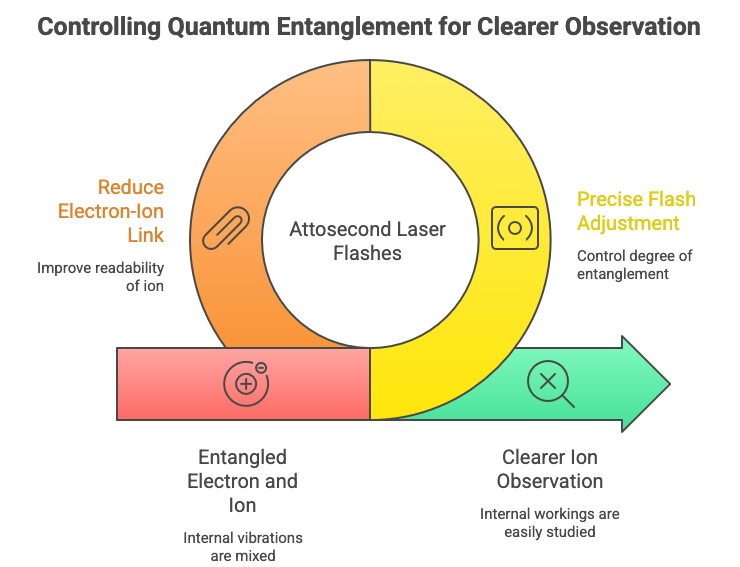
Until now, this entanglement was often seen as an obstacle. Because of this bond, the ion loses its coherence: it becomes difficult to observe its internal vibrations as they are mixed with the properties of the electron that has escaped.
A team of researchers led by Lisa-Marie Koll has published an articleentitled “Experimental control of quantum-mechanical entanglement in an attosecond pump-probe experiment” (3). It deals with a major advance in our ability to manipulate the world of the infinitely small and the infinitely fast. Researchers have succeeded in creating a means of controlling the degree of this entanglement, using incredibly brief laser flashes. The duration of these flashes can be measured in attoseconds (a billionth of a billionth of a second).
By precisely adjusting the color (frequency) and shape of the flashes, they can choose whether the electron and ion will be strongly bonded or almost independent. Access to the inner workings of the ion then becomes clearer if the link with its electron is reduced, just as when a camera is focused to remove the blur and bring the image into sharp focus.
Why is this discovery crucial?
Entanglement lies at the heart of the development of quantum computing. Knowing how to improve the readability of elements makes it possible to study the movements of electrons inside matter with unprecedented precision, without entanglement getting in the way of observation.
Quantum computing: the computer of the future
The race to develop quantum computing is aimed at creating more stable computers. Indeed, the estimated number of errors made by a conventional computer is of the order of one error for every 1,000 operations. Quantum computing, on the other hand, requires a million to a billion operations. The error rate is therefore unacceptably high.
“To understand this, let’s go back to basics. The qubit is to quantum computing what the bit is to classical computers: a unit of information. The difference lies in the fact that qubits can be simultaneously in the 1 and 0 states, giving rise to parallelization that can be exploited to perform certain calculations much more rapidly.” (4)
So-called “logic” qubits are sets of physical qubits grouped together to correct errors through redundancy, making operation more stable and reliable without being hampered by the multitude of calculations.
Another concrete challenge lies in what is known as quantum chemistry, which would make it possible to model molecular interactions in a way that classical computing does not allow today. Such modeling opens the way to understanding how certain drugs work, to producing molecules that capture CO2, and even to nanomaterials.
Quantum entanglement lasts 232 attoseconds (billionths of a billionth of a second / 10 -18 seconds).
For a long time, scientists believed that quantum entanglement occurred instantaneously. But now, for the first time, researchers have succeeded in measuring the speed at which this phenomenon occurs.
Professor Joachim Bugdörfer and his colleagues from the Institute of Theoretical Physics at the Technical University of Vienna in Austria, assisted by a team of Chinese scientists, have shown that there is a tiny time lag (around 232 attoseconds) between the moment when the electron escapes and the state of the one that remains (5). This tiny offset opens up extremely promising avenues. If we can control entanglement at this speed, we could potentially create quantum processors capable of operating at frequencies billions of times faster than current chips.
Why is this a revolution for the future?
Scientists now know how long quantum entanglement takes and how best to control it, and they are paving the way for several breakthroughs. Entanglement is the driving force behind future computing, but it is very fragile. Knowing how to manipulate it at such extreme speed would make it possible to create much faster and less error-prone processors.
By learning to reduce the blurring caused by entanglement, studies can now focus on the movements of electrons inside molecules with unprecedented clarity. This could help us understand how chemical reactions or drugs work at the deepest level.
Illustration: 661678084 – Shutterstock
1 “Excerpt from the film “Saturday Night Fever” 1977 – Director John Badham
https://www.youtube.com/watch?v=fy0rYUvn7To
2 Understanding quantum intelligence and its challenges- Virginie Guignard Legros- Thot Cursus- November 23, 2022- https://cursus.edu/fr/25948/comprendre-lintelligence-quantique-et-ses-enjeux
3 “Experimental control of quantum-mechanical entanglement in an attosecond pump-probe experiment” Lisa-Marie Koll, Laura Maikowski, Lorenz Drescher1, Tobias Witting and Marc J.J. Vrakking – APS Journal – January 2022- https://journals.aps.org/prl/abstract/10.1103/PhysRevLett.128.043201
4 “Quantum computer: a novel architecture for chasing errors” April 2025- INRIA Paris
https://www.inria.fr/fr/ordinateur-quantique-architecture-inedite
5 “Quantum entanglement speed is measured for the first time, and it’s too fast to comprehend – Earth.com- January 2026
https://www.earth.com/news/quantum-entanglement-speed-measured-for-first-time-using-attoseconds/