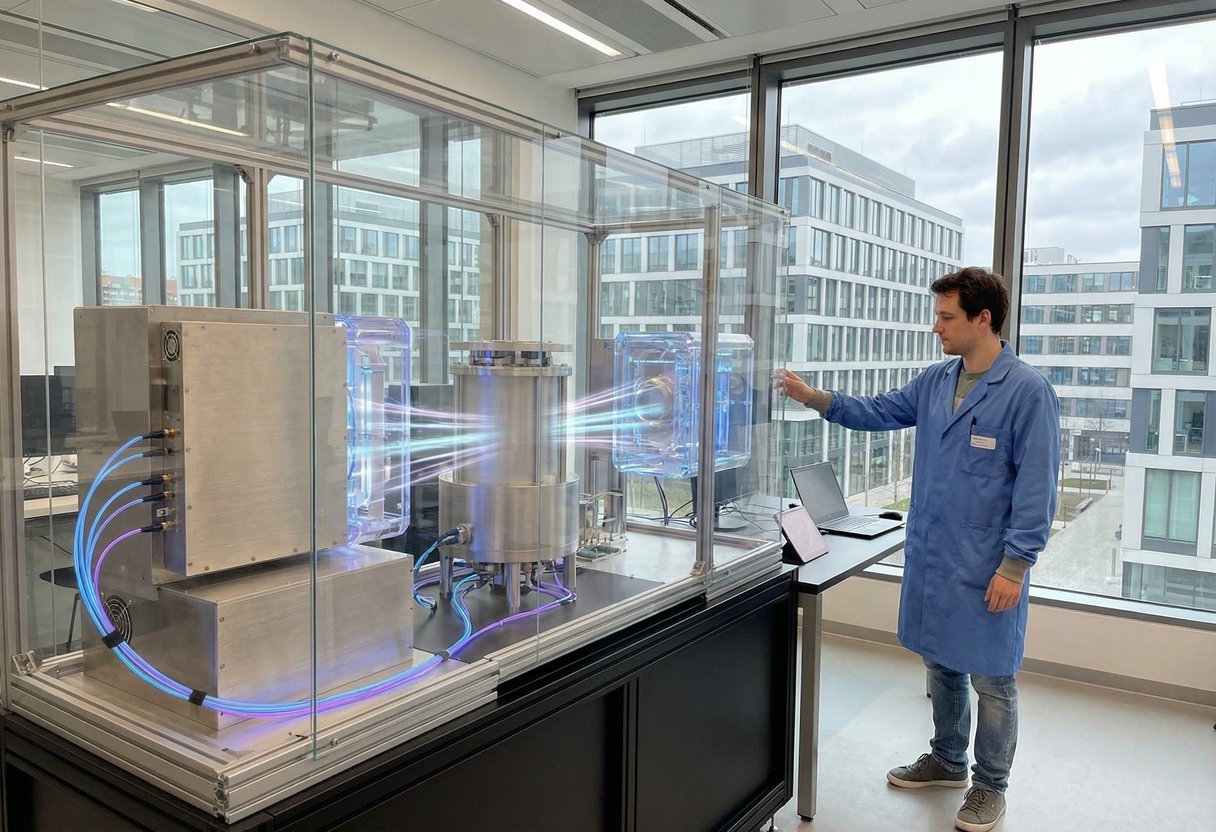
Two computers, no physical link, one shared operation. If that sounds like a trick, the experiment behind it could rewrite how we build quantum machines.
At the University of Oxford, a team has made separate quantum machines behave like one by transmitting the action of a logic gate across a fiber link. Instead of packing ever more fragile qubits into a single freezer, they knit small modules together with photons, entangling distant qubits and letting operations hop between them. To prove it works, the researchers ran Grover’s algorithm across the network and saw the speedup hold. The peer-reviewed study in Nature points to a modular path for scaling quantum computing, with names like Dougal Main and Beth Nichol now tied to a milestone.
A leap forward: Logic gates teleport across computers
Quantum computing, an area of technology as mysterious as it is promising, has just taken a giant step forward thanks to researchers from the University of Oxford. They’ve managed to achieve what was once thought impossible, the teleportation of logic gates between separate computers. This development not only challenges the limits of computing but could also reshape the way we harness quantum mechanics in technology.
The world of qubits: Quantum computing explained
Unlike classical computers, which rely on bits as their smallest unit of information, quantum computers use qubits. These unique units leverage properties like superposition, allowing them to exist in multiple states at the same time. Why does this matter? Because it grants quantum computers the capacity to perform calculations exponentially faster than even the most advanced supercomputers.
But such power comes with significant challenges. Qubits are notoriously fragile, sensitive to heat, vibrations, and even the slightest disturbances. To function, they require an ultra-stable environment close to absolute zero, a feat both expensive and complex. Scaling these systems has been a significant obstacle, forcing researchers to think outside the proverbial box.
A modular strategy: Rethinking quantum computing
Rather than scaling up a single quantum computer into a behemoth, the Oxford team adopted a modular approach. The idea? Use smaller quantum machines connected together, sharing resources. But here’s the trick, the connection isn’t physical in the traditional sense. The key lies in light, specifically photons.
Through optical fibers, researchers successfully entangled qubits between individual modules. This quantum entanglement effectively allows any change to one qubit to instantaneously affect its pair in another module, regardless of the distance. Thanks to this strategy, the once-daunting goal of combining quantum computers without a direct, physical link became achievable.
What teleportation of logic gates really means
Logic gates are the building blocks of computation, stringing together operations that ultimately process information. Introducing teleportation into the picture pushes the boundaries of modular computing. Here, the researchers demonstrated how to transfer logic gates across quantum setups as if they were part of the same hardware, without physical wires or connections.
To prove the concept, the team employed Grover’s Algorithm, a quantum process designed for searching through large, unsorted datasets. They seamlessly processed and tested quantum information across multiple modules. The results? Success. And efficiency, too.
An achievement written in Nature
Their findings, validated and published in the prestigious journal Nature, confirm something extraordinary: the potential to merge modular quantum systems into one powerful, collaborative machine. It’s a breakthrough that hints at a future where quantum computing becomes more practical, more scalable, and far closer to reality than science fiction.
Moments like these, when science reaches beyond limitations and achieves the extraordinary, ignite curiosity about future advances as quantum particles obey our commands and cross boundaries that defy intuition.