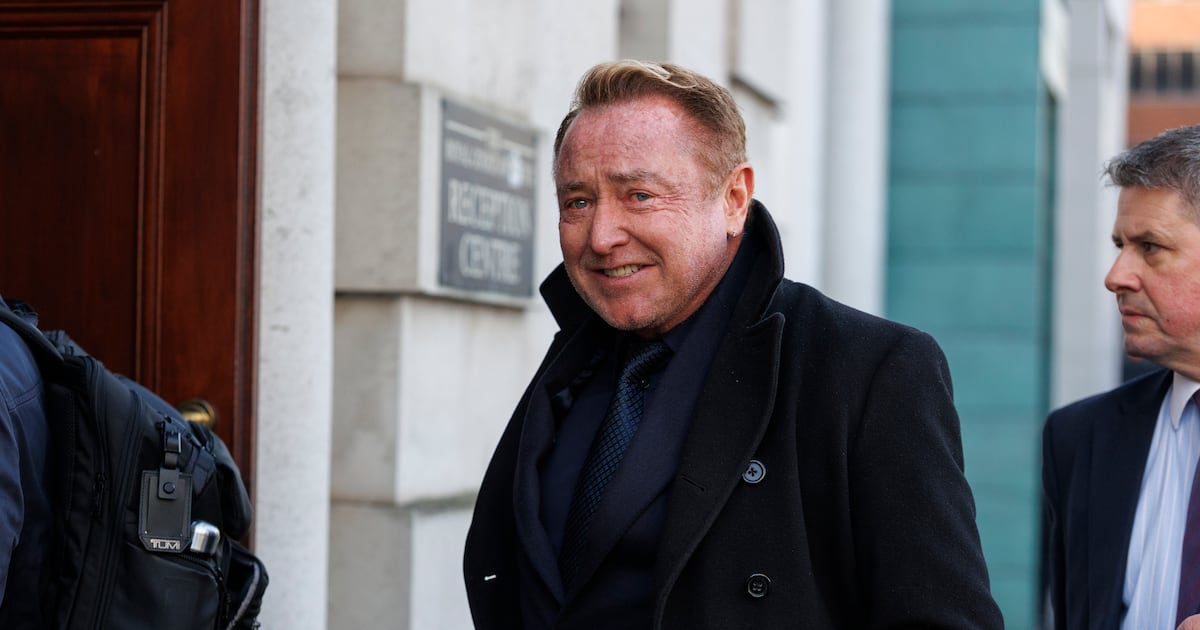
Micheal Flatley has been living the lifestyle of a Monaco millionaire “without the funds to do so” and borrowed €75,000 to pay for his own birthday party, the High Court in Belfast has heard.
On Wednesday, a barrister representing a company which barred the choreographer from involvement in The Lord of the Dance tour submitted documents detailing “horrendous business mistakes” that cost Mr Flatley “millions in additional borrowing”.
Claims were made by Mr Flatley’s former financial adviser, Des Walshe, that his ex-client was “all about image”, the court heard on Wednesday.
“In the bluntest terms, he was faking it on a multimillion euro scale,” Mr Walshe wrote.
Many promoters were “reluctant” to deal with the Lord of the Dance creator directly “as he has an industry wide reputation for not paying his bills”, he added.
“Michael’s appetite for lifestyle cash was insatiable, including borrowing €75,000 for his birthday party and €50,000 to join Monaco Yacht Club. All during a time when he had no income other than borrowing,” Mr Walshe wrote in a letter.
The civil case centres on a temporary injunction granted to Switzer Consulting Ltd a fortnight ago that blocks Mr Flatley from participating in any upcoming productions.
Switzer is suing the 67-year-old for alleged breach of contract.
Two years ago, both parties struck a formal service agreement which allowed Switzer to run the shows.
The production is to begin its 30th anniversary run in Dublin next week.
Despite criticism of Mr Flatley’s “difficult financial history” by Switzer’s legal team, the court heard the retired dancer had taken steps “overnight” to secure €500,000.
“Half a million pounds is now sitting in an account in Dublin on a solicitor’s undertaking,” David Dunlop, a barrister for Mr Flatley, said.
During lengthy submissions on Wednesday, Mr Dunlop said the injunction is akin to “handcuffing together” the two sides.
There was “open war” in relation to “every aspect of their relationship”, he added.
Granting an injunction will lead to catastrophe “because it is simply going to be impossible for the court to police”.
“Neither party is able to work with the other…Mutual trust and respect have completely disappeared,” Mr Dunlop said.
The temporary injunction granted to Switzer was “improperly brought before the courts” and “deceptive and misleading in many respects,” Mr Dunlop claimed.
Under the terms of the agreement, Switzer’s fees were to be capped at £35,000 (€40,427) per month increasing to £40,000 per month after two years.
Mr Flatley had transferred intellectual property rights for Lord Of The Dance to Switzer.
Business management arrangements, such as accounts and payroll, were to be run by the company.
“Everything appeared to be operating swimmingly” until October 2025 when Mr Flatley was a patient at the Beacon Hospital in Dublin and “wanted all his debts cleared”, according to Switzer’s barrister, Gary McHugh.
“Mr Flatley pirouettes on the 2024 agreement and is now seeking to soft shoe shuffle into 2026 with new arrangements altogether”, Mr McHugh said.
Blackbird, the feature film made and funded by Mr Flatley, was a commercial flop in which he had “foolishly” used his home at Castlehyde in Fermoy, Co Cork, as security to borrow money, leading to debts of £4.5 million with “no way to pay it back”, the court heard.
Once Switzer took over Lord of the Dance, the production became a “commercial success” with more 260 performances booked for this year in a “global” tour, Mr McHugh said.
He read a letter written by Mr Walshe, in which he expressed a “growing sense of frustration with Michael’s misbehaviour within a group of people who’ve been working with him for a number of years”.
“At this stage, I’ve lost all tolerance with this type of nonsense,” Mr Walshe wrote in response to correspondence issued by Mr Flatley’s solicitor in Dublin last month.
“Michael knows the full extent of his liabilities and personally he knows why he finds himself in this position.
“Since 2019, Michael has lived the lifestyle of a Monaco millionaire without the funds to do so. He borrowed the initial moneys to move to Monaco…Despite advice to the contrary, as he did not even have the minimum cash required to open a residency bank account.”
Mr Walshe became involved with Mr Flatley’s affairs in 2022.
In his letter, he said Mr Flatley was advised that he should “not move into that wealth circle (in Monaco) as he simply did not have the resources”.
“Michael ignored this advice and has essentially maintained this facade of wealth using other people’s monies ever since.
“Instead of reining in his spending, adjusting his lifetime costs and cutting his cloth to suit his measure, Michael simply borrowed more money from more people.
“Michael would borrow money from anyone he could, and constantly put pressure on everyone looking for cash.
“It was all about image.”
Mr Walshe said his former client would frequently show him his balance on his banking app.
“He knew exactly what he was doing,” he added.
Mr Flatley’s barrister rejected claims that Mr Flatley “was a poor manager of his own affairs and was a man with substantial debts”.
“Ad hominem attacks” had been made on his character, according to Mr Dunlop.
The fact he had secured €500,000 the previous evening was “proof in the pudding” regarding his finances.
“He is the one who’s managed to generate and has made available half a million pounds,” Mr Dunlop said.
“It’s not Mr Flatley who has the financial difficulties in this case, it is the plaintiff.”
Saying that Switzer’s arguments had not addressed the “legal core” of the case, Mr Dunlop added: “To use a football metaphor, they attacked the player not the ball.”
Earlier, Switzer’s legal team singled out Philip Moross as a “central character in the proceedings”, as he holds the music rights to Lord of the Dance.
The court heard a debt of more than £2 million was owed to Mr Moross by Mr Flatley.
A deal was brokered between Switzer, Mr Flatley and Mr Moross to pay the debt in instalments.
There was a fear Mr Moross could “pull the plug” on the tour if there was a default on the deal and money owed to him “was going to be impeded or interfered with”, according to Mr McHugh.
The court heard the previous evening that representatives from Mr Flatley had contacted Mr Moross and appeared to be “trying to buy him off”.
There was “complete silence” from Mr Flatley’s legal team on the matter, Mr McHugh said.
A judgement will be delivered on Thursday.