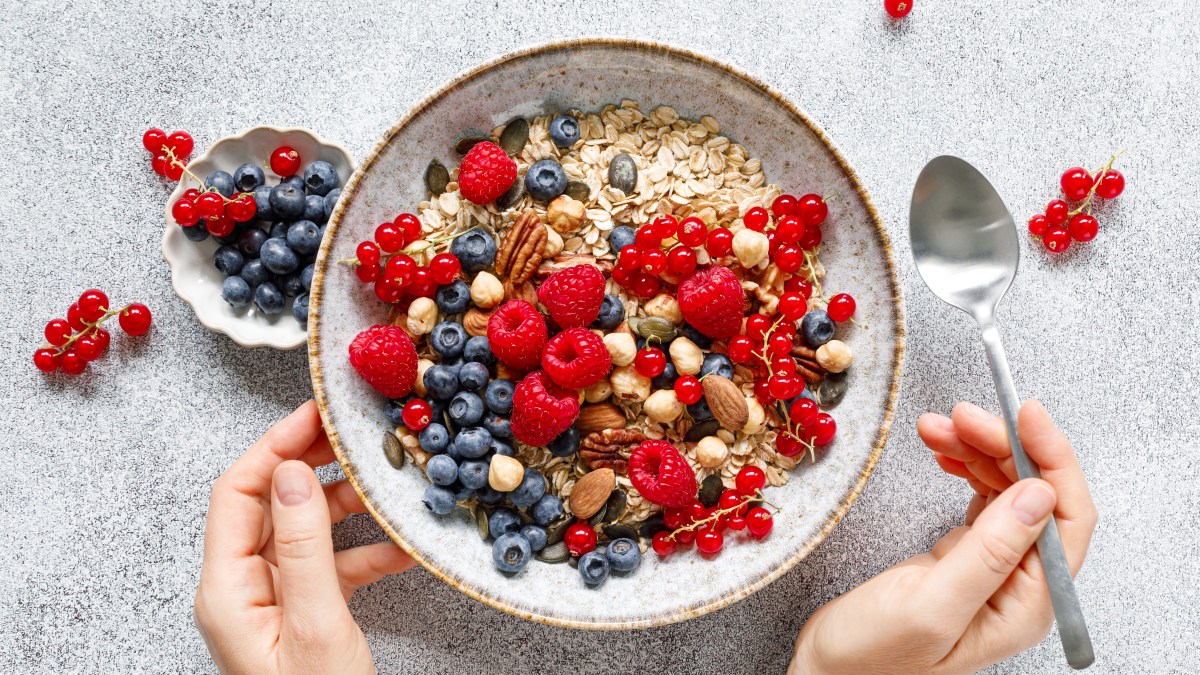
Do you want to lower your cholesterol by the weekend, with change from a fiver? Experts believe they have found the solution in a humble packet of oats.
Last week a study from the University of Bonn revealed that participants at high risk of heart disease saw their levels of harmful LDL cholesterol drop by 10 per cent after following a calorie-restricted diet made almost entirely of porridge for just two days.
It is, as Professor Marie-Christine Simon, the study’s co-author, puts it, “a substantial reduction” — and in a world of dubious quick-fix solutions, sounds almost too good to be true. Yet oats have long been linked to improved cholesterol levels — albeit not within such a dramatic time frame — and myriad other health benefits.
A daily bowl of porridge will lower your risk of heart disease
Oats lower cholesterol because they contain the soluble fibre beta-glucan, which forms a gel-like substance in your gut. “This acts as a sponge, binding to bile acids the liver makes from cholesterol, then excreting them, so the liver has to make more bile acids, using more cholesterol,” explains the nutritionist Laura Southern, founder of London Food Therapy. The link has long been proved: a systematic review in the British Journal of Nutrition in 2016 found eating about 3.5g of oat beta-glucan — the equivalent of a bowl of porridge — lowers LDL cholesterol, one of the leading causes of heart disease, over a period of 3 to 12 weeks. This latest study, however, found that participants who almost exclusively ate porridge, divided into three 100g meals, along with some fruit and vegetables, could slash their cholesterol levels in just two days, with the benefits still evident six weeks later.
• The cardiologist’s guide to protecting your heart
And feed gut bacteria that can lower your risk of cancer and boost your mood
Oats, like all plants, are also a source of prebiotic fibre that feeds essential healthy bacteria in our gut. “They are an easy way of getting prebiotic fibre in addition to fruit and vegetables,” says Southern, who explains that “healthy bacteria produce short-chain fatty acids [SCFAs] as waste products, which have many benefits, from reducing inflammation linked to an increased risk of some cancers, to sending signals to your brain, which might improve mood”. A trial on 210 participants in the journal Frontiers in Immunology found consuming 80g of oats for 45 days “significantly increased” the abundance of bacteria including Akkermansia muciniphila and Roseburia as well as increasing the availability of SCFAs.
Eating oats lowers your risk of type 2 diabetes
Oats, comprised of about 60 per cent carbohydrate, also contain resistant starch, “a form of prebiotic fibre that passes through our gut undigested”, Southern says. “Our body finds it harder to break down than refined carbohydrates such as white flour, meaning we extract the sugar from oats more slowly, which leads to improved insulin sensitivity and more balanced blood sugar levels.” A major review in the journal Nutrients found that higher oat intake was associated with a lower risk of developing type 2 diabetes when the highest and lowest oat consumption groups were compared. Another study in Nutrients found resistant starch has anti-inflammatory effects that have “the potential to promote healthy ageing”.
• One in five people are now at risk of diabetes. Are you among them?
Cooled oats — including flapjack — may have additional health benefits
Studies have shown levels of resistant starch increase when food is cooled after cooking because of a process called retrogradation, in which starch molecules change structure to a form more resistant to digestion. A meta-analysis of cereals including oats in the journal Frontiers in Nutrition found “a significant decrease in starch digestibility” after cooling — one reason that flapjack is a healthier sweet alternative than chocolate. “The cooking process probably increases resistant starch,” Southern concedes. “More importantly, you can add seeds and nuts to flapjack to further improve the nutritional content while still treating yourself.”

Eating oats for breakfast instead of later in the day could lead to less fat storage
NATALIA GDOVSKAIA/GETTY IMAGES
Why overnight oats are the ultimate healthy breakfast
While you can eat oats raw, “consuming them with liquid will help absorption and gut motility”, says Southern, who recommends filling a third of a jam jar with oats, covering it with a layer of seeds, then filling the jar to two thirds full with milk or water before bed for easy overnight oats. “It takes two minutes and is easily transportable to take to work.” She adds milk and chia, sesame and pumpkin seeds to hers and sprinkles it with cinnamon. Soaking, like cooking, reduces levels of compounds called phytates found in oats and other whole grains, which bind to minerals such as iron and zinc in the digestive tract, making them less easily absorbed from food. “This only really matters if your diet is not diverse but is useful to be aware of if you’re pregnant, when iron deficiency is common,” Southern says.
• Three easy make-ahead breakfast recipes for a healthy(ish) start
Eating oats boosts an appetite-reducing hormone
By filling your stomach, soluble fibre sends a signal to your brain that you’re full. Evidence is conflicting as to whether beta-glucan significantly increases levels of GLP-1 produced naturally by the body after eating but it has been shown to influence other hormones involved in appetite. A study of overweight adults in the journal Nutrition Research found that four hours after eating three cereals containing between 2.2g and 5.5g of beta-glucan there were “significant increases” in blood levels of plasma peptide YY, a hormone that reduces appetite.
Steel-cut and rolled oats are much the same
As the least processed option, steel oats may be more fashionable but both steel and rolled oats are made from the whole, intact oat grain, with the inedible husk removed. Steel oats are chopped into bigger pieces, while rolled oats are steamed and, well, rolled. “It’s probably slightly harder for the body to break down steel-cut oats, meaning they release energy more slowly and help regulate blood sugar better, but there’s very little difference in terms of nutrition,” Southern says. “I’d choose whichever version you enjoy more.”
But avoid instant oats
Prepackaged porridges such as Ready Brek and Oat So Simple aren’t terrible for health but because the oats have been finely ground and are often precooked they are far easier for your body to digest, increasing the likelihood of blood sugar spikes, Southern says. “They might help lower cholesterol but are often lower in fibre, aren’t good for satiety and often have sugar, salt and flavourings added.” In December 2024, when the government included a list of foods that were “less healthy” as part of its impending TV advertising ban, sweetened porridges and oat-based cereals came under this category. “Making your own porridge is far better for you,” Southern says.
• Read more expert advice on healthy living, fitness and wellbeing
Eat your oats in the morning
Our bodies are more sensitive to insulin, instrumental in breaking down the carbohydrate in oats, in the morning, she says, “so I’d advise eating oats for breakfast — in the evening they’re more likely to lead to fat storage”. While there’s no strong evidence that eating oats for breakfast helps to reduce weight, an American study in the journal Nutrients found underweight, normal weight and overweight people consumed “significantly” more oats than obese people, a finding “consistent with clinical studies in which the consumption of oatmeal was found to induce improvements in subjective measures of satiety”. To make porridge a more nutritionally rounded breakfast, Southern suggests adding protein and fat in the form of seeds.
Don’t add them to smoothies but do experiment with granola and crumbles
Although oat smoothies — and oat milk — are popular, they can make oats too easily digestible and lead to blood sugar spikes, says Southern, who adds them to crumble toppings and pancakes, and suggests “an easy granola using oats, nuts, seeds mixed together with an egg, drizzled with a bit of syrup and oven-baked”. Oat flour is a good alternative to white flour, she adds, as it is “higher in fibre and better for our microbiome”.