Every January, the Australian capital city – Canberra – is temporarily transformed. Founded in 1913 as the seat of government (to settle the sensitive dispute over whether Sydney or Melbourne should be the nation’s bureaucratic and symbolic home), it’s widely known elsewhere in Australia as “the bubble”.
It’s a planned city in every sense of the word – a place designed with a touching faith in the idea that with enough signage and structural encouragement, human behaviour will fall into line.
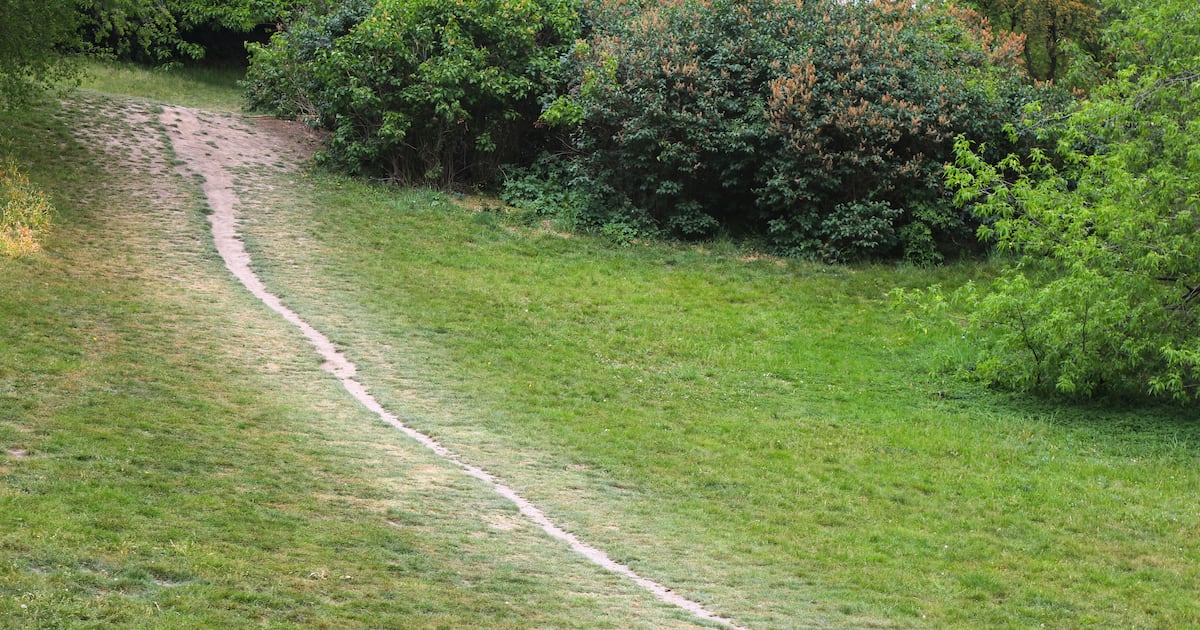
I often think the city’s many desire paths illustrate this brilliantly. Within parks, green areas and public spaces, there will be the official path as dictated by the architect, and then there will be the route everyone actually takes. You see them everywhere – tracks worn through grass or even shrubbery, where countless people have done the mental arithmetic and decided they aren’t bothered going all that way around. Desire paths are human will and proclivity worn into the earth.
Canberra is full of these soft negotiations between design and reality. Third spaces randomly plonked in a grassy area between two busy roads in the belief that if you build it, they will come. Sometimes they do. When the conditions aren’t right – the location isn’t convenient, comfortable, located near amenities – they don’t. The city was in some sense conceived by committee, so it makes sense that the ideal or intent is not always aligned with the organic messiness of collective behaviour and individual preference.
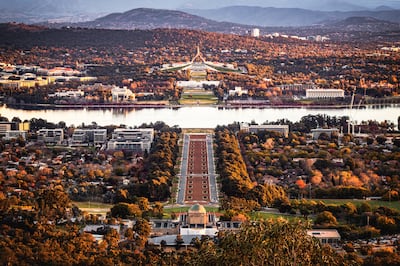 Parliament House and the city of Canberra from Mount Ainslie. Photograph: Gavin Guan/Getty
Desire paths evidence the fact that pedestrians – or rather those who don’t have a car, which is on average most likely to be the young, the old, the socioeconomically disadvantaged and more recent immigrants – are something of an afterthought.
Canberra was designed by the American architect Walter Burley Griffin along with his wife Marion Mahony Griffin, and its car-first culture is one way that design can indeed heavily influence the choices people make.
The Australian capital does not compare with other western capitals in its public transport, which is very far behind (though it is working hard on that with massive investment in a growing light rail network). For now though, living here without a car is far less convenient than having one.
Its vehicle-first design makes Canberra ideal for Summernats, the specialist car festival that rolls into town at the beginning of each year. The city’s wide, well-engineered roads, comparatively low congestion and generous expanses of often unused public space are what drew the festival here. Running since 1987, Summernats is uniquely Australian in its culture. It just isn’t particularly Canberran in its culture.
Every January, vast numbers of – mostly, though not exclusively – black clad male auto enthusiasts flood into the city, abruptly puncturing the bubble. This is not the sort of classic car culture many Europeans might think of.
There are no Barbours or brandy. No Edwardian Daimlers or staid displays of British vintage cars in highly polished racing green to be appreciated sedately at a respectful distance. Summernats is more about modified muscle cars.
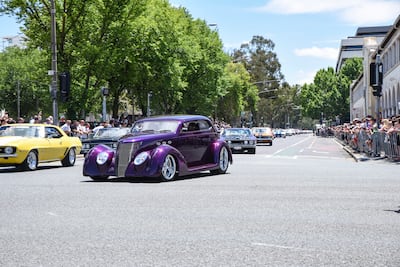 The Summernats car festival in Canberra. Photograph: Daniiielc/Getty/iStock
Exuberance and extraversion. It centres on the sort of cars that have the engine on top of the bonnet and that you can hear from space. Cars designed in the spirit of the papal tiara, with a sort of “Here I am, and the GDP of a small nation went into this” energy. Subtlety and practicality are very much not the point.
There are stunt shows, displays and burnout competitions. Canberra’s roads are streaked with tyre tracks. The sound of hundreds of muscle cars grumbling through the city day and night is enough for many locals to decamp otherwhere until normality resumes.
Because multiculturalism is after all the moral lodestar of contemporary urban life, it is fascinating to watch two cultures collide during Summernats. When the festival kicks off, Canberra’s Lonsdale street in Braddon— sometimes affectionately referred to as The Lentil Belt thanks to its reputation as the city’s young creative and activist hub – becomes the unlikely stage for this anthropologically fascinating encounter.
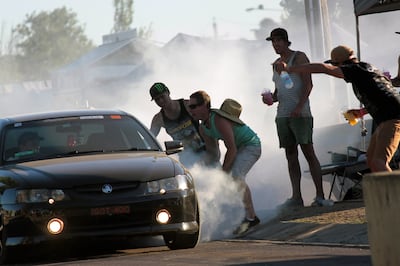 Motoring enthusiasts gather for Summernats 26, the biggest car festival in the southern hemisphere. Photograph: Mick Miller/Getty/iStock
Summernats takes over and for a few days, Birkenstock-wearing students and bicycle-helmeted bureaucrats with strong views on sustainability and social justice brush shoulders with largely working-class Australian men, some sporting hefty mullets, cruising the street in cars that burn petrol as liberally as Braddon locals burn incense.
These are not groups who typically socialise. They generally limit their interaction to pretending the other doesn’t exist, or insulting one another on X. Consequently, watching them coexist for a few days each year is tremendously good fun.
There is something comic in the idea that a city designed to embody order becomes, once annually, the home of bellowing muscle cars, (mostly controlled) mayhem and a kind of sleeveless, heavyback-haircut masculinity that our culture is squeamish about. Meanwhile Summernats resists domestication.
Despite efforts to sell the car festival as family friendly in a city which is such a great place to raise children, its image is not that easy to soften. In comparison to the city’s usual family friendly events, like Floriade, which is a flower festival, Summernats is less obviously wholesome. Doing PR for tulips is easier.
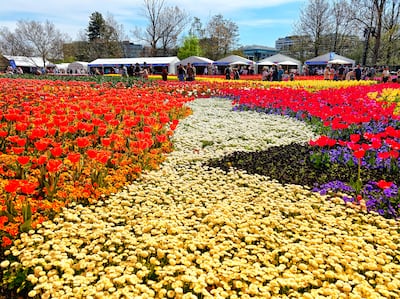 Spring tulip flowers at Floriade in Canberra. Photograph: Andrew Buesnei/Getty/iStock
There is much value in the fact that the festival becomes an annual proxy for deeper conversations about belonging, taste, class and which hobbies are granted cultural status.
As in Ireland, class is an underdiscussed topic in Australia, where a more permeable class hierarchy is often mistaken for none.
The values of Summernats clash within the conspicuous confines of The Lentil Belt but it’s good for everyone to spend a little time around the sort of people they usually avoid or flatten into stereotypes. Bubbles are for bursting, after all.