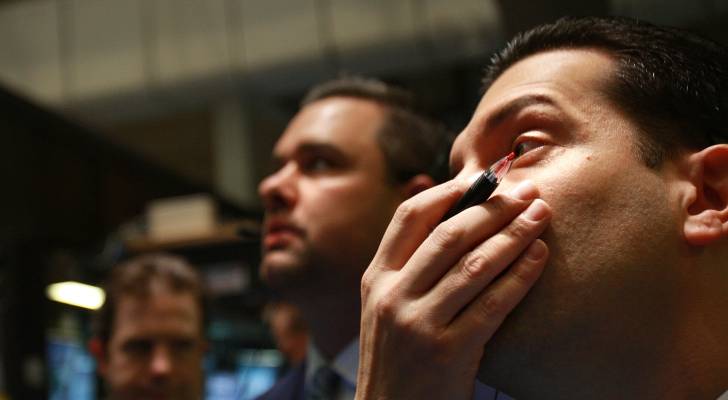
 Platt/Getty Images
Moneywise and Yahoo Finance LLC may earn commission or revenue through links in the content below.
Economist Peter Schiff made his name by predicting the 2008 financial crisis.
Now, he says he sees something even more ominous on the horizon — and this time, he believes it’s headed straight for the U.S.
“We are headed for an economic crisis again that will make the 2008 financial crisis look like a Sunday school picnic,” Schiff said in a recent interview with Fox Business (1).
“The biggest difference between the crisis that we’re about to have and the one we had back then is this one is all in America.”
According to Schiff, the issue is embedded in the structure of the U.S. economy and its monetary system.
“We have a dysfunctional, consumer-based credit economy that rests on the foundation of the U.S. dollar’s reserve currency status,” he explained. “And the world is now pulling the rug out from under the U.S. The dollar is going to collapse. The dollar is going to be replaced by gold. Central banks are buying gold to back up their currencies.”
Some recent data points lend support to that view. The U.S. Dollar Index — which tracks the greenback against a basket of major foreign currencies — has fallen to its lowest level in four years (2).
At the same time, reports show that central banks have more than doubled their gold purchases to over 1,000 tonnes a year since 2022 (3).
Gold prices have surged, recently breaking past the $5,000-an-ounce mark.
Schiff, who is also involved with SchiffGold, believes the rally in precious metals is more than just a trade — he sees it as a warning signal for rampant inflation.
“Inflation is going to be much more pernicious over the next few years than it was when Biden was president, unfortunately. That’s what gold and silver are telling you — they are a warning,” he said (1).
Inflation has steadily eroded the dollar’s purchasing power, regardless of who was in the White House. According to the Federal Reserve Bank of Minneapolis, $100 in 2025 buys what just $12.05 did in 1970 (4).
Gold has long served as a hedge against inflation.
Unlike paper currency, the precious metal can’t be printed at will by central banks, nor is it tied to the fortunes of any single country or economy — qualities that often draw investor interest during periods of uncertainty.
Schiff declined to put a specific price target on gold. When asked how high he thinks it could go, he said (1), “I don’t have a target price other than much higher, because there’s no floor on the dollar, so there’s no ceiling on gold.”
Other prominent voices on Wall Street have also highlighted gold’s potential.
JPMorgan CEO Jamie Dimon recently said that in this environment, gold could “easily” rise to $10,000 an ounce.
One way to invest in gold that also provides significant tax advantages is to open a gold IRA with the help of Priority Gold.
Gold IRAs allow investors to hold physical gold or gold-related assets within a retirement account, thereby combining the tax advantages of an IRA with the protective benefits of investing in gold. This makes it an option for those looking to help shield their retirement funds against economic uncertainties.
When you make a qualifying purchase with Priority Gold, you can receive up to $10,000 in precious metals for free.
Read More: Approaching retirement with no savings? Don’t panic, you’re not alone. Here are 6 easy ways you can catch up (and fast)
During the interview, Schiff was asked about two precious-metals mining stocks he highlighted in September 2024 — Agnico Eagle Mines (AEM) and Pan American Silver (PAAS) — which have since climbed roughly 161% and 206%, respectively.
Despite those gains, Schiff says he still sees value.
“Even though those stocks are up a lot… they’re actually cheaper now than they were back then because the earnings of these companies have gone up a lot more than the share price,” he said (1).
Some investors, Schiff noted, argue that gold and silver prices are already in bubble territory. He disagrees.
“It’s not a bubble. It’s the pin. The bubble is in the dollar. The bubble is in the U.S. economy,” he said. “And when investors start to realize that not only are gold prices and silver prices not going back down, but they’re going to keep going up, these stocks are going to go ballistic.”
Beyond those two names, Schiff also pointed to Franco-Nevada (FNV) as a “real high-quality” gold stock.
He added that this year’s biggest movers may be junior mining companies — smaller, lesser-known names that didn’t rally as much last year.
For investors interested in picking individual stocks, platforms like Moby aim to simplify the process. Their team of former hedge fund analysts does the heavy lifting — breaking down the market, flagging quality stocks and making the research easy to digest.
In fact, across nearly 400 stock picks over the past four years, Moby’s recommendations have beaten the S&P 500 by almost 12% on average. Their research keeps you up-to-the-minute on market shifts and takes the guesswork out of choosing investments.
Plus, their reports are easy to understand for beginners, so you can become a smarter investor in just five minutes.
Gold isn’t the only asset investors turn to during inflationary times. Real estate has also proven to be a powerful hedge.
When inflation rises, property values often increase as well, reflecting the higher costs of materials, labor and land. At the same time, rental income tends to go up, providing landlords with a revenue stream that adjusts for inflation.
Over the past ten years, the S&P Cotality Case-Shiller U.S. National Home Price NSA Index has jumped by more than 87%, reflecting strong demand and limited housing supply (5).
Of course, high home prices can make buying a home more challenging, especially with mortgage rates still elevated. And being a landlord isn’t exactly hands-off work — managing tenants, maintenance and repairs can quickly eat into your time (and returns).
The good news? You don’t need to buy a property outright — or deal with leaky faucets — to invest in real estate today.
Lightstone DIRECT, for instance, offers accredited investors access to institutional-quality multifamily and industrial real estate — with a minimum investment of $100,000.
Founded in 1986 by David Lichtenstein, Lightstone Group is one of the largest privately held real estate investment firms in the U.S., with more than $12 billion in assets under management.
Over nearly-four decades, their team has delivered strong, risk-adjusted performance across multiple market cycles — including a 27.6% historical net IRR and a 2.54x historical net equity multiple on realized investments since 2004.
With Lightstone DIRECT, you gain access to that proprietary deal flow.
Here’s the kicker: Lightstone invests at least 20% of its own capital in every deal — roughly four times the industry average. With skin in the game, the firm ensures its interests are directly aligned with those of its investors.
Schiff’s warning comes as the U.S. stock market hovers near record highs.
That backdrop has renewed the case for diversification. Nearly 40% of the S&P 500’s weight is concentrated in its ten largest stocks and the index’s CAPE ratio hasn’t been this high since the dot-com boom.
This is where, for many investors, alternative assets come into play.
These can include everything from real estate and precious metals to private equity and collectibles.
But there’s one store of value that routinely flies under the radar: It’s scarce by design, coveted worldwide and frequently locked away by institutions.
We’re talking about post-war and contemporary art — a category that has outpaced the S&P 500 with low correlation since 1995.
It’s easy to see why art pieces often fetch new highs at auctions: The supply of the best works of art is limited and many of the most desirable pieces have already been snatched up by museums and collectors. That scarcity can also make art an attractive option for investors looking to diversify and preserve wealth during periods of high inflation.
Until recently, purchasing art has been a domain reserved for the ultra-wealthy — like in 2022 when a collection of art owned by the late Microsoft co-founder Paul Allen sold for $1.5 billion at Christie’s New York, making it the most valuable collection in auction history (6).
Now, Masterworks — a platform for investing in shares of blue-chip artwork by renowned artists, including Pablo Picasso, Jean-Michel Basquiat and Banksy — can help you get started with this asset class. It’s easy to use and, with 25 successful exits to date, Masterworks has distributed more than $65 million in total proceeds (including principal).
Simply browse their impressive portfolio of paintings and choose how many shares you’d like to buy. Masterworks can handle all the details, making high-end art investments both accessible and effortless.
New offerings have sold out in minutes, but you can skip their waitlist here.
Note that past performance is not indicative of future returns. Investing involves risk. See Reg A disclosures at masterworks.com/cd.
We rely only on vetted sources and credible third-party reporting. For details, see our editorial ethics and guidelines.
Peter Schiff (1); The Guardian (2); World Gold Council (3); Federal Reserve Bank of Minneapolis (4); S&P Global (5); Christie’s (6)
This article provides information only and should not be construed as advice. It is provided without warranty of any kind.