NANJING — Scientists in China have unearthed a treasure trove of ancient fossils that is helping to rewrite the story of one of Earth”s earliest and least-understood catastrophes: the first mass extinction of complex animal life.
This event, known as the Sinsk event, struck about 513 million years ago. It occurred not long after the Cambrian explosion, a remarkable period during which all major animal groups first appeared in the oceans. The extinction was severe, wiping out the majority of marine animals, with extinction rates of around 41 to 49 percent — a toll comparable to the later, more famous mass extinctions like the one wiped out the dinosaurs.
For decades, however, our comprehension of this crisis has been incomplete. Evidence came mostly from fossils of skeletonized creatures in shallow seas, which only tell part of the story. The key piece of the puzzle — a detailed record of soft-bodied animals from the period immediately after the extinction — had long been missing. This gap made it impossible to see its full impact on ocean life.
Now, that gap has been spectacularly filled. A team led by researchers from the Nanjing Institute of Geology and Palaeontology at the Chinese Academy of Sciences (NIGPAS) has announced the discovery of the Huayuan Biota, a stunning collection of fossils dating to about 512 million years ago, right on the heels of the Sinsk event. Their findings have been published in the latest issue of the journal Nature.
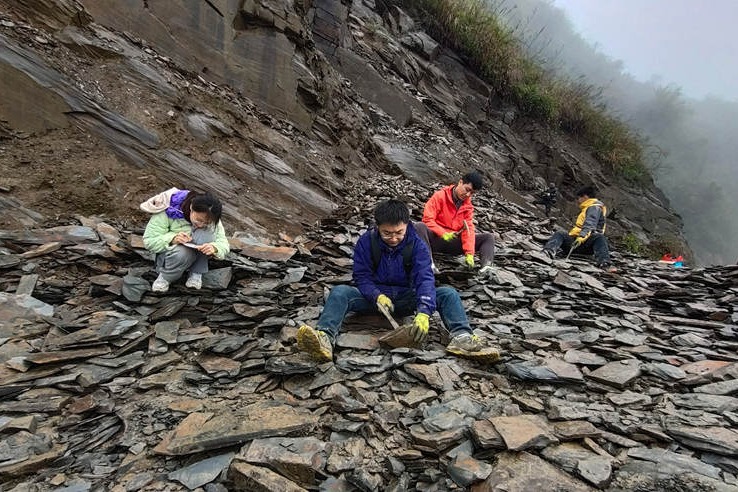
The story of the discovery began in 2020 in Huayuan county, in Central China’s Hunan province, when road construction exposed ancient shale rock layers. Scientists began excavating the area and uncovered an extraordinary site. To date, they have collected over 50,000 fossils. An initial study of thousands of these specimens revealed 153 animal species, with a remarkable 59 percent being completely new to science.
What makes the Huayuan Biota so important is the exceptional way in which the soft tissues have been preserved. These fossils capture delicate animals — early relatives of everything from worms and jellyfish to chordates — in fine detail, showing features like guts, nerves, and gills. This provides an unprecedented snapshot of a complete ancient ecosystem.
According to the study, the biota offers crucial new insights into the extinction event itself. By comparing it with fossil communities from shallow waters, the researchers found that the Sinsk event was devastating for life in sunlit, nearshore environments, likely due to deoxygenation. In contrast, the deep-water Huayuan community appears to have been a refuge, suffering far less. This demonstrates that the extinction’s impact was not uniform across the oceans.
The discovery also reveals a striking global connection: the Huayuan Biota shares several animal species with the Burgess Shale site in North America, despite these continents being separated by a vast ocean during the Cambrian period. This suggests that ancient marine animals, including some with limited swimming abilities, could disperse across incredible distances, according to the study.
International experts have hailed the Huayuan Biota as a fossil deposit of global significance, with diversity at this single site rivaling that of world-renowned fossil localities.
By providing the missing link right after a major extinction, it offers invaluable clues about resilience and recovery of the ecosystem, said Zhu Maoyan, a researcher at the NIGPAS.
“This research not only illuminates a pivotal chapter in our planet’s distant past but also helps scientists understand how biodiversity responds to and rebounds from planetary crises,” he added.