
NASA’s Perseverance rover has uncovered the most definitive signs yet of an ancient Martian shoreline. The discovery, found in Jezero crater, includes rocks shaped by waves and altered by underground water, pushing back the timeline during which life-supporting conditions may have existed on the Red Planet.
Led by researchers at Imperial College London, the study describes how an area known as the Margin unit shows clear geological evidence of both subsurface water activity and shoreline processes. The findings suggest Mars’s climate may have been more stable and wetter over longer periods than previously understood.
A Dual-origin Terrain Reshaped by Water
Prior to this study, scientists debated whether the Margin unit formed as sediment deposited along an ancient lake or as volcanic rock later altered by water. According to the results published in the Journal of Geophysical Research: Planets, high-resolution images taken by Perseverance confirm both interpretations.
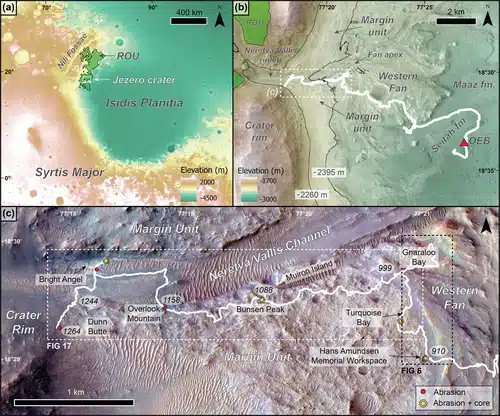 Jezero Crater’s western delta and ancient channels, tracing Mars’ long water history. Credit: Journal of Geophysical Research: Planets
The unit’s structure indicates it likely began as igneous rock, possibly from a magma chamber or lava lake within Jezero. Over time, carbon dioxide-rich water circulating underground chemically altered olivine crystals, converting them into iron- and magnesium-rich carbonates.
“This transformation… indicates that water circulated below the surface of the Margin unit, altering the rock over vast timescales,” said Professor Sanjeev Gupta of Imperial’s Department of Earth Science and Engineering.
These changes mirror hydrothermal systems on Earth, which are known to support microbial life, making them valuable targets in the search for ancient biosignatures.
Unmistakable Traces Of A Martian Shoreline
In lower areas of the Margin unit, researchers found layered sandstone embedded with rounded grains of olivine and carbonate, matching structures typically formed by wave action at a shoreline. “We are looking at what was once a beach,” said Alex Jones, Ph.D. researcher and lead author of the study. According to Jones, the waves from the Jezero lake reshaped local volcanic rock, rounding particles and depositing them into a sandy layer.
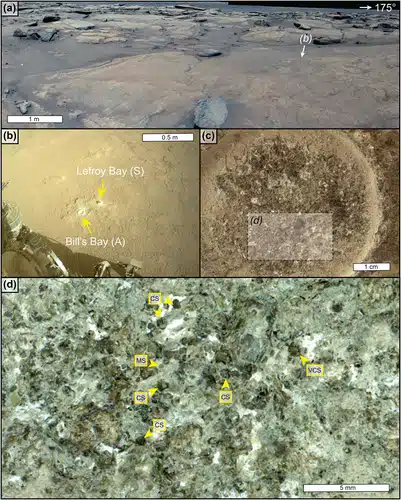 Rover and close-up views of Jezero sediments, showing mineral-rich deposits linked to long-lasting water activity. Credit: Journal of Geophysical Research: Planets
The positioning of this ancient beach, beneath the delta deposits fed by an ancient river, suggests that calm, stable lake conditions existed at Jezero even earlier than the delta itself, pushing back the timeline of habitable surface environments on Mars.
Jezero: A Lake That Kept Changing Over Time
The research builds on previous findings from the same team, which reported evidence of a younger, dammed lake in a region feeding into Jezero. In the Bright Angel formation, they discovered mudstone layers indicating long-standing water coverage in parts of the valley.
Together, the two studies provide a more layered view of Mars’s hydrological past, suggesting the Red Planet experienced repeated and prolonged periods of water presence, both on the surface and below it. As Jones explained:
“Jezero crater continues to prove it is the ideal place to investigate past habitability on Mars, and to help answer the question of whether life ever emerged.”
Perseverance has collected three core samples from the Margin unit and one from Bright Angel, all of which are being stored for NASA’s upcoming Mars Sample Return mission. These samples could provide crucial data, including precise dating of volcanic and sedimentary processes, chemical snapshots of past climates, and signs of ancient life trapped in the Martian rock.