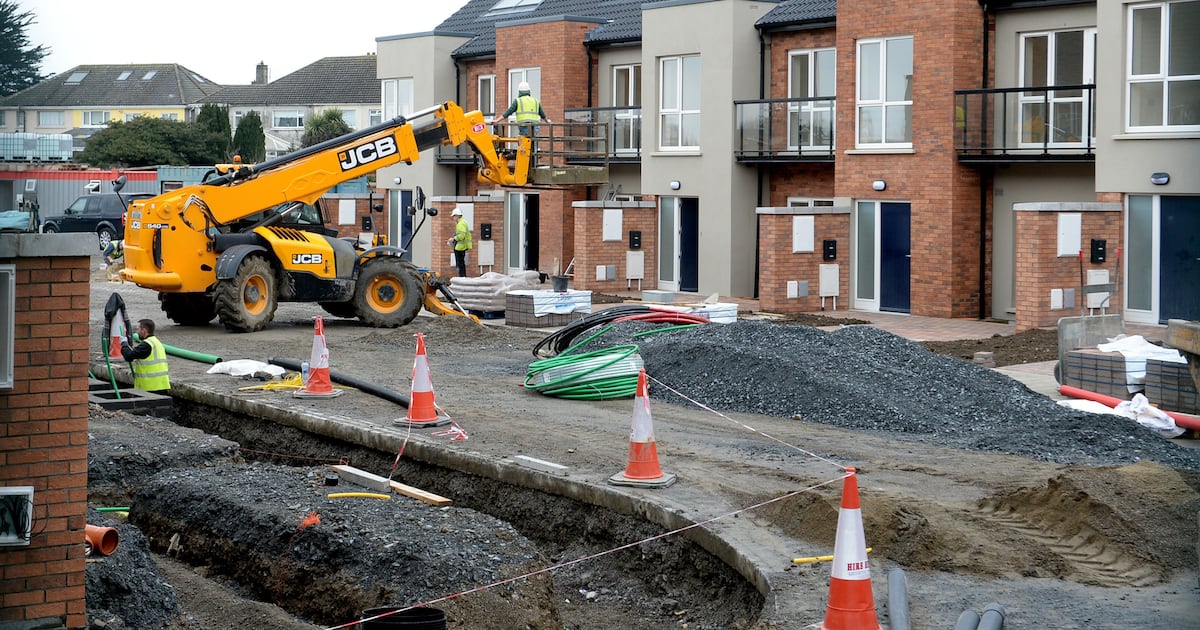
Irish home completions rose by 20.4 per cent last year to 36,284 units, to come in ahead of the expectations of the Central Bank and Economic and Social Research Institute (ESRI) – even if they fell well short of a target set by the Department of Housing.
More than half – or 57.6 per cent – of the completions for the full year of 2025 were in Dublin or the mideast of the country, including counties Kildare, Louth, Meath and Wicklow, the Central Statistics Office (CSO) said in a statement on Thursday.
The number of apartments completed rose by 38.7 per cent to 12,047, while scheme housing units increased by 13.1 per cent, according to the data. Single dwellings advanced by 12.5 per cent to 5,929 units.
The total output for last year was the highest since the CSO began its data series on house completions in 2011, in the wake of the property crash.
The Department of Housing had set a target in late 2024 of delivering 41,000 homes in 2025 as part of a broader aim of 300,000 units being built by the end of the decade.
That objective quickly became unrealistic. The Central Bank estimated late last year that 33,000 homes would be built, while the ESRI and Banking & Payments Federation Ireland had forecast an outcome in the region of 35,000 completions.
The Government effectively abandoned setting specific annual targets late last year as it reaffirmed its commitment to 300,000 new homes by 2030.
An ongoing shortage of houses being built in the State has driven inflation in home prices for more than a decade, according to economists.
Irish residential property prices were rising at an annual rate of 6.6 per cent in November, according to the latest data from the CSO.
Trevor Grant, chairperson of Irish Mortgage Advisors, welcomed the increase in completions last year, saying it is important the Government builds on the momentum.
“The biggest driver of Irish house price inflation is the shortage of homes coupled with the pent-up demand for housing and an expanding population,” said Mr Grant. “Without a significant boost to housing supply, steep house price inflation will persist and homes will continue to be unaffordable for a large cohort of young people as well as the many others who wish to buy.”
At a press conference in Cork, it was put to him that there were still not enough homes being built to meet demand.
While Taoiseach Micheál Martin described last year’s increase as “very significant” at a press conference in Cork, he conceded that “it’s not enough”.
“We have to get to about 50,000 per annum, some say even more,” he said. “We’re learning over the last years that this is a hard slog in many respects.”
Mr Martin added: “We want prices to moderate.”
“We accept that they’re extremely expensive,” he said, before noting that there are affordable housings schemes in place, including local authority and cost-rental schemes, as well as “lot of supports” for first-time buyers.
Deloitte Ireland’s chief economist, Kate English, said at least 20,000 new homes need to be completed by the end of June for the Government’s medium-term targets to remain credible.
“2025 was marked by significant housing policy announcements – this year the implementation of these policies will be critical in order for them to start to have an impact on the market,” said Ms English.
The Government unveiled a new housing action plan in November that includes regulatory reforms, tax incentives and a commitment that €275 billion would be spent in critical infrastructure, focusing on housing, energy and transport by 2035.
Budget 2026 also included a number of measures aimed at boosting apartment construction.