Just over 512 million years ago, Earth’s life was shaken by a major extinction event, yet fossil evidence reveals it persisted. A newly discovered fossil site in South China captures an entire marine ecosystem in recovery, frozen in rock with unprecedented detail. Named the Huayuan biota, the site preserves not just bones and shells, but soft tissues, internal organs, and entire species never seen before.
This find is helping researchers understand how life rebounded after the Sinsk extinction event, which disrupted the rapid diversification known as the Cambrian explosion. With over 8,600 fossils representing 153 species, nearly 60 percent of which are new to science.
Deep Water as a Refuge for Surviving Species
According to a research team led by Maoyan Zhu of the Chinese Academy of Sciences, the fossils were excavated from a single site and display extraordinary preservation. The locality qualifies as a Burgess Shale-type Lagerstätte, the rarest kind of fossil deposit, where even fragile anatomical features can survive, including traces of nerves and digestive systems.
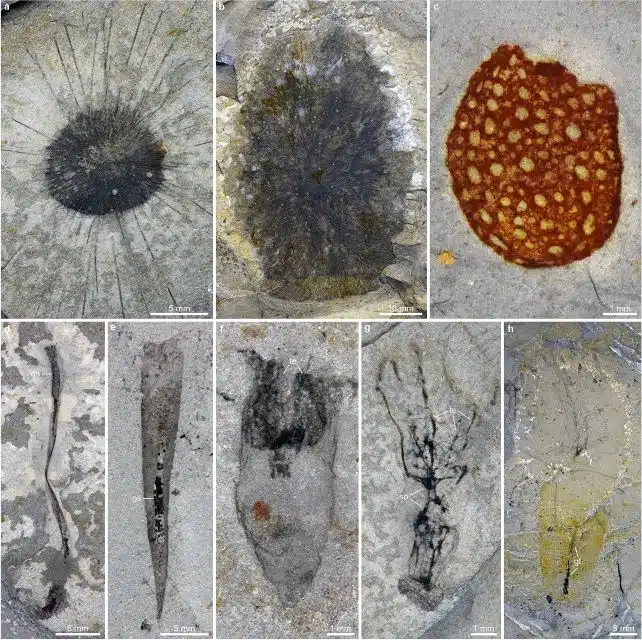 The fossil collection includes several bizarre forms, notably a set of Cnidarians and a particularly well-preserved sponge visible in the upper right corner. Credit: Nature
Unlike many previously known Lagerstätten, which often capture life from relatively shallow settings, the Huayuan biota appears to record a deeper-water marine ecosystem. According to the study avaliable on Nature, the organisms were not swept in from elsewhere but were likely preserved in place, where they lived and died.
Among the finds are trilobites, sponges, comb jellies, anemones, and radiodonts, which sat at the top of Cambrian food chains. It also contains vetulicolians, enigmatic animals frequently found in groups at Huayuan, hinting they may have formed shoals. Most notably, the team reports the oldest known pelagic tunicate, a free-swimming filter feeder still common in modern oceans, pointing to the early emergence of ecological roles that persist in today’s marine food webs.
Soft-Tissue Fossils Expose Hidden Anatomy
What makes the Huayuan site extraordinary is its preservation of biological features rarely fossilized. Researchers documented gut diverticula, optic neuropils, and even cellular-level structures. One newly discovered arthropod retained a full digestive tract, a rare find in fossils over half a billion years old.
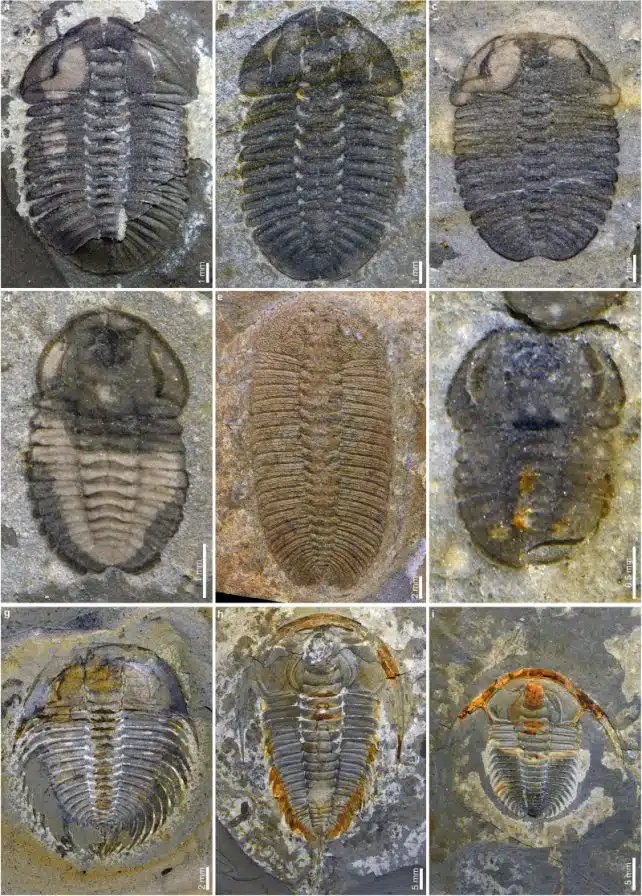 This sample displays some of the trilobite species identified within the Huayuan biota. Credit: Nature
This level of detail places the Huayuan biota among the most informative Cambrian fossil beds yet discovered. With 60 percent of species new to science, the biota is expected to generate years of research and revision in early evolutionary biology.
Many of the fossils appear undisturbed, their bodies not deformed or disarticulated, implying they were rapidly buried and preserved in their living environments.
Unexpected Species Links Across Continents
Though separated by millions of years and thousands of kilometers, the Huayuan biota shows clear parallels with fossil sites like the Burgess Shale in Canada. According to the scientists, iconic species once thought to be exclusive to that site have now been identified in Huayuan’s fossil layers as well.
“The extraordinary biodiversity of the Huayuan biota provides a unique window into the Sinsk event by revealing the post-extinction recovery or radiation in the outer shelf environment,” the authors said.
These connections hint at a broader distribution of some Cambrian species than previously understood and suggest that similar environmental conditions may have existed across distant regions.