
Met Éireann director Eoin Moran and Minister for Housing James Browne have held talks in the wake of the Minister’s criticisms of the forecasting service during Storm Chandra.
Mr Browne said in a statement after their meeting that he “recognises the important work that our meteorological teams and forecasting service do”.
The Minister said on Wednesday Met Éireann needed to improve its communications and he suggested the forecaster had withheld information that would have helped with flood preparations.
His comments on South East Radio sparked huge frustration within the forecaster.
Met Éireann is responsible for providing weather warnings for the general public but releases information regarding flood risks to local authorities whose job it is to alert potentially affected communities.
Briefings for the Minister and his officials were swiftly organised for Thursday morning in the wake of the Minister’s remarks on Wednesday.
In a statement issued on his behalf afterwards, his Department said: “The director [Mr Moran] has assured him that the requisite flood forecast data was fed into the bigger system including all of the relevant stakeholders ahead of the event.”
It added: “Minister Browne is very appreciative of all parties working together to tackle the current impacts of Storm Chandra, particularly as floods are complex and difficult events which require input and analysis from multiple stakeholders.”
The statement said the Minister was “very determined that a joined-up approach across Government is central to the overall response to significant weather events and their impacts.
“As with all such events, there will be learnings for the future. The Minister is determined that any such learnings will be incorporated into how future events are dealt with.”
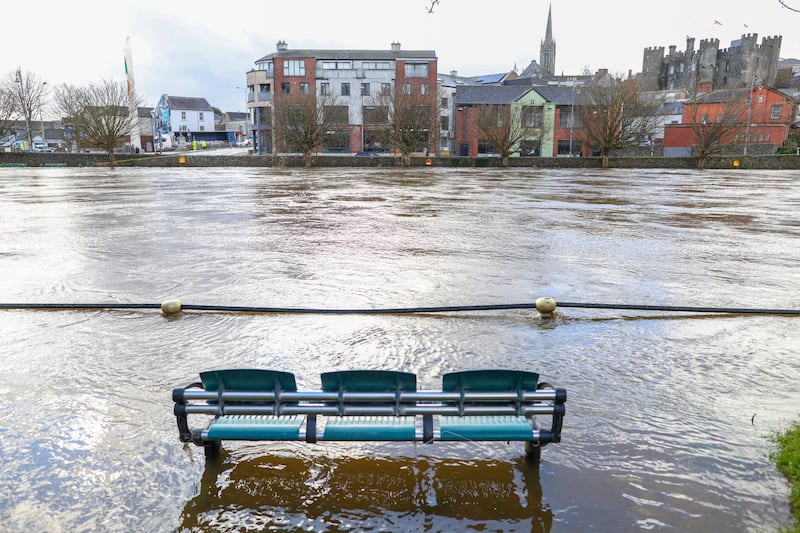 Water from the river Slaney surrounds a bench on the bank of the river during Storm Chandra, in Enniscorthy, Co Wexford, on January 28th. Photograph: Paul Faith/AFP via Getty
Earlier, Met Éireann defended itself from the criticisms which came after the minister visited flood-hit Enniscorthy in his Wexford constituency.
Mr Browne said Met Éireann seemed to have “guarded” information.
“Some State agencies seem to think that it’s their duty to somehow withhold information,” he said on air.
Met Éireann said in response that its services, operations and engagement with all stakeholders were “always evolving to meet current and future needs”.
The forecaster said it indicated during a technical briefing of the National Emergency Co-ordination Group on Monday afternoon that there would be a “high likelihood” of river flooding and surface flooding in parts of Leinster and Munster.
“The expected impacts and flooding risks, including mention of river levels and soil saturation, were communicated to the public through a commentary on our website, social-media channels, bulletins and media interviews,” a spokesperson said.
They said Met Éireann was focused on its role of “monitoring, analysing and predicting Ireland’s weather, climate and flooding, and supporting emergency planning responses to weather events such as Storm Chandra”.
Mr Browne said on radio that the forecaster needed to review how it provided warnings, saying there needed to be a greater use of “judgment calls” in warning the public.
“It’s based on a mathematical formula, whereas in other countries they use the mathematical formula, but then they also make a judgment call,” he said.
Asked about the level of warnings issued, Met Éireann said it issued a series of rain and wind warnings in advance of Storm Chandra based on the “latest model guidance”.
“Met Éireann takes into account the considerations of the expected impacts in its warnings.
“The numerical criteria are guidelines but impacts from the meteorological parameters which depend on the location, recent weather conditions and duration of the event are also considered when producing a weather warning.
“In any individual weather event, not every location in the warning area may experience the same degree of weather or impacts,” it said.
Mr Browne’s comments were labelled “extraordinary” by some Opposition TDs, including Labour’s climate spokesman Ciaran Ahern.
“Attempting to blame Met Éireann for a communications failure during Storm Chandra is ridiculous given his own failure to host a storm preparedness media briefing in advance of the storm arriving on our shores,” Mr Ahern said.