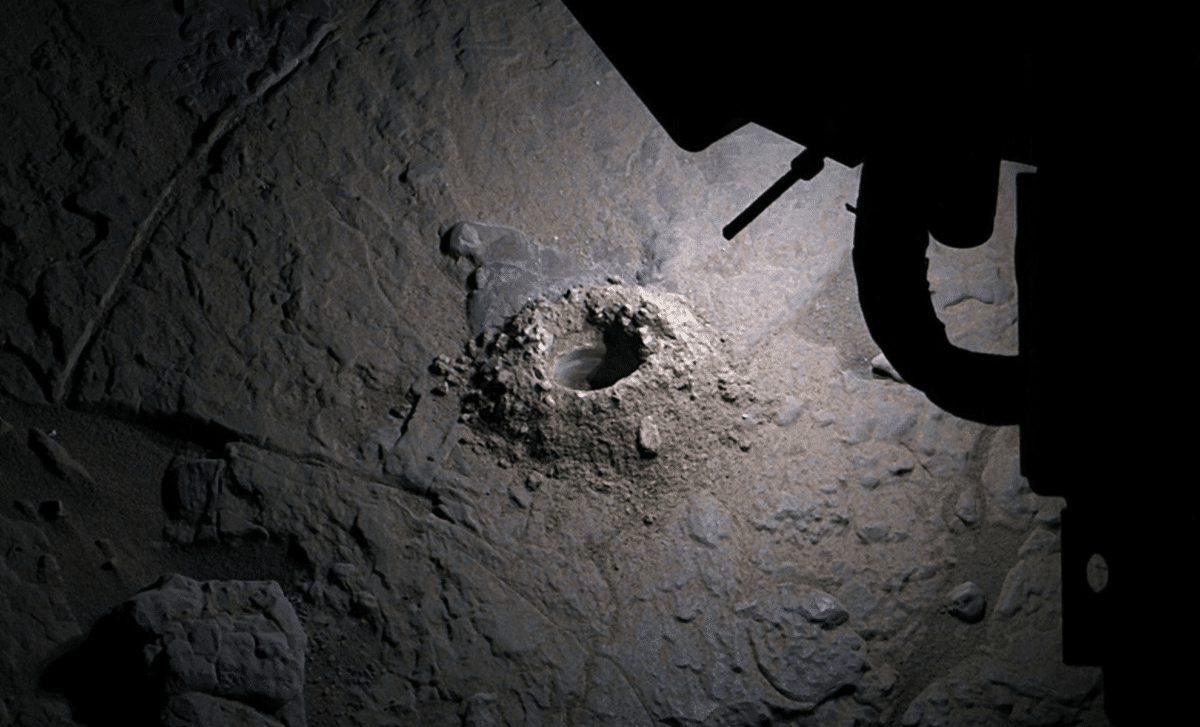
NASA’s Curiosity rover has delivered a rare nighttime glimpse of the Martian surface by illuminating a drill site nicknamed Nevado Sajama, offering scientists a fresh way to study Mars after dark. The image, released by NASA Science, was captured using onboard LED lights.
A Nighttime Experiment Unlike Anything Seen Before On Mars
For most of its mission, Curiosity has relied on sunlight to analyze rocks, soil, and geological structures across Gale Crater. Night operations are uncommon, mainly because imaging without natural light offers limited scientific return. This observation broke that pattern. By activating LED lights mounted on the rover’s robotic arm, engineers created an artificial light source strong enough to reveal fine surface details normally hidden in darkness.
The image was taken on December 6, 2025, corresponding to Sol 4,740 of the mission. The rover used its Mast Camera (Mastcam) to capture the scene while the LEDs from the Mars Hand Lens Imager (MAHLI) illuminated the drill hole. This configuration allowed scientists to observe how light interacts with freshly exposed rock layers, providing contrast and texture impossible to obtain during daytime imaging alone.
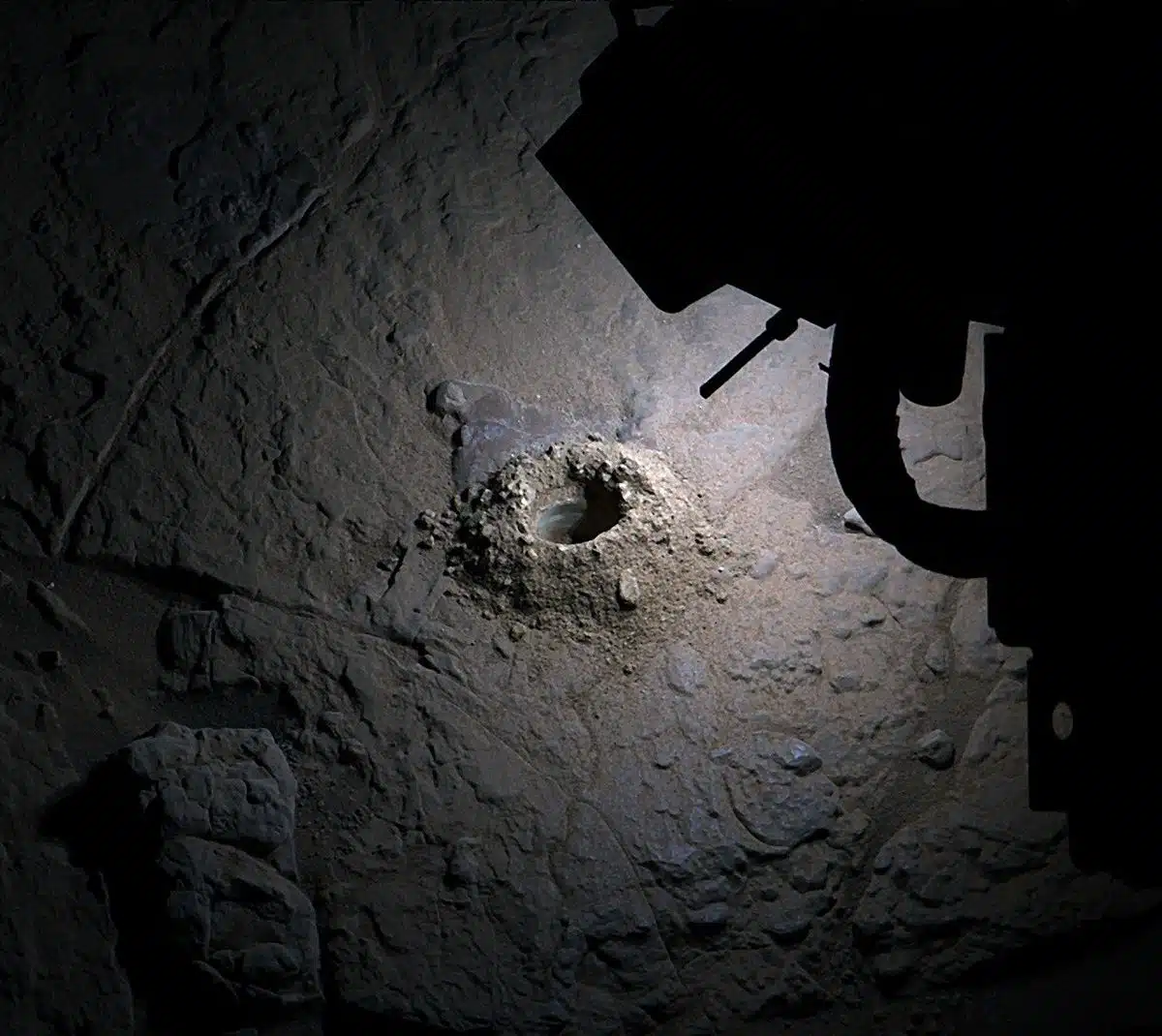 Credit: NASA/JPL-Caltech/MSSS
Why The Nevado Sajama Drill Hole Matters To Scientists
The rock target known as Nevado Sajama was drilled on November 13, 2025, in a region dominated by unusual geological formations called boxwork. These formations resemble giant spiderwebs when seen from orbit and are believed to result from mineral-rich fluids moving through cracks in ancient rock.
After drilling, the science team noticed that the walls of this hole were smoother than usual. This detail was significant. In earlier phases of the mission, nighttime LED imaging helped identify layering within drill holes, offering clues about how Martian rocks formed. Recent changes in drilling techniques often left holes too rough or dusty for such analysis. Nevado Sajama presented a rare opportunity to revisit this method and test whether subsurface layering could still be observed under controlled lighting conditions.
How Curiosity Uses Artificial Light On The Red Planet
The LEDs used in this experiment are not floodlights designed for panoramic views. They are precision tools built into MAHLI, intended to illuminate small targets at close range. During daytime operations, these lights are sometimes used to peer into shadows, instrument inlets, or deep cavities where sunlight cannot reach.
Using them at night adds a new dimension. Without solar glare or variable shadows, the rover can create consistent lighting angles. This helps scientists assess grain size, texture, and subtle color variations inside the rock. The approach also reduces visual noise caused by dust reflecting sunlight, making it easier to distinguish genuine geological features.
NASA’s Long-Term Strategy Behind This Night Observation
According to details published by NASA Science, this nighttime test was not a routine operation but a targeted decision driven by geology. The Jet Propulsion Laboratory, managed by Caltech, continues to adapt Curiosity’s tools as the rover ages, finding new ways to extract high-value data from familiar instruments.
This strategy reflects a broader philosophy across NASA’s Mars program: flexibility. Even after more than a decade on Mars, Curiosity is still capable of surprising science by reusing hardware in creative ways. Each successful experiment expands the operational playbook for future rovers that may carry similar imaging systems.