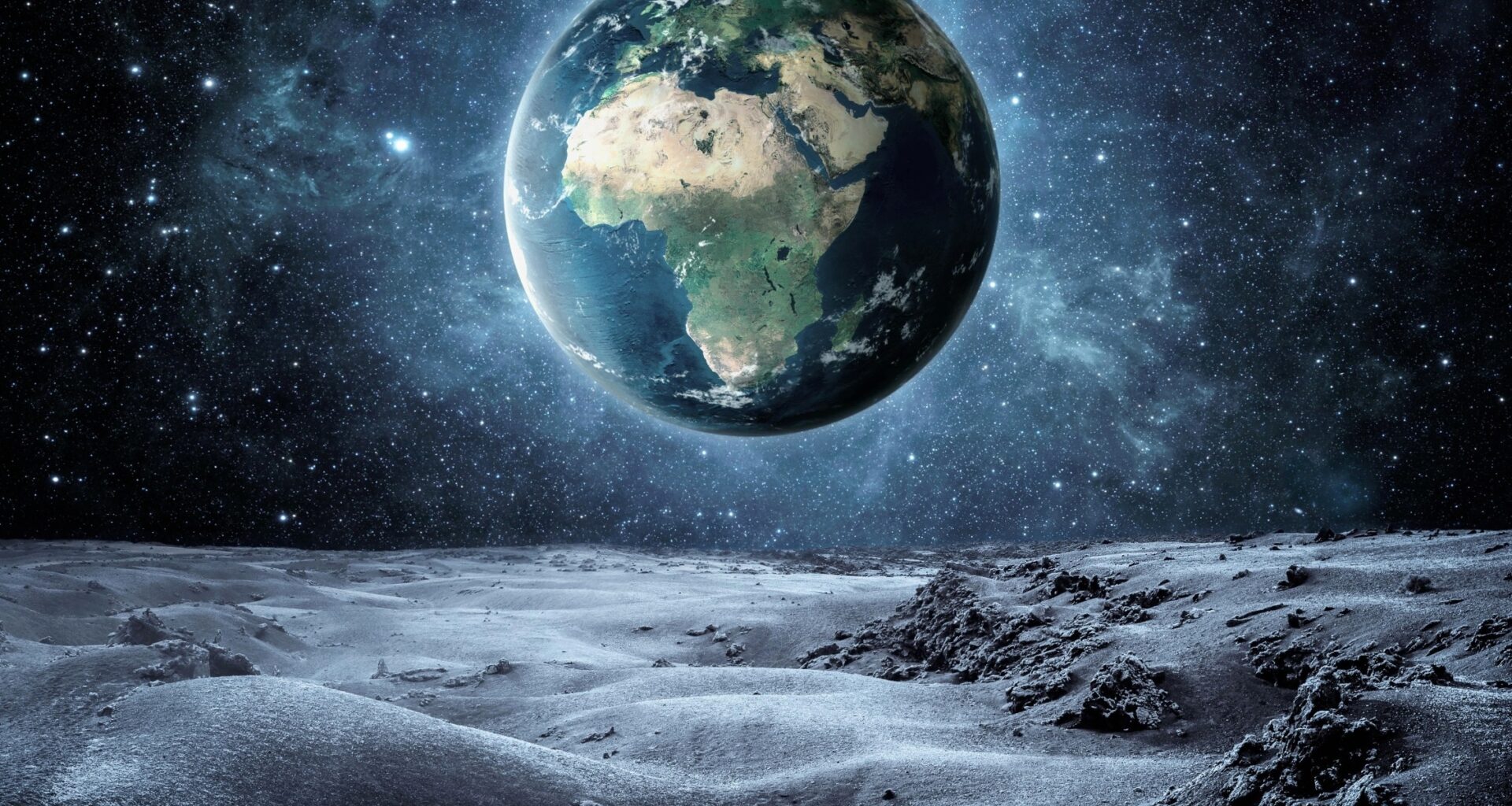
Earth’s atmosphere may feel permanent, but it is slowly leaking into space. New research suggests some of that lost air does not disappear.
Instead, it drifts outward and settles onto the Moon, quietly accumulating in lunar soil over billions of years. That process matters for both science and exploration.

The Moon may preserve a chemical record of Earth’s ancient atmosphere, and those same materials could one day support future lunar missions.
Using computer simulations, researchers at the University of Rochester traced how charged atoms escape Earth and reach the Moon.
Led by graduate student Shubhonkar Paramanick, the team focused on times when the Moon passes through Earth’s magnetic tail.
During these alignments, Earth’s magnetic field can guide atmospheric particles toward the lunar surface.
When air slips away
High above Earth’s surface, sunlight strips electrons from atmospheric atoms, turning them into electrically charged particles. Once ionized, these atoms respond to electric and magnetic forces rather than drifting freely.
The solar wind – a constant stream of fast, charged particles from the Sun – can intercept some of this ionized air and sweep it along.
Charged atoms have the best chance of escape, though only a small fraction ultimately reaches the Moon.
Earth’s magnetosphere usually protects the atmosphere by deflecting solar particles, but that shield is incomplete. Magnetic pressure can expand the upper atmosphere, exposing more atoms to stripping and escape.
In the simulations, this expanded cross-section and the connection through Earth’s magnetic tail outweighed the magnetosphere’s trapping effect under present-day solar conditions.
That balance helps explain how Earth-sourced oxygen and nitrogen can continue leaking into space and gradually accumulating on the Moon’s near side.
A monthly magnetic pathway
When the Moon is nearly full, it passes through Earth’s magnetotail – the long, nighttime extension of Earth’s magnetic field that stretches away from the Sun.
During this alignment, magnetic field lines can steer escaping charged atoms in the same direction the Moon is traveling around Earth.
The simulations showed that atmospheric transfer becomes efficient mainly during these brief passages.
At most other points in the Moon’s orbit, Earth’s escaping air spreads too widely to reach the lunar surface in meaningful amounts.
For a few days each month, however, the geometry changes. Earth’s magnetic shield temporarily turns into a channel, guiding oxygen, nitrogen, and other charged atoms outward and allowing a small but steady flow to reach the Moon.
Moon dust traps gases
The Moon’s surface is covered in regolith – loose, dusty material created by billions of years of impacts. With no thick atmosphere to deflect incoming particles, the regolith acts as a natural trap for atoms arriving from space.
Charged atoms strike the surfaces of dust grains and lodge within shallow layers, where collisions with solid material quickly slow them down and limit their chance of escape. Over time, these particles become locked into the lunar soil.
Depth-profile analyses revealed nitrogen and hydrogen signatures in some grains that differed from the chemical mix found in the solar wind.
Later impacts can bury older grains beneath fresh material, helping preserve their chemical fingerprints even as the surface above is repeatedly churned.
Fingerprints of Earth’s air
Samples collected during the Apollo 14 and 17 missions allowed the team to test their simulations against lunar soil with a well-documented history.
“We used lunar samples brought to Earth by the Apollo 14 and 17 missions to validate our results,” said Paramanick.
By examining isotopes – atoms of the same element with different weights – the researchers could distinguish particles born in the solar wind from those that originated in Earth’s atmosphere.
This separation mattered because both sources deliver similar elements but leave different isotopic fingerprints.
“We have this solar wind coming onto the terrestrial atmosphere, and then the terrestrial atmosphere leaking away,” said Paramanick.
That overlap makes isotopic analysis essential for identifying which atoms truly came from Earth rather than the Sun.
The Moon as a time capsule
Evidence for Earth-to-Moon atmospheric transfer did not begin with this study. Previous spacecraft observations detected oxygen ions streaming down Earth’s magnetic tail, hinting that the Moon may be collecting traces of Earth’s air.
A 2017 study strengthened that idea by linking these oxygen ions to periods when the Moon passed through Earth’s magnetotail.
That connection mattered because oxygen from Earth carries isotope ratios shaped by life, geology, and long-term climate processes – unlike oxygen formed in the solar wind.
If buried layers of lunar regolith preserve these signals, scientists could use them to reconstruct portions of Earth’s ancient atmosphere that no longer exist above the planet today.
In that sense, the Moon may serve as a time capsule, holding chemical evidence of Earth’s lost atmospheric history.
Mining the Moon’s air
For future missions, oxygen, hydrogen, and nitrogen in surface soils could support breathing mixes, water production, and chemical propellants.
Heating regolith can release trapped molecules, and running electric current through water splits it into gases used in engines.
The same delivery process may also bring nitrogen-bearing compounds, but local amounts likely depend on depth, location, and solar activity.
Any mining plan still must handle abrasive dust, high energy costs, and the fact that delivery happens in pulses.
What the Moon may keep
Future landers could test this idea directly by measuring light elements on site and returning core samples that preserve older, buried layers.
Comparing soils from the Moon’s near side and far side would help reveal whether Earth-derived gases fade when the Moon moves outside Earth’s magnetic tail.
Improved models could also trace how the Earth-Moon distance has changed over time, since that gap controls how much escaping atmosphere can reach the lunar surface.
Together, these approaches link space physics, magnetic fields, and dusty lunar geology into a single story of ongoing chemical exchange.
Even if the signal appears uneven, finding a clear Earth fingerprint would connect lunar geology to long-term climate history and suggest that the Moon still preserves lost chapters of Earth’s ancient atmosphere.
The study is published in the journal Communications Earth & Environment.
—–
Like what you read? Subscribe to our newsletter for engaging articles, exclusive content, and the latest updates.
Check us out on EarthSnap, a free app brought to you by Eric Ralls and Earth.com.
—–