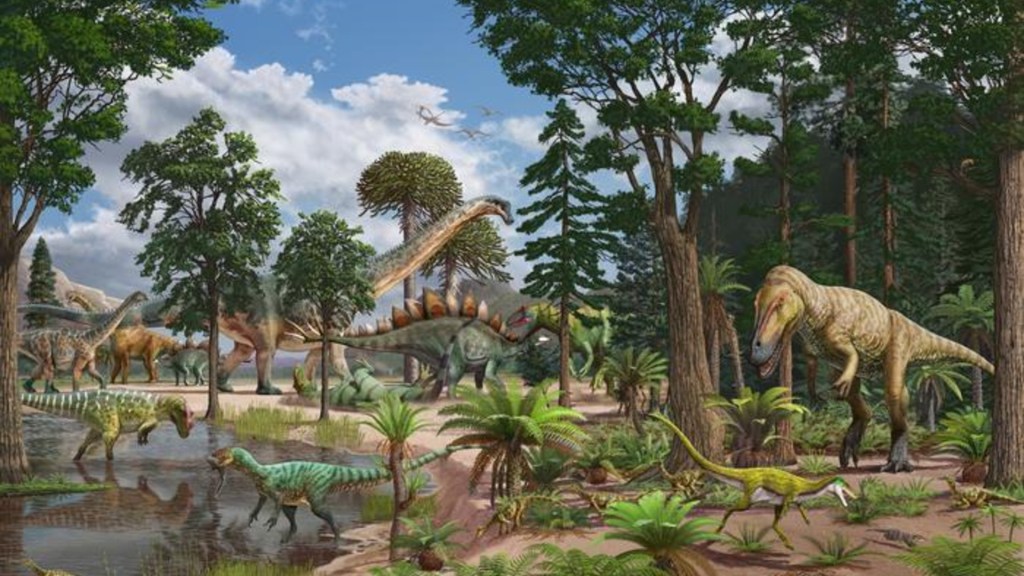
Infant and juvenile sauropods were the primary food source for fearsome predators during the Late Jurassic period.
Though they would eventually grow into the most massive titans to ever walk the Earth, adult sauropods — the iconic long-necked, long-tailed herbivores — started life as vulnerable links in a brutal food chain.
The University College London team states that these young dinosaurs occupied a unique and vulnerable niche in their ecosystem.
Sauropods were most likely eaten by dinosaurs such as Allosaurus, which lived about 145 million years ago during the Jurassic period.
“Life was cheap in this ecosystem and the lives of predators such as the Allosaurus were likely fuelled by the consumption of these baby sauropods,” said Dr Cassius Morrison, lead author.
Easy prey to super-predators
To reconstruct this ancient ecosystem, the UCL team analyzed 150-million-year-old fossils from the American Morrison Formation to create a high-resolution food web.
At least six types of sauropods were discovered at the site, with Diplodocus, Brachiosaurus, and Apatosaurus among the most notable finds.
Data from the Dry Mesa Dinosaur Quarry in Colorado, which included bone isotopes, tooth wear, and fossilized stomach contents, was examined.
With this information, the researchers mapped the complex dietary relationships between species. This network of consumption revealed that the ecosystem depended on the abundance of defenseless young sauropods to sustain its apex predators.
“Adult sauropods such as the Diplodocus and Brachiosaurus were longer than a blue whale. When they walked the earth would shake. Their eggs, though, were just a foot wide and once hatched their offspring would take many years to grow,” said Morrison.
The study posits that sauropods were simply too big to be good parents. If a 30-ton Apatosaurus tried to nurture a nest, it would likely crush the eggs or the hatchlings underfoot.
“Size alone would make it difficult for sauropods to look after their eggs without destroying them, and evidence suggests that, much like baby turtles today, young sauropods were not looked after by their parents,” Morrison added.
Emergence of T.rex
The data showed that sauropods had more links to predators than other herbivores, like the Stegosaurus.
While a Stegosaurus could swing a spiked tail to defend itself, a baby sauropod was essentially defenseless prey.
This abundance of easy prey may have shaped history. The study suggests that predators like the Allosaurus thrived because food was so accessible.
However, this free lunch didn’t last forever.
“Reconstructing food webs means we can more easily compare dinosaur ecosystems across different periods. It helps us to understand evolutionary pressures and why dinosaurs might have evolved in the way they did,” the author added.
By the time Tyrannosaurus Rex appeared 70 million years later, the easy sauropod buffet had dwindled. This scarcity likely forced the T. Rex to evolve its bone-crushing bite and acute vision to tackle more dangerous, armored prey like the Triceratops.
The study involved an international team of researchers from the UK, the United States, Canada, and the Netherlands.
The findings were published in the New Mexico Museum of Natural History and Science Bulletin on January 30.