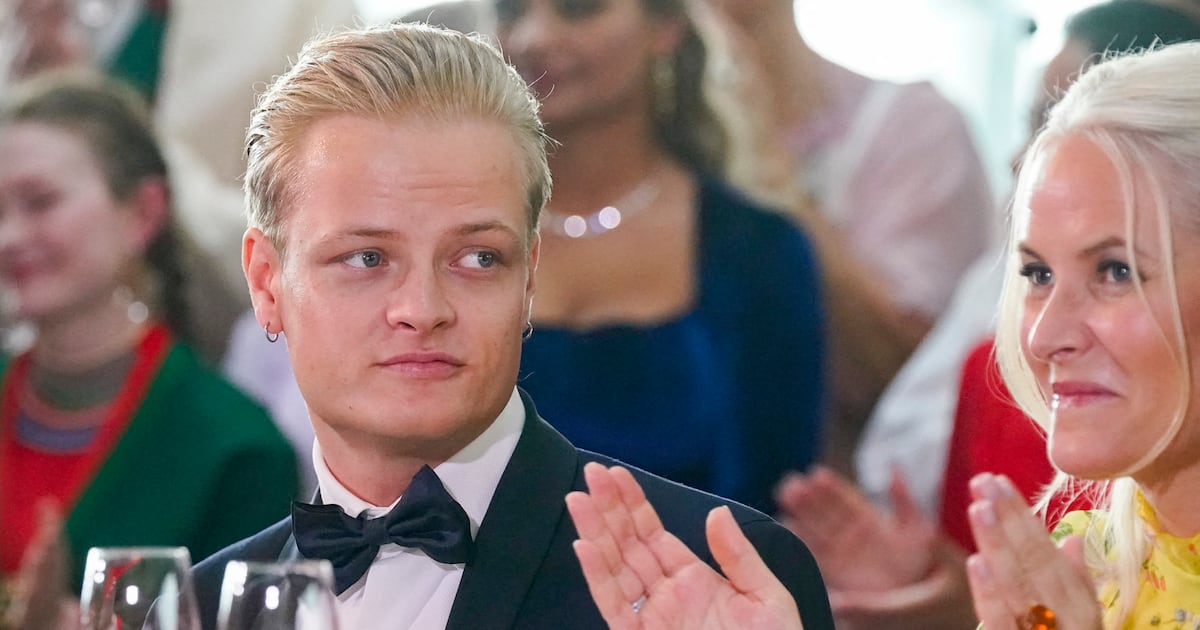
At the Quart musical festival in southern Norway in July 1996, the headliner was Nick Cave and the Bad Seeds.
In the crowd was Mette-Marit Tjessem Høiby, a 22-year-old waitress from the southern coastal city of Kristiansand.
She had yet to tell anyone she was three months pregnant with the child of a man named Morten Borg. She hadn’t even revealed the pregnancy to her friend at the festival who introduced her that night to Norway’s most eligible bachelor: Haakon, crown prince of Norway.
The 22-year-old royal fell hard for the ‘commoner’ and a short summer romance followed, but friends say things went quiet again until they met three years later at the same festival.
By now Mette was a single mother of a two-year-old son, Marius Borg Høiby, and Haakon, sure she was the one, was determined not to let her slip away again.
Their subsequent courtship was a tabloid fever dream as the couple tried but failed to dodge the paparazzi with dates in London and New York.
After months of public headlines and private lobbying, Haakon won over his doubting family and his marriage to Mette-Marit in August 2001 was billed a triumph of love.
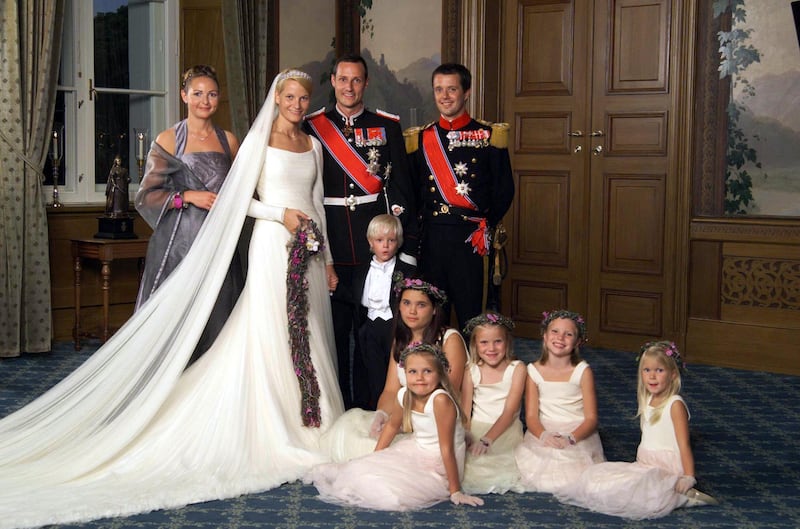 Newlyweds Prince Haakon, second right, and Mette-Marit, second left, with four-year-old Marius Borg, standing, in August 2001. Photograph: Getty
Featured in almost all pictures of the happy couple was Marius, by now an exhausted-looking blond four year-old. The tabloids dubbed him “the little prince”.
On Tuesday the little prince, Marius Borg Høiby, now a 29-year-old tattooed lover of drugs and guns, goes on trial in Oslo in what Norway has billed its trial of the century.
Charges include four counts of rape – one with sexual intercourse – and 28 other crimes, including acts of violence against women, many allegedly filmed by him on his phone.
Borg Høiby has admitted to assaulting one woman, Rebecca Helberg Arntsen, in a drink-and-drug-fuelled attack on August 4th, 2024. The night ended with her in hospital and him in a police cell.
His victim says the assault involved strangling and multiple blows but, in recordings obtained by Norwegian tabloid VG, Borg Høiby allegedly described his assault as “a little pat on the back”.
Subsequently, two further women have come forward with similar stories; whether any were girlfriends of Borg Høiby is a matter of dispute.
Earlier this month, an additional six-count indictment was brought, including a “narcotics offence” involving 3.5kg of marijuana.
Defence lawyer Petar Sekulic has said his client will plead guilty to some lesser charges, but denies the more serious charges of rape and violent assault.
In a statement 10 days after his arrest in August 2024, Borg Høiby said he had suffered from “mental Troubles”, had struggled “for a long time with substance abuse” and, during the August altercation, acted “under the influence of alcohol and cocaine”.
“The drug use and my diagnoses do not excuse what happened,” he said. “I want to be responsible for what I have done, and will explain myself truthfully to the police.”
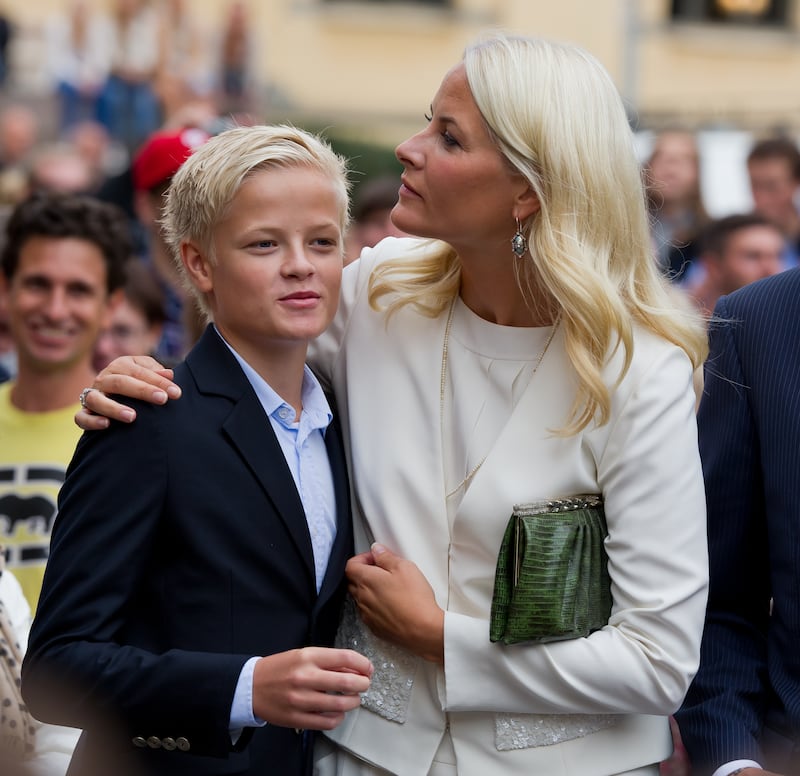 Princess Mette-Marit with son Marius Borg Hoiby in August 2011 in Oslo. Photograph: Nigel Waldron/Getty
The nature of the charges, his partial confession and leaked pictures of Borg Høiby posing with banknotes and a pistol have, taken together, shocked Norway.
More shocks are likely to come with testimony of the three women over rape claims dating back as far as 2018.
This week, a haggard Prince Haakon went before the press to profess his love for his stepson Marius as an “important party of our family”, while confirming that he and his wife will stay away from the trial.
“It’s clear we think a lot about all those affected in the case,” he said in a muted, trembling voice, hands shaking. To the alleged victims of Marius, he said: “I know many of you are having a hard time right now.”
Watching him up close was journalist Jonas Jørstad, of celebrity magazine Se og Hør (See and Hear).
His magazine has led coverage on the scandal and Jørstad has trailed the 52-year-old Haakon through years of joy and tragedy. But the trembling man before him, taking deep breaths as he struggled to speak, was a very different person.
“This was not a crown prince delivering a message. It was a deeply affected family man who had difficulty speaking,” Jørstad says. “This is not just a trial. It is the most serious burden the royal family has ever faced.”
Norway has one of Europe’s youngest monarchies, established by referendum in 1905 after the dissolution of the Swedish-Norwegian union, but it draws on one of Europe’s oldest royal houses.
The House of Glücksberg, with roots in Schleswig-Holstein in northern Germany, has its fingers in most of Europe’s royal family pies: Denmark, Sweden, Iceland, Greece, the UK and several German states.
Founding king Haakon VII, formerly Prince Carl of Denmark, was married to his first cousin Maud, a sister of George V and great-aunt of Queen Elizabeth II.
And when it comes to family drama, the Norwegians have always given their British cousins a run for their money.
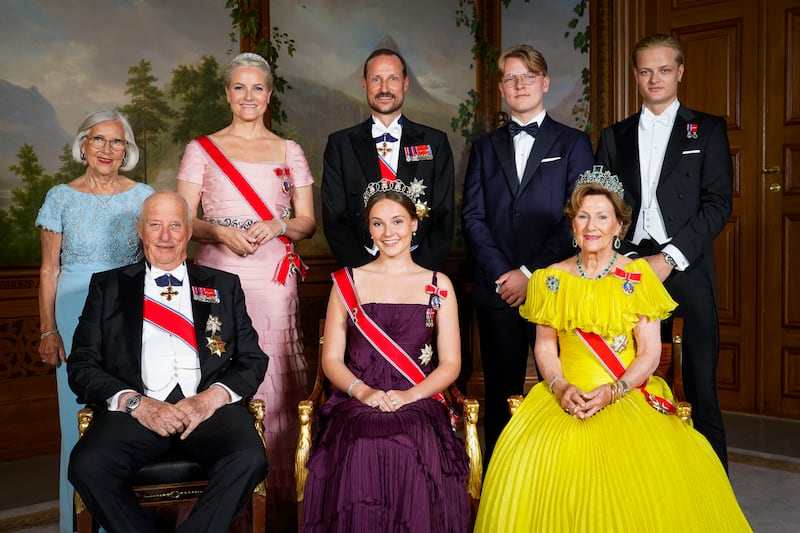 Norway’s Princess Ingrid Alexandra, front, poses for a family photo next to King Harald V and Queen Sonja and, back row far right, Marius Borg Hoiby to mark her 18th birthday in 2022. Photograph: Lise Åserud/Getty
Current King Harald V, now 88, ascended the throne in 1991 but, as a young man, had a nine-year secret relationship with dressmaker Sonja Haraldsen.
She was a ‘commoner’ and their relationship caused a scandal when it became public, prompting pushback from the royal family.
Harald pushed back even harder, reportedly threatening to remain single unless he could marry Sonja, which he did in August 1968.
Their story, retold in last year’s Amazon film The Commoner, pales in comparison to a competing Netflix production, Rebel Royals, featuring Harald and Sonja’s only daughter, Princess Märtha Louise.
A self-described clairvoyant, Märtha Louise divorced her first husband in 2017 and, seven years later, married self-styled shaman and sexual healer Durek Verrett.
The Netflix documentary skirts around the many lurid claims about the couple; instead they used the film to accuse the Norwegian royal family of racism for not accepting Verrett, a Black American citizen.
Märtha Louise has since been cut off as an active royal and faces repeated accusations from her family of violating an agreement not to cash in on her royal connections, such as her Netflix show and her own brand of gin.
While Märtha Louise still features on the royal family website, Marius Borg Høiby never has.
As Prince Haakon’s stepson, he is part of the royal family but not the royal household. He has with no royal duties and remains outside the line of succession.
Some Norwegians see the roots of Marius’s Troubles in this tension between his life as a ‘commoner’ ex-motorbike mechanic with two royal half-siblings Ingrid Alexandra and Sverre Magnus, the younger children of Mette-Marit and Haakon.
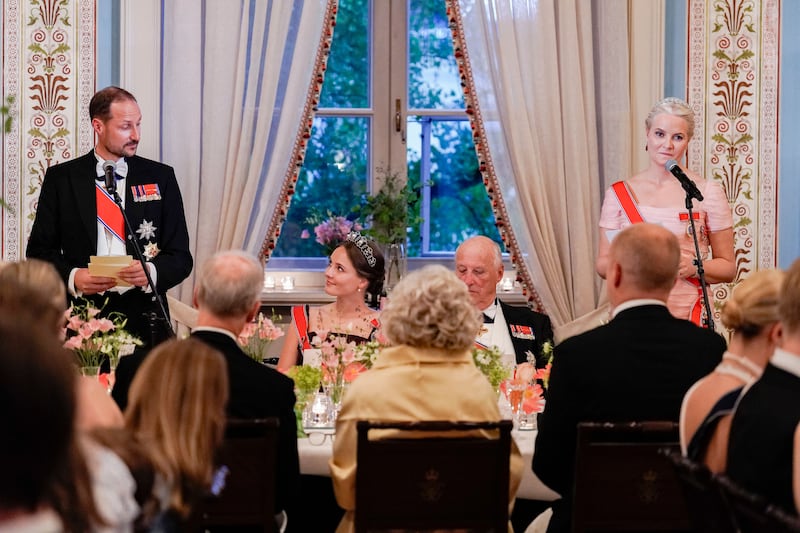 Prince Haakon and Princess Mette-Marit address a gala dinner for their daughter Princess Ingrid Alexandra, centre. Photograph: Håkon Mosvold Larsen/Getty
Norwegian journalist Torgeir Pedersen Krokfjord is co-author of a bestselling book on the unfolding scandal: Hvite Striper, Sorte Får (White Lines, Black Sheep). He thinks Marius had “a very strange upbringing”.
“It’s comparable to Prince Harry as the ‘spare’, but even worse,” Krokfjord says. “His siblings have formal roles and taxpayer salaries and he has nothing.”
Marius may have charmed the nation as “the little prince” in 2001, and he has appeared regularly in official royal family portraits since, but the snowballing scandal has seen the palace edge him out of their world – and the royal narrative.
Other Norwegians reject this disassociation narrative, suggesting instead the apple doesn’t fall far from the tree.
On the eve of her wedding in August 2001, still facing headlines that she was “more Fergie than Diana”, Mette-Marit took drastic action. She held an tearful press conference, acknowledging her wild party years and subsequent struggles as a single mother.
“My youthful rebellion was much stronger than many others, with me living quite a wild life,” she told journalists, a nod to her convicted felon father who divorced her mother to marry a stripper.
Mette-Marit conceded she had, in the past, “overstepped limits”.
“The experience came at a cost for me and was something I took a long time to get over,” she said. “I would like to take this opportunity to say that I condemn drugs.”
The same cannot be said for her son’s father, Morten Borg.
He grew up in one of Oslo’s most exclusive streets, was a 1990s nightclub regular and, according to a biographer, “no stranger to the police”.
Borg was arrested in an Oslo apartment early in 1991 during a police raid that secured 70 grams of cocaine, worth €22,500.
Later that year he was arrested again with 130 grams of cocaine, leading to a 31-month prison term.
When he was sent to prison in 1998, again on cocaine possession charges, Marius had just been born.
Borg, a financial analyst by profession, was reportedly shocked by Mette-Marit’s news she was pregnant as they had been casual friends and never a couple.
He has kept a lower profile in recent years, appearing in public for occasions such as Marius’s first day at school. Father and son reportedly spent last Christmas together.
Like his parents in their younger days, Marius has a love of wild parties – but is in the public eye. Tabloids named his regular blowouts with motorbike gang friends “the Skaugum festival”, after the royal family estate.
Krokfjord describes Morten Borg, whom he met once, as “a very charming, nice guy, yet at same time he was one of our first convicted cocaine dealers, a real cocaine pioneer in Norway”.
His book White Lines, Black Sheep claims the son, Marius Borg Høiby allegedly had links to a drug cartel in Iran.
Borg Høiby and his defence lawyer have dismissed the claim as false, but Krokfjord and co-author Øistein N Monsen stand by their multi-sourced claim.
“Yet when these concerns reach the royal family they are put in a safe in the hope they’ll go away,” Krokfjord says. “To some extent they have succeeded with this approach as it is only in the last two years that these things have come into the spotlight.”
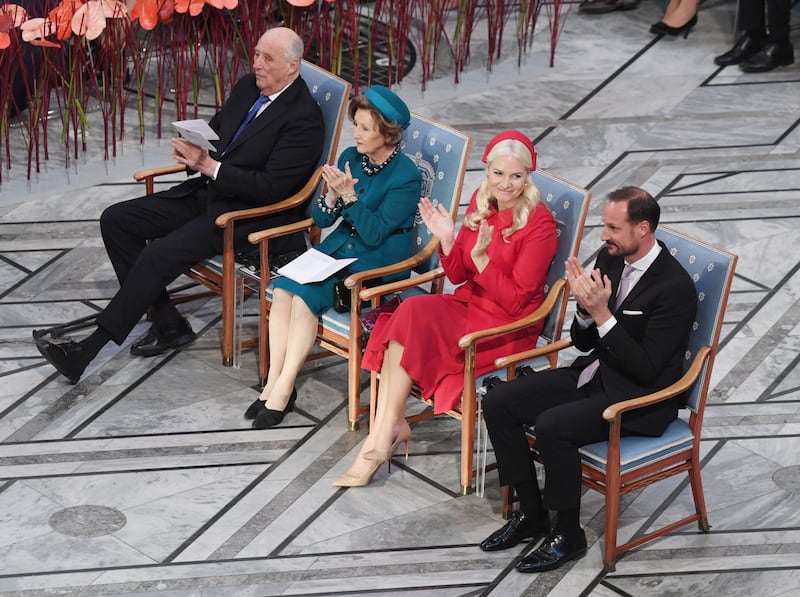 Queen Sonja, King Harald, Prince Haakon and Princess Mette-Marit attend the Nobel Peace Prize Ceremony 2022 in Oslo. Photograph: Rune Hellestad/Getty
That spotlight has cast a harsh light on the royal household in the last 18 months. With his parents in poor health, Prince Haakon has attracted considerable sympathy for his balancing act between royal obligations and family loyalty.
Opinion is less clear about his wife, Mette-Marit, particularly given what might emerge during the trial.
On the one hand many are sympathetic, seeing a mother struggling with a wayward son. On top of that is her own poor health: chronic pulmonary fibrosis that has worsened and is likely to require a lung transplant in the near future.
However, when police seized her son’s phone following an allegation he had attacked his girlfriend, the SIM card was missing and it prompted questions around an alleged cover-up.
“People were furious when that emerged, but people’s anger mellows with time,” Krokfjord says.
British-born Craig Aaen-Stockdale moved to Norway in 2012 with his Norwegian wife, took citizenship and now heads Norge som Republikk (Norway as a Republic).
His organisation, with 700 paying members and 3,000 Facebook followers, campaigns for the abolition of the monarchy. Its campaign has included legal action against the Norwegian royal household: over Princess Märtha Louise gin – for breaking rules on alcohol promotion – and over a sarcophagus commissioned for King Harald without a public tender process.
For the large part, Aaen-Stockdale sees support for Norway’s royals as based on sentimentality and apathy.
“Only when scandals like this come along do people think, ‘It’s a bit odd, this arrangement’,” he says, reflected in a 2024 membership surge for his organisation. “For now the dominant narrative is ‘Poor King Harald who has to deal with all this chaos around him’. The Marius-as-rotten-apple narrative, which is being heavily pushed here, too, will probably win out.”
But there is a chance that things could turn out very differently, he thinks, particularly if the trial asks pointed questions about palace-state collaboration – and the number of blind eyes turned to Borg Høiby’s criminality because of his position.
“I hope it will come out in court why the police felt the need to tell the royal family in advance they were coming to arrest him,” Aaen-Stockdale says. “For now, we are trying to keep the focus on the fact that we think the seeds of all this are planted in the system of monarchy itself, that inherited power is wrong.”
As the trial date approaches, Prince Haakon and Mette-Marit have remained silent on the private side of their family drama, saying only in a statement: “Our view has always been that this matter must be dealt with in the legal system. That is where it belongs.”
On Tuesday, somewhat cryptically, Prince Haakon said: “It is good to know that we live in a rule of law.”
Veteran royal watcher Jørstad, of Se og Hør (See and Hear) magazine, says it is clear the scandal has damaged the royal family “even if it is too early to see the full extent”.
“At the same time, the monarchy unquestionably remains strong in Norway, and the royal family continues to enjoy broad support,” he says. “Most of what will emerge during the trial is already known, and it is therefore unlikely that anything will come out that would cause significantly further damage.”
After a disastrous run of health scares and scandals, not even its most vocal critics underestimate ongoing public support for the Norwegian monarchy. Some of them are even monarchists themselves – like Krokfjord, who praises King Harald’s role as an honourable man and unifying figure.
“I support the monarchy and it has never been our intention to affect it [negatively] in any way,” he says. “Our job is to investigate them and find out information. It is up to others to judge.”
Final judgment against Borg Høiby is likely in about six weeks and, if convicted, the 29 year-old faces up to 10 years in prison.
Some 30 years after his mother’s fateful encounter with a prince at a musical festival, her bad seed son is – in the words of Nick Cave – nobody’s baby now.