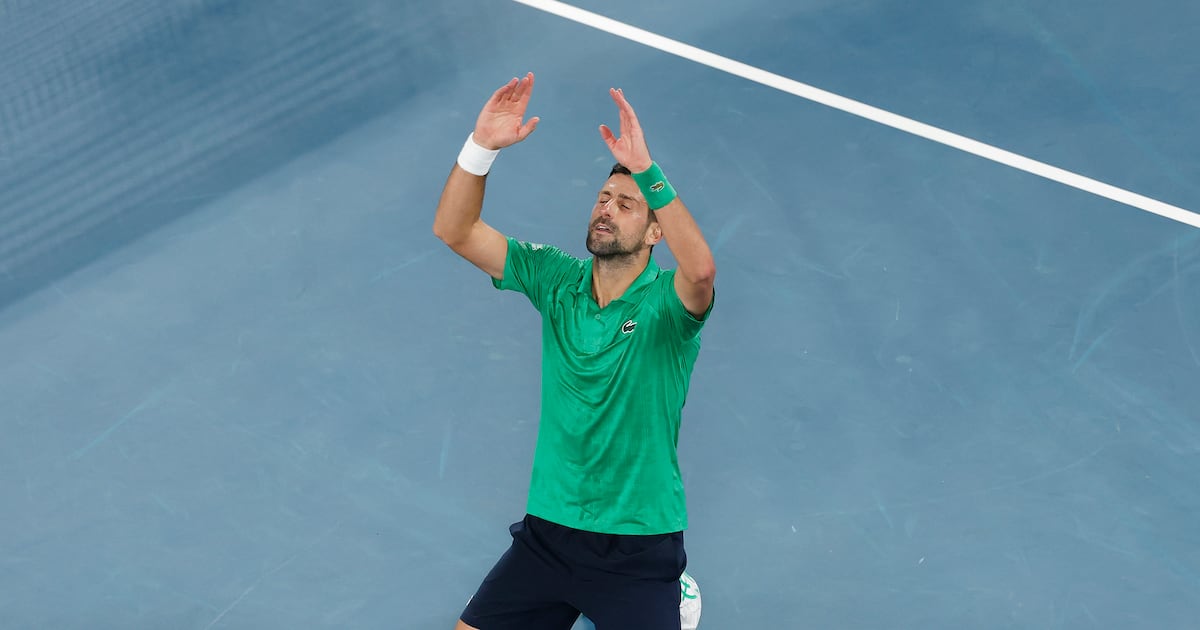
Never before had Novak Djokovic been such an underdog in such a significant match. His mere presence in the Australian Open semi-finals, after all, had been the result of a significant slice of good fortune. As he faced off against one of the dominant players in his sport, for many a competitive match would be close enough to a win.
This special champion has achieved so much for so long, but in the early hours of Saturday morning the 38-year-old pulled off one of the greatest upsets of his legendary career, recovering from a two sets to one deficit to topple the two-time defending champion and second seed Jannik Sinner 3-6, 6-3, 4-6, 6-4, 6-4 to improbably return to the Australian Open final.
No tennis player in the history of this sport has come even close to achieving the longevity that Djokovic commands. As he chases his record-extending 25th grand slam title, he has become the oldest man in the open era to reach the Australian Open final. Djokovic has now reached his 11th Australian Open final and 38th grand slam final overall, extending his all-time records in both categories.
Djokovic’s victory rounded off one of the great Australian Open semi-final days in history as, after so many uneventful, routine days, the tournament finally came alive with consecutive epic five set tussles. Djokovic will rekindle his rivalry with Carlos Alcaraz in the final, with Djokovic aiming to become the oldest men’s grand slam champion in history while Alcaraz tries to become the youngest man in history to complete the career grand slam.
Confidence in Djokovic before the match was low for good reason. On Wednesday, he had been completely outplayed for two sets to Lorenzo Musetti, the fifth seed, before the Italian was forced to retire while leading two sets. This had been preceded by a withdrawal from the 16th seed Jakub Mensik in round two, meaning Djokovic had not even won a set since the third round.
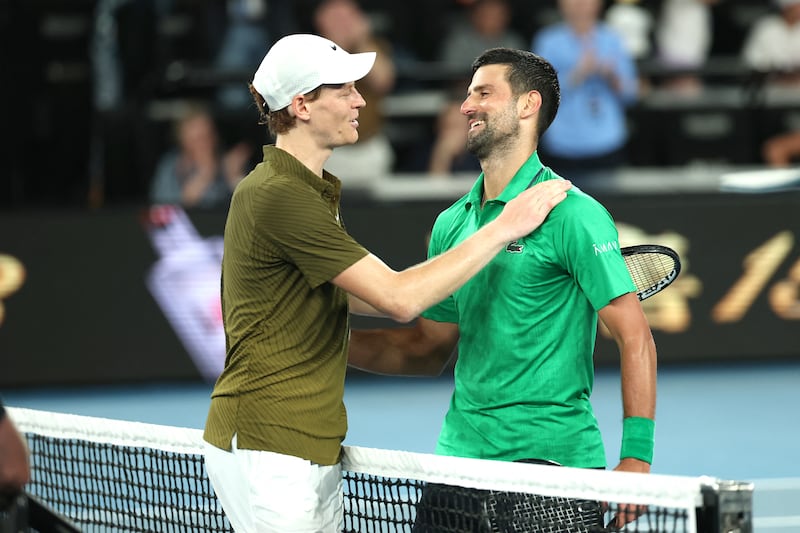 Serbia’s Novak Djokovic embraces Italy’s Jannik Sinner after their men’s singles semi-final match. Photograph: Martin Keep/Getty
Things did not look hopeful in the early exchanges as he conceded his first service game with two sloppy errors and the first set vanished in a flash. As the match endured, however, the world No 4 gradually began to settle down and once he found his range, he played at an extremely high level. Djokovic relentlessly attacked his forehand, snatching the first strike from Sinner as much as he could. He refused to move from his position on top of the baseline, taking the ball early and effortlessly redirecting the ball off both wings. He also served well in tight moments, finding precise first serves to keep Sinner at arms’ length.
The scoreline gradually began to reflect Djokovic’s form. He took an early break in set two for 3-1, which he consolidated throughout the set thanks to some brilliant serving in tight moments. By the time he had levelled the match at one set all, however, Djokovic was clearly struggling physically. Not only has he played very few matches since the US Open last year, the intensity demanded by Sinner on every point is immense, particularly for his 38-year-old body.
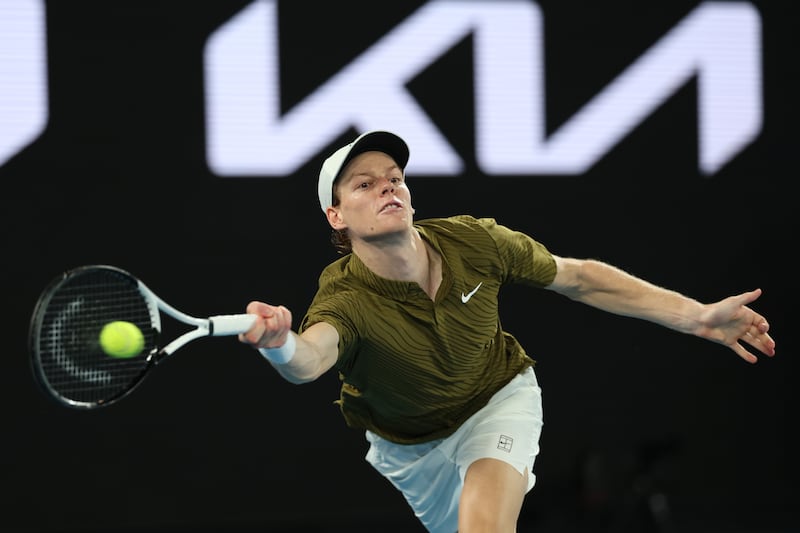 Jannik Sinner of Italy plays a forehand. Photograph: Clive Brunskill/Getty
Across the net, this was a strong serving performance from Sinner, who finished with 26 aces, by far the most he has ever served in a match. While Djokovic struggled physically throughout the third set, Sinner marched through his service games and reimposed himself on top of the baseline. At 5-4 to the Italian, the scoreboard pressure weighed heavily on Djokovic’s shoulders and a few sloppy errors from the Serb were enough for him to relinquish the third set.
Once Sinner established a two sets to one lead, it seemed reasonable to assume that the Italian would tighten his grip over the match. Instead, it was Djokovic who broke in the opening game of the set, continuing to force himself inside the baseline and take the first strike. With the break secured, Djokovic served so well throughout the fourth set, shutting Sinner out of his service games and pulling an increasingly delirious Rod Laver Arena crowd into another fifth set.
Three and a half hours into the contest, Djokovic let his instinct and determination guide him throughout the fifth set. He faced five break points early in the set, saving each one with some of his most outlandish shotmaking of the tournament. Once he finally had an opportunity of his own, there was no chance that he would let it pass him by as he powered through to another historic achievement in an unparalleled career filled with them.
Earlier … the Alcaraz-Zverev report
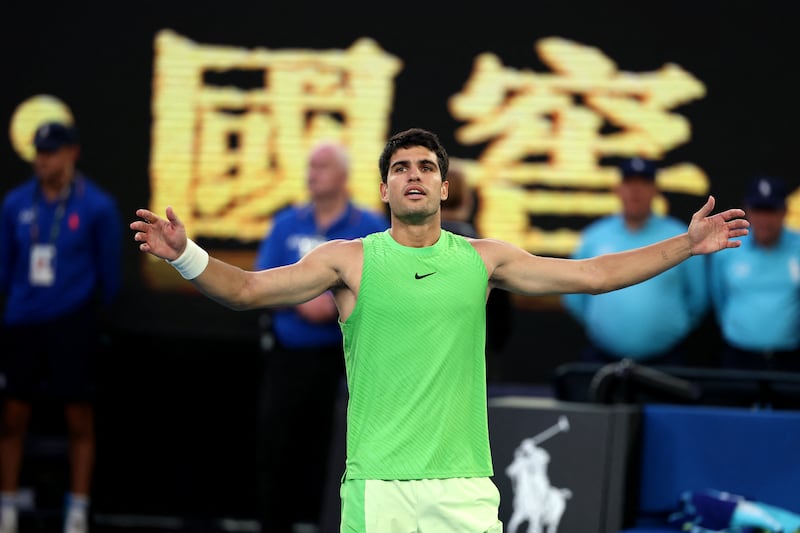 Spain’s Carlos Alcaraz celebrates victory over Germany’s Alexander Zverev. Photograph: Martin Keep/AFP via Getty
Murmurs around Melbourne Park had been building. That the men’s Australian Open draw had not met expectations in 2026. That matches had been one-sided, and lacking memorable moments. That so-called SinCaraz was a foregone conclusion. That tennis had lost its touch.
Murmur no more. In this year’s first match on Rod Laver Arena to go five sets, Carlos Alcaraz leapt off the canvas to outlast Alexander Zverev 6-4, 7-6 (5), 6-7 (3), 6-7 (4), 7-5 over five hours and 27 minutes – the third longest match in Australian Open history.
It was so long it pushed the second men’s semi-final back more than an hour and left thousands watching on big screens around Melbourne Park. It was filled with more twists and turns than the Great Ocean Road. It was a duel that tossed expectation out the window, and then opened the door and walked out as well.
Walk? Carlos Alcaraz wished he could, when he was within a game of the match all the way back in the third set. The Spaniard appeared to be sailing towards victory, but cramping in his legs left him unable to run, swing or serve at full pace, and allowed Zverev a way back. Alcaraz took on fluids and received massages, including in a controversial medical timeout opposed by Zverev, and rediscovered his form.
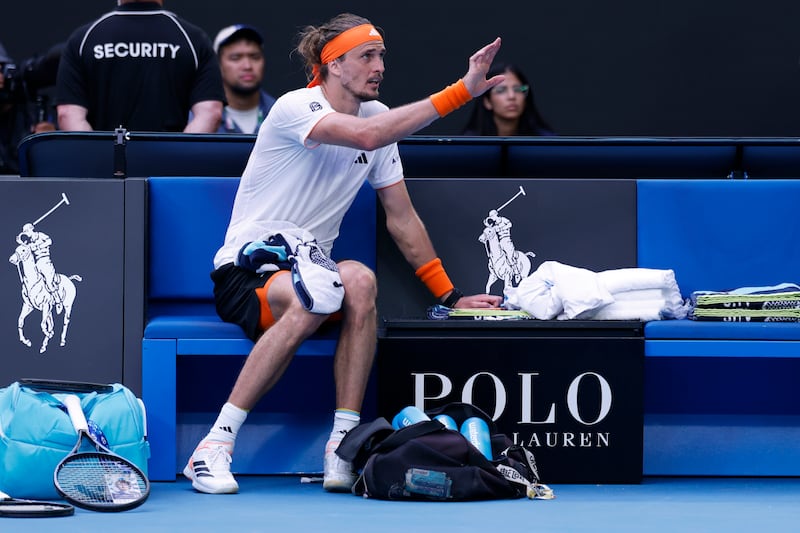 Alexander Zverev of Germany talks to the umpire. Photograph: Darrian Traynor/Getty
But the German remained focused, and quashed Alcaraz’s revival by staring him down in the fourth set tie-break and then breaking early in the fifth. All he needed to do was rely on his potent serve and serve it out. Spoiler alert: this was not that kind of match.
A now refreshed Alcaraz threw everything at the fading German. At 3-2, Zverev saved a break point, but across the net the Spaniard looked the fresher. There was desperation in his voice when Zverev shouted “water” on a change of ends, as Alcaraz – despite trailing – pumped up the crowd with a grin and a fist.
At 4-3, Zverev trailed 0-30 again, soon facing one break point, and another. On his haunches between play, somehow he climbed out of the hole, time and again. He landed a clean forehand winner in the corner to put him one game away, but did not have enough energy left to celebrate.
The crowd were on their feet as the match reached its decisive game. The time was 8pm, the heat that had once sapped the world No 1 was long since passed. Zverev was serving at 5-4, needing just one more hold. But in an instant, Alcaraz had his arms aloft, level at 5-5 and then ahead at 6-5.
Alcaraz would not be stopped, saying afterwards he just kept the faith. “I always say you have to believe in yourself, no matter what you’re struggling [with], what you’ve been through, you’ve got to still believe in yourself all the time.”
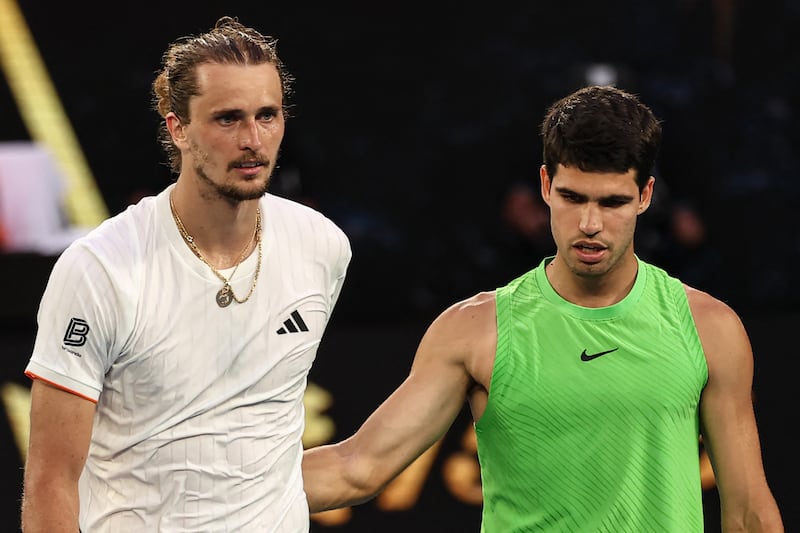 Spain’s Carlos Alcaraz greets Germany’s Alexander Zverev after winning. Photograph: Izhar Khan/Getty
In the end Alcaraz’s victory felt inevitable, even if the final break – on match point – was a point of quality befitting such an epic. Alcaraz lunged to reach a forehand and whipped it back past Zverev at the net.
When Alcaraz went up two sets to love he stood solid and saluted his team, and appeared to be waltzing towards the final. But within minutes he was unable to walk, bringing about the tournament’s magnificent twist.
He admitted he was struggling in that third set. “Physically, it was one of the most demanding matches I have ever played in my career,” he said. “I had to put my heart into the match.”
The world No 1 – who is now 15-1 in five-set matches – is now within one victory of a career grand slam. If he wins on Sunday, he will be the youngest man to secure one: the Alcaraz fairytale, to which Friday added a barely believable chapter. – Guardian