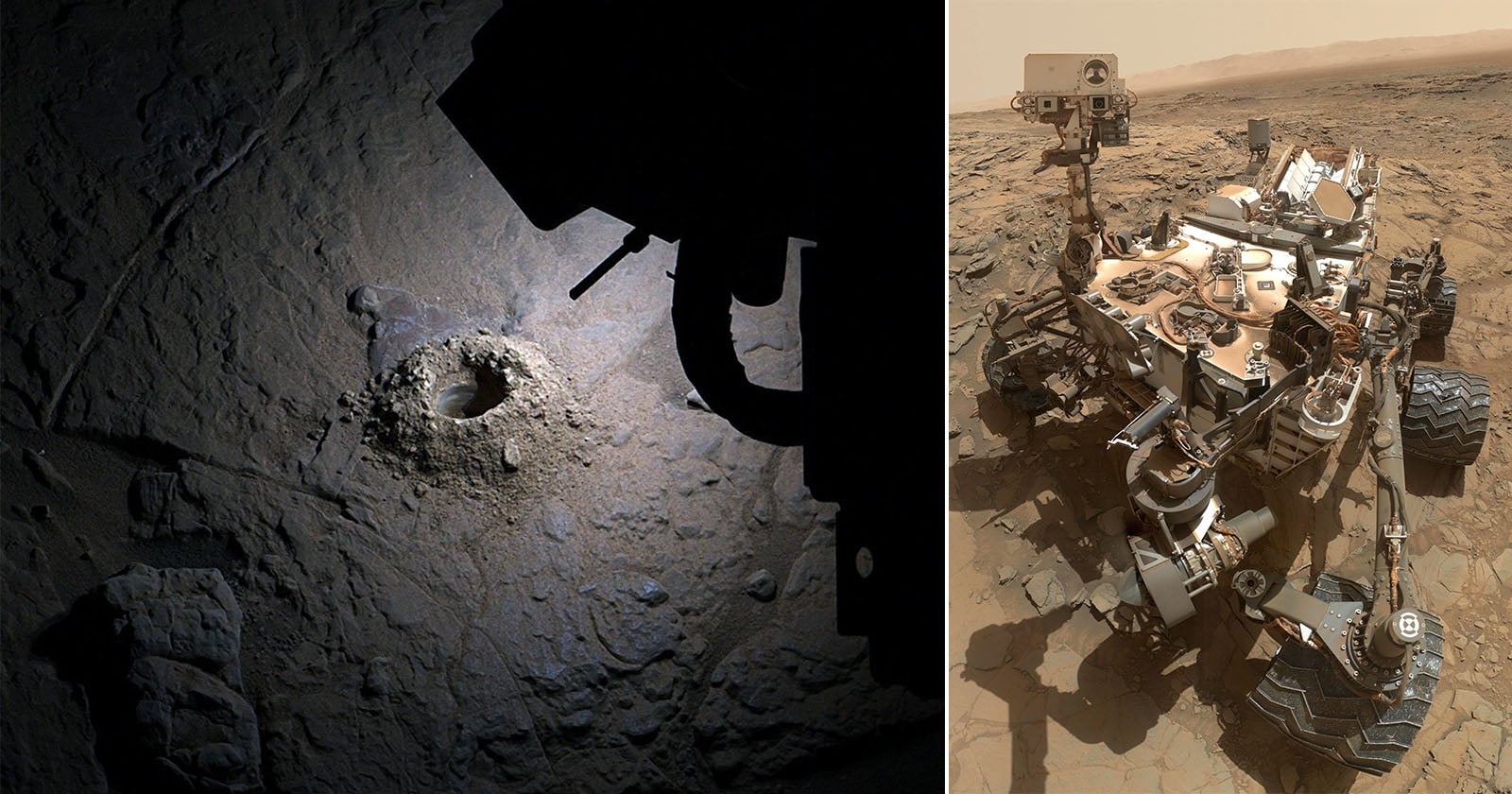
NASA’s Curiosity Mars rover used its onboard LEDs, typically used for illuminating shaded areas during daytime operations, to capture a very rare nighttime shot of the Martian surface.
Curiosity captured its illuminated shot of Mars at night on December 6, 2025, the 4,740th Martian day, or sol, of its mission. Although the photo was captured nearly two months ago, NASA just released it this week.
The rover’s LEDs are part of its Mars Hand Lens Imager, or MAHLI, which is a camera on the end of Curiosity’s robotic arm. However, the new photo itself was shot using the rover’s Mast Camera, or Mastcam. Scientists occasionally use MAHLI’s lights to illuminate shadows during daytime operations, such as the inside of holes that Curiosity drills into the Red Planet’s surface. The lighting can help scientists better analyze a rock’s composition.
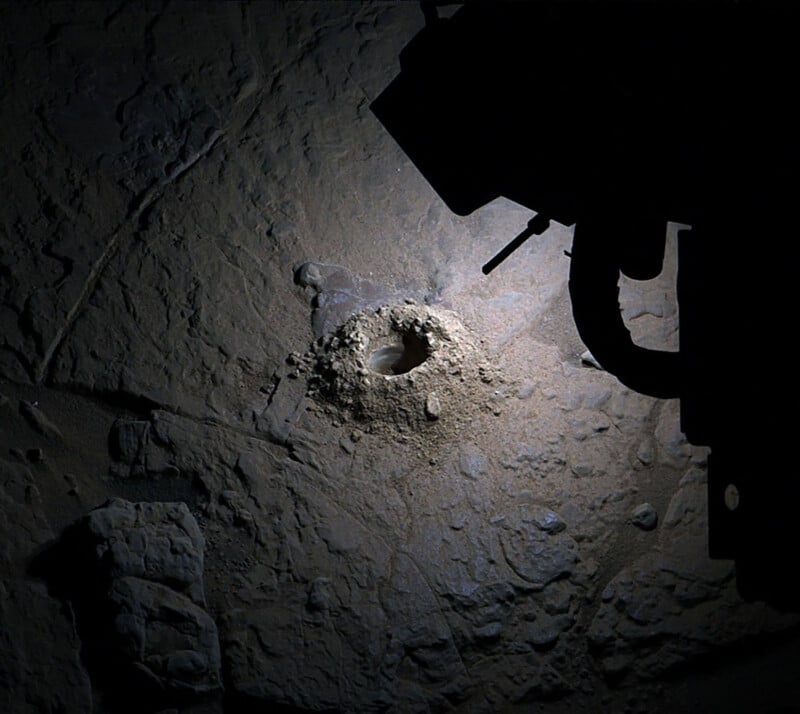
The Curiosity mission recently changed how it drills holes on Mars, and the new method typically results in rough, dusty holes that are hard to visually analyze. However, after drilling a rock target, which scientists have nicknamed “Nevado Sajama,” on November 13, 2025, the team thought the drill hole walls looked smooth enough to photograph. So, the team scheduled a nighttime photoshoot to get a good look at the hole in Nevado Sajama.
Tex Kubacki spoke to PetaPixel about the nighttime photo and how it was captured. Kubacki is Mastcam Operations Lead at Malin Space Science Services, the company that built Curiosity’s Mastcam and MAHLI.
“The M-100 (Right) came was used for the collaboration with MAHLI because of its higher resolution,” Kubacki tells PetaPixel. “The exposure time for the released M-100 image was 5 seconds. Normal daylight auto-exposure images are typically ~0.015 seconds, suggesting the LED-illuminated scene is ~300-400x dimmer than Martian daylight (which already receives less than half the sunlight that Earth receives). Anyway, that day/night difference is the equivalent of about 8 or 9 stops.”
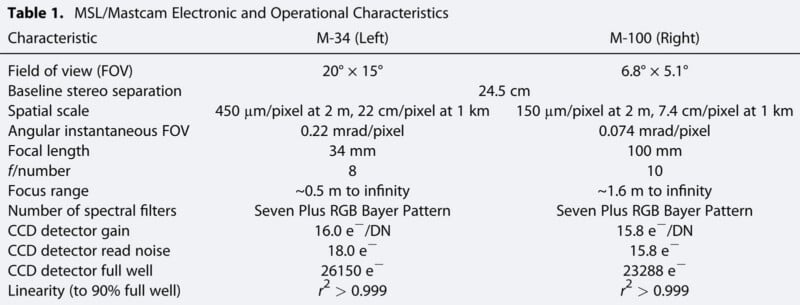
Kubacki also passed along a 2017 research article that discusses Curiosity’s Mastcam instruments in detail. While the full paper is beyond the scope of this story, the table below shows some of the M-100 (Right) camera’s specifications.
When asked about the camera’s other settings, like ISO and aperture, Kubacki noted that M-100 only has exposure controls.
“Like, with the Canon 7D sitting on my shelf, I have an exposure knob, an f-stop knob, and an ISO knob. When I want to photograph dark scenes at night, I crank the exposure way up, the f-stop way down, and the ISO way up. How does Martian imaging compare?
“M-100 essentially only has an exposure knob. For these nighttime shots, we took an autoexposure image which used an iterative pixel-counting process to find an exposure time of 6.148 seconds. Then we took two manual exposure images at 3 seconds and 5 seconds just in case autoexposure had failed.
“M-100 does not have an f-stop knob. It has a fixed aperture at f/10. It also doesn’t have a mechanical shutter. The sensor is constantly exposed to light, and uses an “electronic shutter” system to clear charge before exposing.
“And finally, M-100 does not have an ISO knob. In the words of Mike Caplinger, our Lead Engineer: ‘ISO is essentially a measure of gain. Mastcam operates at a single gain that provides the best possible noise performance over the sensor dynamic range.’”
For what it’s worth, Dr. Caplinger says M-100’s ISO is basically equivalent to about 100.
Curiosity’s white LEDs have significant scientific benefits. As Kubacki explains, the white-light LEDs help eliminate the environmental effects of dusty, reddish sunlight on Mars, making it easier to achieve accurate color reproduction. In the case of a night shot illuminated by the white light LED, colors are even more accurate.
“Using the White light LEDs eliminates the environmental contribution of dusty sunlight (that is reddish) to the color imaging, making such night time white light LEDs the best way to assess the ‘true color’ when not doing other processing. The drill hole has been additional processed, so it doesn’t necessarily show ‘true color.’ Some of our processing tries to mitigate the environmental contribution of color by performing ‘white balance’ and gray adjustment. This shows rocks as they might look on the Earth. The White LEDs do that ‘automatically,’” Kubacki continues.
However, despite the apparent power of Curiosity’s lights, they are actually not very bright. They are, at most, “like lighting a few candles at the dinner table,” Kubacki says. The MAHLI LED array is “much dimmer” than a standard flashlight, and each of the four white light LEDs has an illumination range of 450 to 715 millicandelas (mcd). A typical candle is about 1,000 mcd, or one candela.
Curiosity’s new night shot is just its latest notable imaging achievement. At the end of last year, Curiosity captured a beautiful “postcard” of Mars that blended day and night. In 2024, Curiosity captured a unique portrait of Earth, as seen from the Martian surface. Sometimes, Curiosity is even a photo subject itself. The HiRISE camera inside NASA’s Mars Reconnaissance Orbiter snapped a wild photo of Curiosity mid-drive across the surface of Mars from hundreds of miles above Mars.
Image credits: NASA/JPL-Caltech/MSSS